


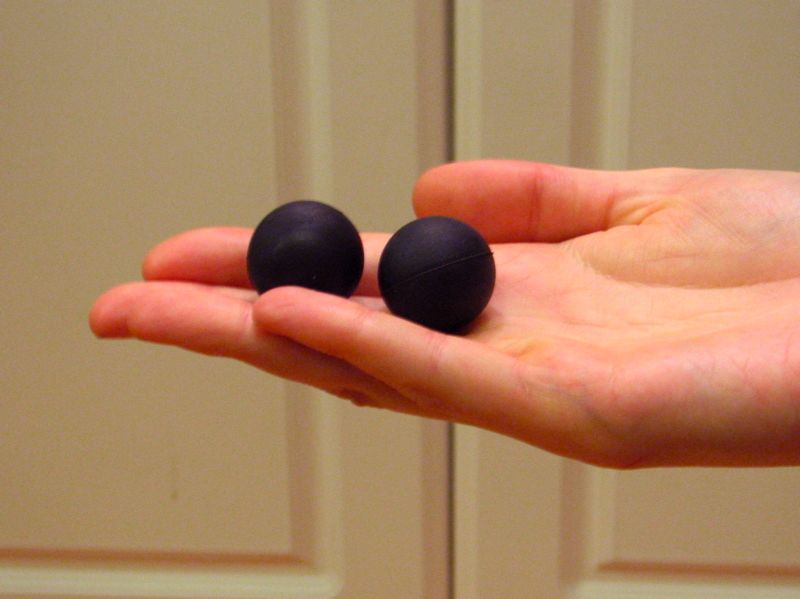
They look the same. They feel the same. What’s the difference? You’ll have to drop them to find out.
You say you don’t have a pair of your own? Alright, you can check out the video. Warning, though – it might make you want a set. They are immensely fun to play with.
Choose your format:
You can see that one bounces and one stays on the ground. Why? They are made of two different materials: Polychloropene (trade name Neoprene) and Polynorbornene (trade name Norsorex). Both feel nice and rubbery and are about the same density. Both are pretty elastic – when you squish them, they return to shape nicely. Polychloropene is very bouncy – it wants to snap back to shape quickly. Polynorbornene is an impact-absorbing material that can be used for things like shoe insoles and high-tech golf balls.
Okay, with help from the data sheet (pdf) that comes with these emotional little guys, here’s the technical explanation: the two materials differ in hysteresis, which is a measure of the delay in the return to original state after a change is introduced. The happy ball (polychloropene) has low hysteresis, meaning it wants to get back to normal now! so it bounces right back into shape and into the air. As it bounces almost as high as you dropped it from, you could say that it has a high coefficient of restitution. The sad ball (polynorbornene) has high hysteresis, so when you deform it by dropping it against the floor, it only slowly returns to shape. Its kinetic energy is dissipated as heat. There are some other suggested experiments for these, but what could possibly be cooler than to weird people out with your non-bouncy rubber ball?
You can get happy and sad balls (also creatively called happy and unhappy balls) from many science education suppliers, but Arbor Scientific seems to have the best deal at $3.50 a pair.

I had so much fin with these when I taught 4th grade science.
I let the kids theorize, and then we’d try to test their theories without slicing open the balls. If a kid thought that there was sand in the sad ball, we tried putting some sand in a tennis ball to see how that would affect the bounciness of the tennis ball. Toward the end of our experimenting, I’d slice both balls open.
Peter Hoh
It *is* funny how many people ask what’s in the "sad" ball!
—
Windell H. Oskay
drwho(at)evilmadscientist.com
http://www.evilmadscientist.com/
Yo dude how r u
I was surprised by the statements above that the ‘happy ball’ was made of Chloroprene rubber (Neoprene) vs the Polynorbornene rubber (Norsorex). The balls cited here may be exactly as advertised. It is possible as well to make happy and sad formulas using only Norsorex material as the base polymer and the same curing system but using differing plasticizers.
The ‘happy’ ball can be easily tested to determine if it contains chlorine using the Beilstein test.
Heat a copper wire in a bunsen burner or propane torch until it glows red. While still hot touch the wire to the surface of the rubber causing a bit of smoke.. Return the wire to the flame. If chlorine is present as it would be in chlorprene rubber you’ll observe a brief bright green flame.
. A ‘new’ freshly stripped copper wire will also show the transient green flame if it has the typical PVC insulation.