


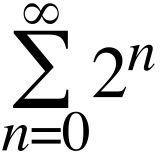
Here is a cool math trick that shows that the sum of an infinite number of positive integers is equal to negative one.
Show that the infinite sum S = (1 + 2 + 4 + 8 + 16 + . . .) adds up to S = -1.
Given that S = (1 + 2 + 4 + 8 + 16 + . . .),
if you multiply both sides by two, you get
2S = (2+ 4 + 8 + 16 + 32 + . . .).
Then, add one to both sides:
2S + 1 = 1 + (2 + 4 + 8 + 16 + 32 + . . .)
= 1 + 2 + 4 + 8 + 16 + 32 + . . . = S.
Thus, 2S + 1 = S.
To solve for S, subtract 1 from both sides:
2S = S – 1.
Finally, subtract S from both sides:
S = -1.
Isn’t just amazing that you can add up so many positive numbers and get a negative answer?
Yes, it’s a trick. I found it in the book Mathematical Methods in the Physical Sciences, by Mary L. Boas. Can you figure out why this actually doesn’t work?
MetaBlog links for this story: [ +digg | +del.icio.us | +redditt | technorati ]


Subtracting infinity from infinity is not a Good Idea(TM). In reality, it’s better to say that the sum you show doesn’t converge.
Also, two times infinity is also not a Good Idea(TM).
I won’t argue with that =)
2S – S is not 1, it is 2^(n+1) – 1
S = (1 + 2 + 4 + … ) = infinity
2S = 2 * infinity = infinity
2S + 1 = 2 * infinity + 1 = infinity
Since S is infinity and 2S + 1 is infinity, the equality becomes infinity = infinity, hardly surprising.
Subtracting s from 2s does not give you s…
It would give you 2s – s
You would need to divide s from both sides to solve for s as 2s is actually:
2 X S
2s = s+s say s = 4 or whatever
2(4) = 4+4
8 = 8
so
2s – s = s + s – s
8 – 4 = 8 – 4
4=4
2s / s = 2
2*4 / 4 = 2 dont you slash of the common number like that?
However if you do divide both sides guess what?
2S = S – 1
2S / S = (S – 1) / S
2 = -1
?? right?
nope it would be 2= -1/s
nope it should be
1 = -1/S
S=-1
Thus
2S = S – 1
-2 = -2
Pshaw. I could _tell_ them S’s were movin funny.
Still: Gives a feelin in me brains like Im Bullwinkle J. Moose a-cryin out, "Im SO confused!"
So the trick is a deepdown error, a hard catchin rough- followin, brain hurtin neat cute major miscalculation, I guess?
Huh. Aint right lying bout the value of a good ol boy like our pal S.
(Now placeholder [], why he’s Another Story. Wouldn’t give that lil weasel the Time o Day. Reckon you should mathtrick _him_ next. An after, dont ferget X and all the mean things _he_ done to pore lil number one.)
Just a thawt. Bye now!
Common mathematical error…
2S-S = 2S-1S
therefore 2-1 = 1
thus 2S-1S= 1S=S.
the "1" is an implied coefficient.
The trick seems to work, but logically you can’t have two infinities.
Um, 2S = S + S: it’s NOT s to the power of 2 (s*s)
S = Sum of 2 ^ n from 0 to n.
lim S
n -> inf
= 1 + 2 + 4 + 8 + 16 + 32 + … + 2 ^ (n – 1) + 2 ^ n
2 * lim S + 1 = 1 + 2 + 4 + 8 + 16 + … + 2 ^ n + 2 ^ (n + 1)
2 * lim S + 1 = lim S + lim 2 ^ (n + 1)
2 * lim S +1 = lim S + inf
lim S + 1 = inf
inf + 1 = inf
inf = inf
:)
You can make this entirely kosher by working with 2-adic numbers: define a topology on the rationals different from the usual one, by defining the absolute value of (a/b)*2^n to be 2^-n (for a and b odd). Then this series converges to -1 in this topology.
That reminds me a little bit of taking the limit of sin(x)/x, as x goes to infinity. The answer is six– if you allow the x’s to cancel. It all depends which rules you use. =)
—
Windell H. Oskay
drwho(at)evilmadscientist.com
http://www.evilmadscientist.com/
Heh. But p-adic numbers are extremely useful in number theory; there’s a whole theory of calculus on them (which is in fact better-behaved than ordinary calculus: for example a series converges whenever the terms go to zero). And this trick works because *how* convergence happens doesn’t matter for it; all one needs is to know that it converges in some sense.
It is correct as if we take s as common in 2s-s eq. then we get s=-1
Did the fellas at Northern Rock know about this? They shudda.
Weird things happen when you play with an infinit sequence of numbers, substracting infinity from infinity gives you a nondetermination, as you noted the sequence with S you lost this little detail. The sequence does converge – limit when n tends to infinity from 2^n = infinity, but you could calculate the sequence knowing n using the geometric progression a1*((q^n) – 1)/(q-1) where a1 means the first term and q represents the ratio in our case a1=1, q=2 so it gives – (2^n)-1. And you could also prove your -1 answer false with induction but i grow tired and this bores me, bye.
Ok, my turn:
There exists a bijection from the natural numbers to the elements of your sum (namely, shockingly, 2^n), so the two sets have the same cardinality (aleph null). Similarly, there is a bijection from the naturals N to f(n), where f(n) = the sum of 2^x for x = 0..n.
That’s just a fancy way of saying that your sum S has a cardinality of aleph null.
Now to go through your steps:
2S = aleph null
2S + 1 = aleph null
(and yes, being countably infinite, S = 2S = 2S + 1 = 2S + 5999999999999999999999999)
and 2S = S – 1, of course.
But now you run into problems when you subtract S from both sides. Basically since 2S and S are both countably infinite, 2S – S is undefined.
So that last step is just nonsense. It makes just as much sense to say "subtract a banana from each side, and thus dogs = cats."
As I like to say, you can’t have 2 infinities…
Caused a lot of fights with my brother over that :|
This is very like a trick my cousin showed me years ago when we were kids. What he "proved" was not quite as radical: that .9999… = 1
n = .9999…
10n = 9.9999…
10n – n = 9
9n = 9
n = 1
The difference is that the statement “0.99999… = 1” is actually true.
We even have a separate article about that.
—
Windell H. Oskay
drwho(at)evilmadscientist.com
http://www.evilmadscientist.com/
It’s not really like that. The proof you mentioned is valid. This one isn’t.
>It’s not really like that. The proof you mentioned is valid. This one isn’t.
Not sure which proof you’re referring to as being valid or which one as being invalid….
—
Windell H. Oskay
drwho(at)evilmadscientist.com
http://www.evilmadscientist.com/
This one is REALLLY old and so intersting indeed. I’ve known it a looooong time ago. But it doesn’t seem true, ’cause you work with infinit stuff and the result’s not acceptable.
>This one is REALLLY old
Um… yeah. It says *right up top* what book this is from, and that book was published in 1983.
—
Windell H. Oskay
drwho(at)evilmadscientist.com
http://www.evilmadscientist.com/
Actually, that one isn’t a trick. It’s fact. 0.999…. does equal 1. The trick is in the visualization only, since most people don’t view 0.999… as infiniti. I had a math prof who explained it another way that makes more sense:
1/3 = 0.333…
3(1/3) = 3/3 = 1
therefore by substitution
3(0.333…) = 1
or
0.999…. = 1
(of course, if we wrote 0.999… as 0.999999999999999999999999 for ever, it starts to make sense visually).
Then, add one to both sides:
2S + 1 = 1 + (2 + 4 + 8 + 16 + 32 + . . .)
You didn’t add 1+ infinity, you added 1 + (infinity – 1)
Move the parenthesis back over and add the one and you get 2S + 1 = infinity + 1
Reply to:
2S + 1 = 1 + (2 + 4 + 8 + 16 + 32 + . . .)
= 1 + 2 + 4 + 8 + 16 + 32 + . . . = S.
Thus, 2S + 1 = S.
Reply:
1 + (2 + 4 + 8 + 16 + 32 + . . .) is not equal to
1 + 2 + 4 + 8 + 16 + 32 + . . .
because you are adding it and since 1 + 2 + 4 + 8 + 16 + 32 + . . . is equal to S, then of course 1 + S is not equal to S…
and if distributed, it will be:
3 + 5 + 9 + 17 + 33 + . . .
Thank you…
– cezus
its just ABS.. its not a distributed property
It is not advisable to equate the sum to infinity and then add 1 to it and your"S" +1 will also beequtal to in finity.
what i mean is ,you showed-
2S+1=1+(2+4+6+8……..)
then can also be written as,
2S+1=S
and 1+(2+4+6+8……)=S
and as a part of Euclid’s Postulates,positive units add up to form only positive units which is universally accepted
Well, yeah, I think it doesn’t work. You can’t work with infinit as easily as that, UNfortunately. Though, I always like that kind of methods to prove something apparently true, but which actually is false(often).
WRONG.
S=Infinity
2S=2xInfinity=Infinity
2S+1=2xInfinity+1=Infinity+1=Infinity
Therefore, Infinity=Infinity.(and not -1)
Get it?
2S-S = S and S-1-S = -1
thats how it works.
Here’s one fer yer bad brains:
if e^(i*theta) = cos(theta) + i*sin(theta) where i = sqrt(-1)
then if theta = pi
then e^(i*pi) = cos(pi) + i*sin(pi)
or e^(i*pi) = (-1)+ i *(0)
or e^(i*pi) + 1 = 0 <-all five fundmental numbers!!!
Does this mean…
pi = ln(-1)/i ??? I don’t know, I just shake head…
I was taught about orders of infinity in 7th grade, by a nun who did not understand what she was teaching. I did. The argument over the grading of that test was the beginning of the end of my Catholicism. (Then in public school I heard about Galileo.)
There are _orders_ of infinity. (I’m not sure how many but you can look it up.) The number of positive integers is infinity. The number of odd integers is infinity. The total number of primes is infinity. All the fractions between zero and one is an infinity. All the numbers between zero and one that _cannot_ be represented as a fraction are also an infinite set.
You can show that the infinity of positive integers is _equal_ to the infinity of _even_ positive integers by setting up a "one-to-one correspondence":
1:2, 2:4, 3:6….
The infinity of all numbers from zero to infinity is greater (a higher order) than the infinity of all _integers_ from zero to infinity. I don’t remember how you prove this, but I remember that the proof was elegant.
The given infinite series doesn’t converge to a finite sum (i.e. divergent series). Algebraic functions doesn’t apply on these kind of infinite series on general basis (there are few exception though).
"Thus, 2S + 1 = S.
To solve for S…"
Why did you solve for S if you just told us that S = 2S +1?
And if S = 2S + 1 then how can S also equal -1? No need to "solve for S"!
1) If ( S=inf ) ===>mistake because ( inf – inf ) Impossible
2) If ( S = limited set then ==
==> ex) we have
S = [1+2+4+8]
2S = 2+4+8+16
2S+1= (1+2+4+8)+16
2S+1= S +16
2S+1=S+2(Last Number on S) In general,
2S-S=2(L N)-1
S=2(L N)-1
1+2+4+8=15=S
2(L N)-1=16-1=15=S
then S = 2(L N) – 1 ===>> S # -1
it’s bigggggg mistake
Looks like you didn’t understand the statement of the problem!
—
Windell H. Oskay
drwho(at)evilmadscientist.com
http://www.evilmadscientist.com/
Excellent–I’d never seen that fun riddle before. Thanks for posting it, Christian!
You know what this reminds me of?
Aleph-null bottles of beer on the wall,
Aleph-null bottles of beer
Take one down, pass it around,
Aleph-null bottles of beer on the wall!
this could be the prfct ans
I understand S is not equal to -1.
But let me show you an interesting fact.
-1 = S
-1 = 1+2+4+8+…
(-1)_10 = (111111….)_2
Here, xx_10 means decimal, yy_2 means binary.
If you are familiar with computer science,
this equation seems like two’s complement.
[reference]
Wikipedia Two’s complement
Heh, as an old computer geek that’s what I first thought this was about.
The simple complete error is made immediately at the first step.
S = (1 + 2 + 4 + 8 + 16 + . . .)
or… S = (infinity)
Multiply both sides by 2 is NOT
"2S = (2 + 4 + 8 + 16 + 32 + . . .)"
It is:
"2S = 2(1 + 2 + 4 + 8 + 16 + . . .)"
or… "2S = 2(infinity)" = "xS = x(infinity)" = S = (infinity)
There cannot be infinity times any number at all – It is always a single entity.
S is always S. It is never (S – 1) or (S) -1 or 2(S) or x(S) or… et cetera
The answer to proving that the real numbers are a greater infinity than the integers was done by Georg Cantor. Look up his stuff on Wikipedia. Specifically his "diagonal proof" method.
Unfortunately your argument doesn’t hold water. Yes, those bijections exist, but the trouble is that the same can be said for other sums that *do* converge – for example, the sum from n = 1 to infinity of 1/(2^n) – there are still a countably infinite number of terms, and the same for the partial sums – but the whole sum is well-defined (and this sort of manipulation works, for this example at least).
So while you’re right to conclude that there is something fishy to do with the way “infinity” is abused in this “proof”, you need a better argument to show it :-)