



One of our favorite shapes is the Sierpinski triangle. In one sense, a mere mathematical abstraction, on the other, a pattern that naturally emerges in real life from several different simple algorithms. On paper, one can play the Chaos Game to generate the shape (or cheat and just use the java applet).
You can also generate a Sierpinski triangle in what is perhaps a more obvious way: by exploiting its fractal self-similarity.
Beginning with a single triangle, replace that triangle with three half-size copies arranged so that their outer border form a new triangle of the same size as the original. Then, replace each of those three triangles with three triangles half that size, and so forth. (Turns out of course, that the fractal pattern is due to the algorithm of shrinking and positioning the shapes, not due to the fact that the initial shape that we began with was a triangle– any plane figure can be used.) This algorithm is easy enough to implement directly and physically, using a flexible medium like polymer clay.
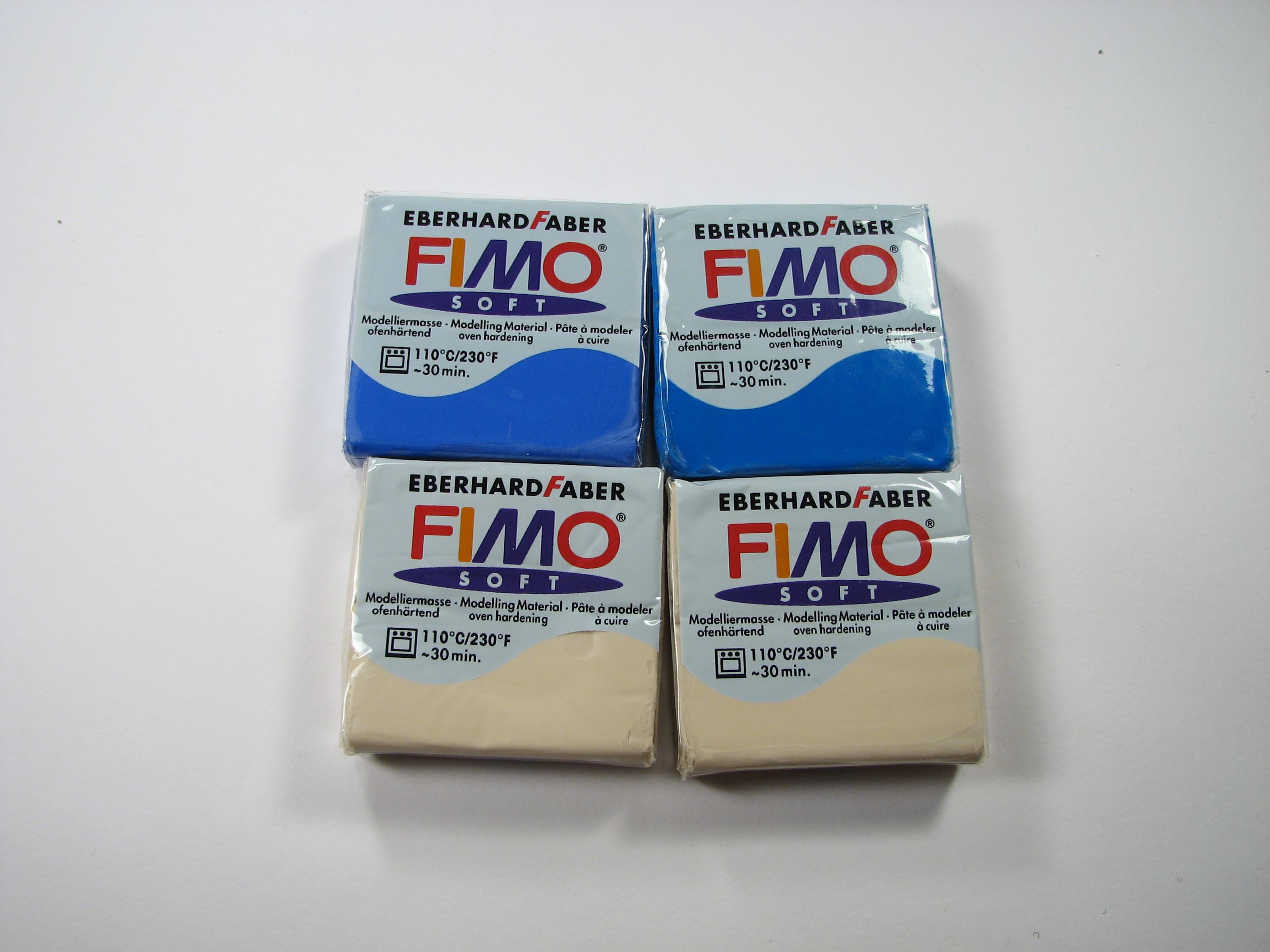
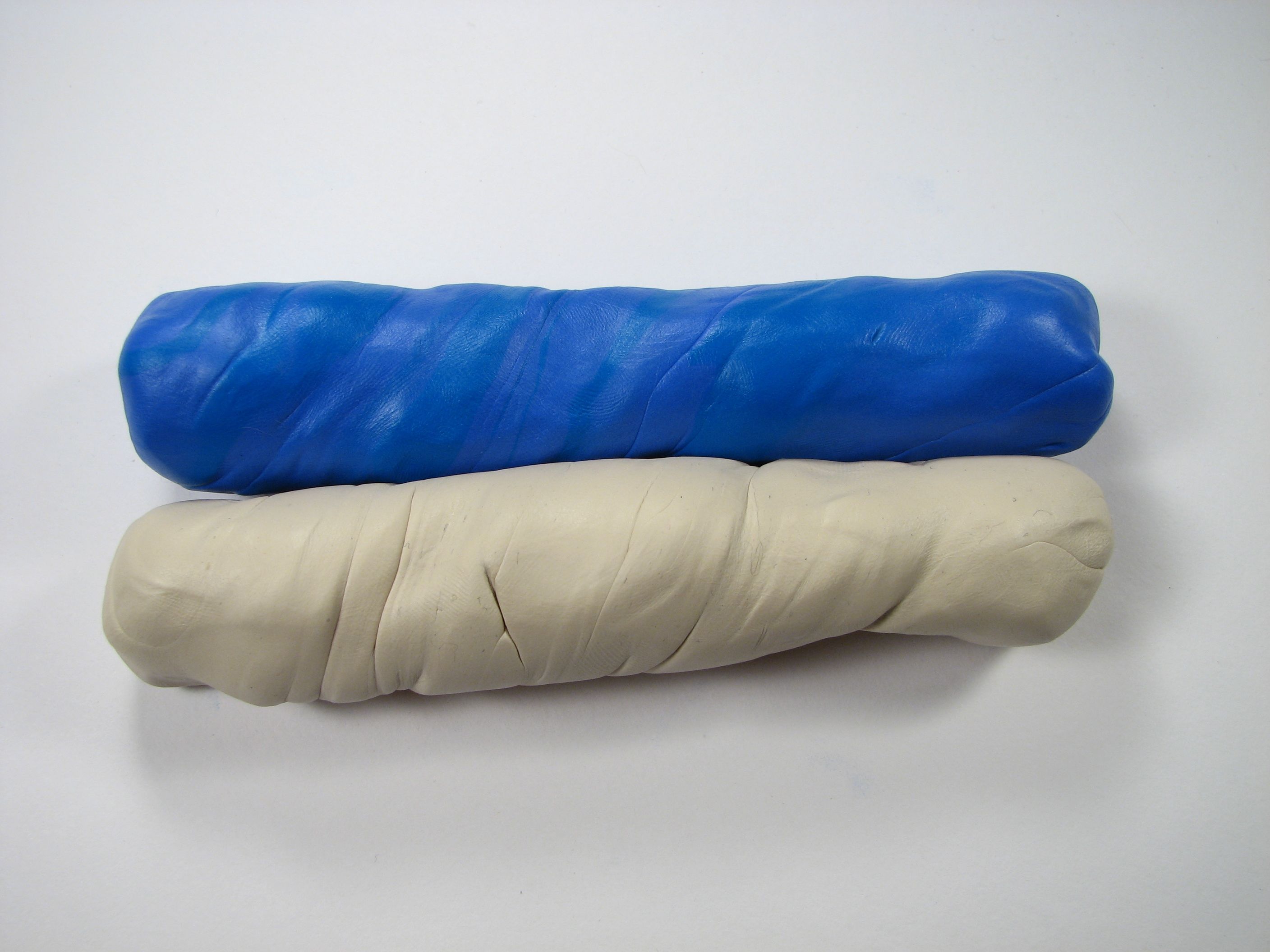
We begin with a few packages of polymer clay– two colors of Fimo Soft, in this case. (It’s a common oven-hardening material that you can get at craft and art supply stores. Overused in some contexts, but still has its uses.) Knead it until it’s actually soft and workable, a few minutes. It turns out, for the color pattern that we are using, that we need a lot more of the beige than the blue.
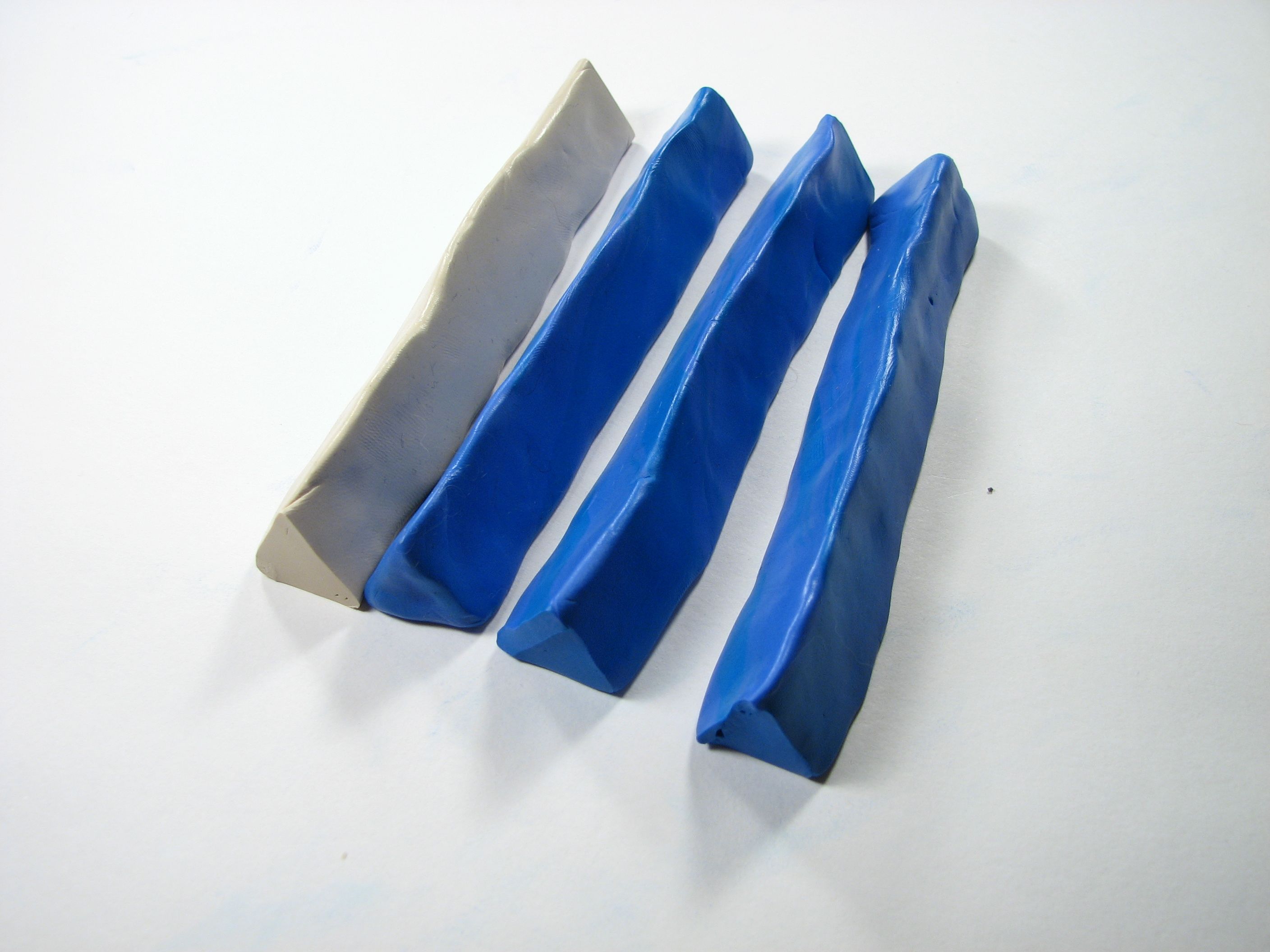
Form the two clay colors into long triangular shapes. The cross section of each should be equilateral, with side length near 1/2″ to 1″.
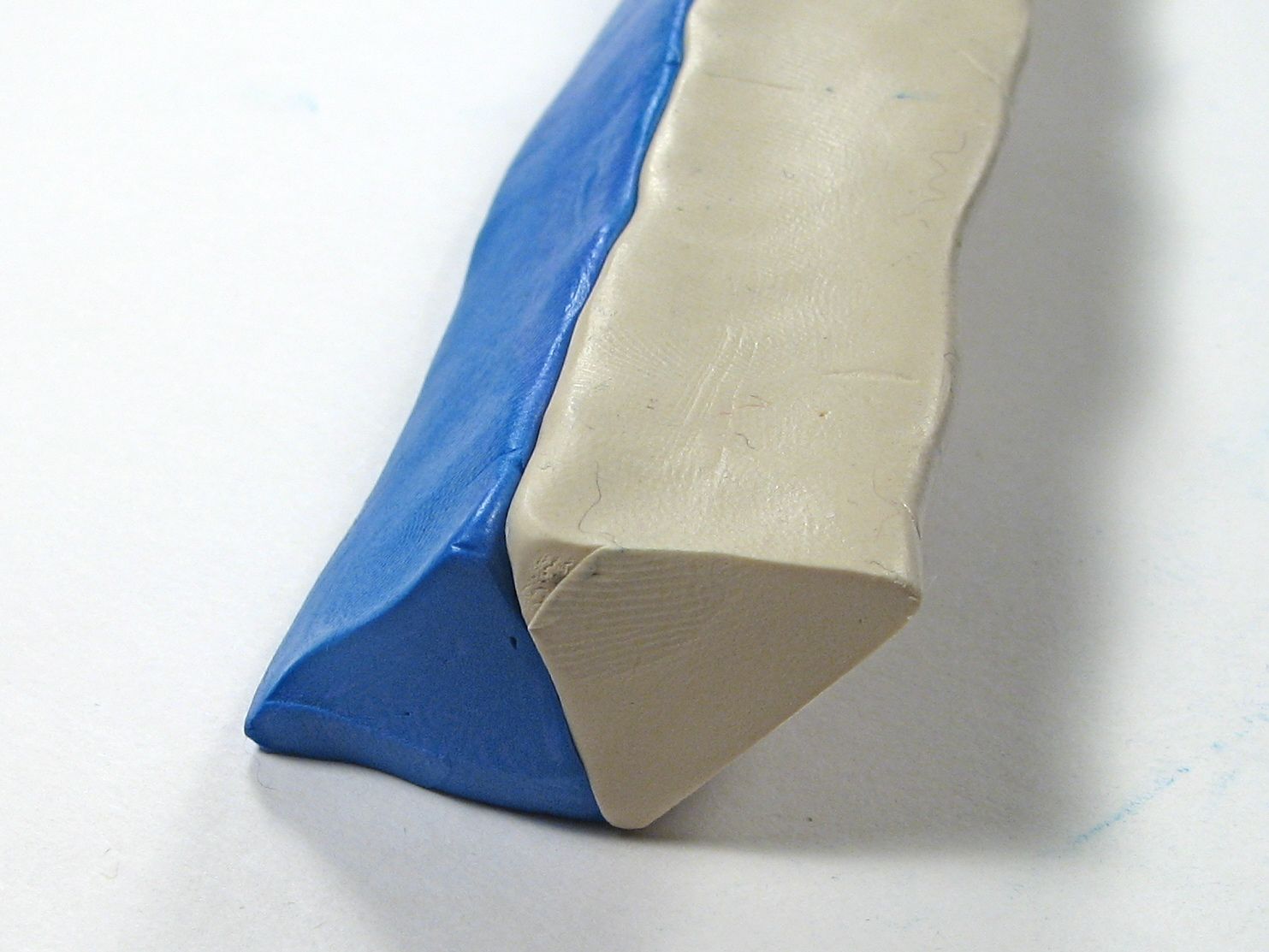
Using a knife, cut three equal-length sections of the darker color and one equal length of the lighter color, ideally using less than 1/8 of your total supply of the light color. Mate the three dark pieces to the sides of the light piece, carefully matching them edge to edge and avoiding air gaps to the extent possible. The stack, as presently assembled, is the first iteration of the Sierpinski triangle, with a total of three dark triangles.
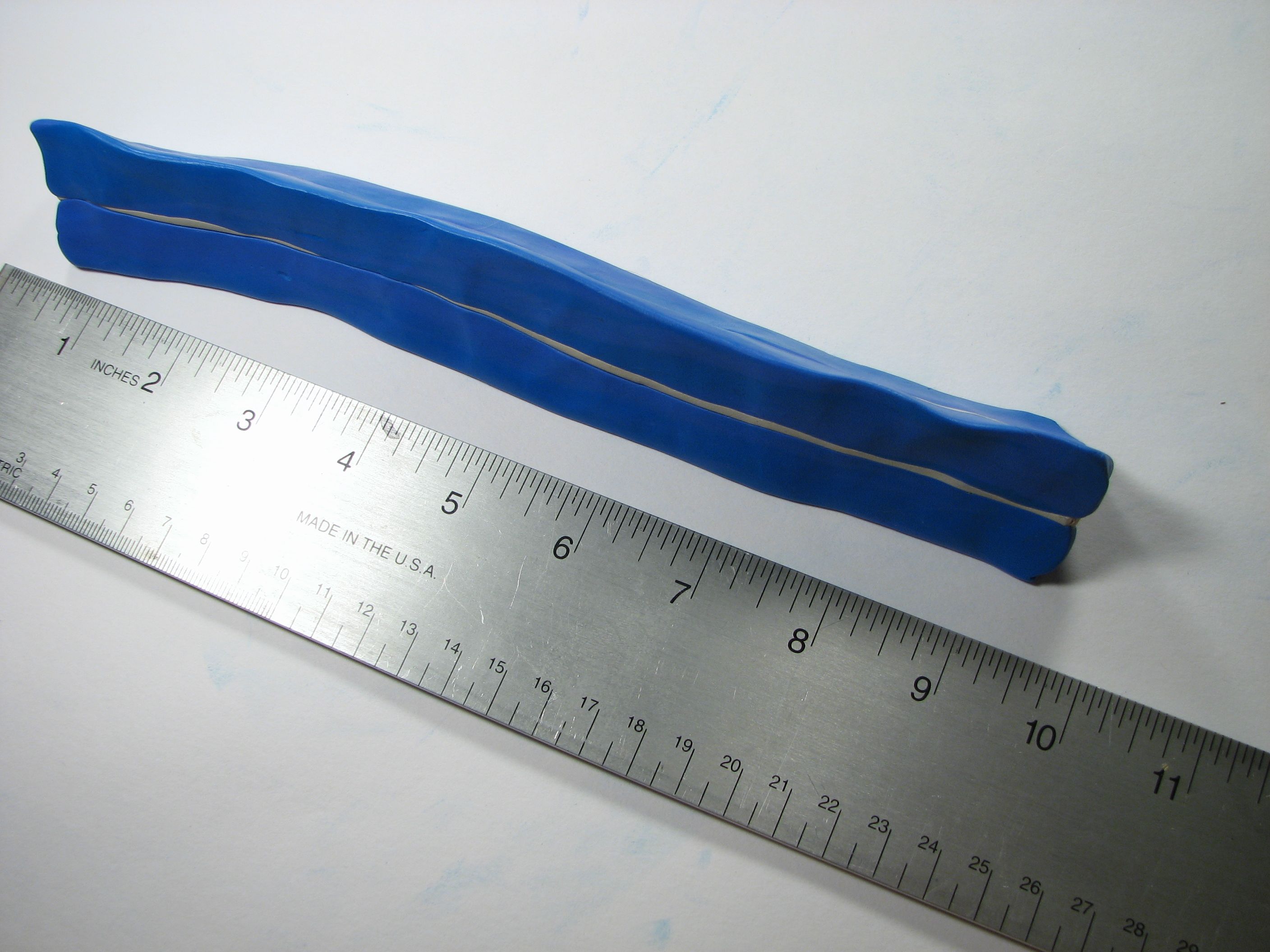
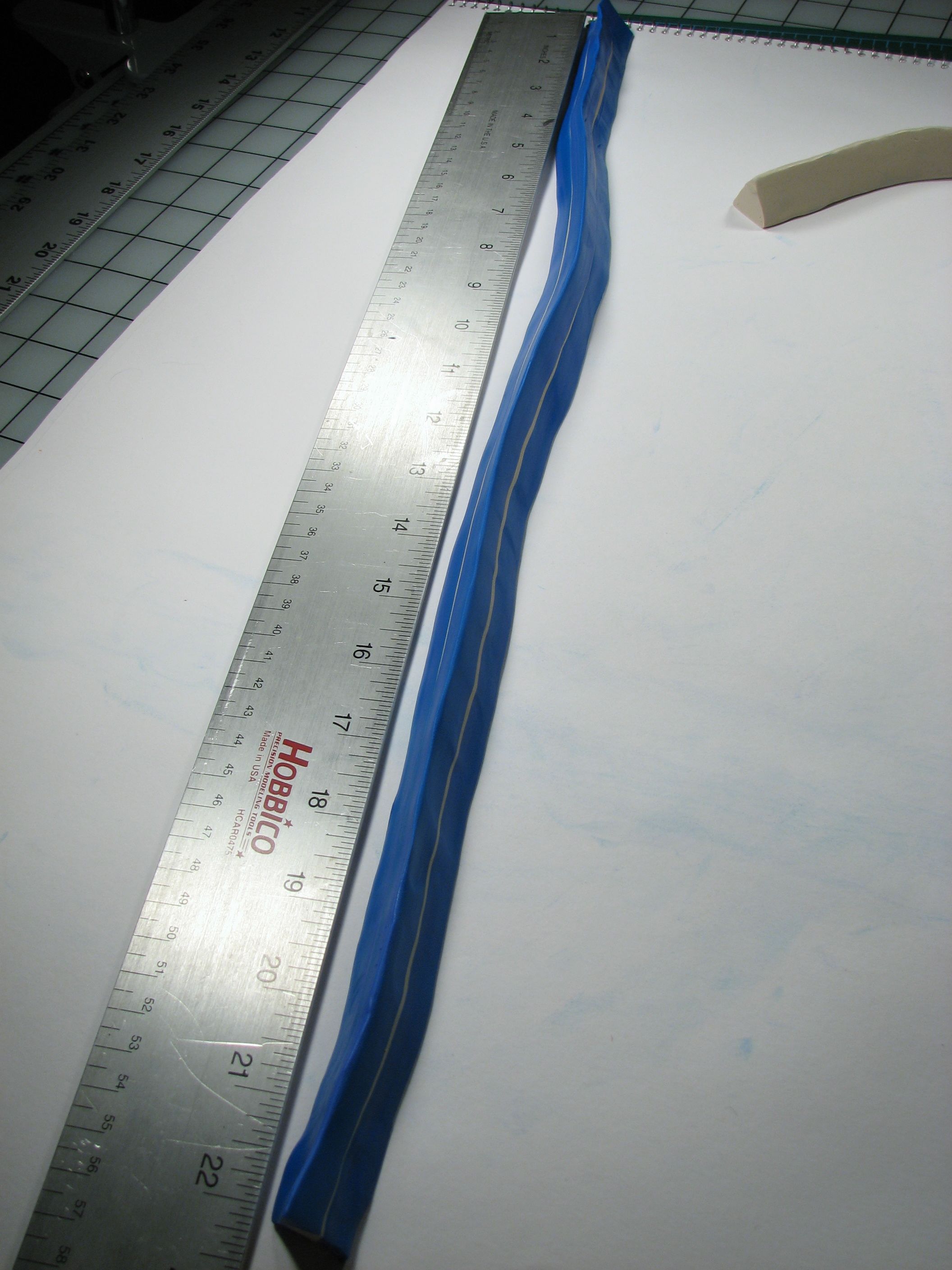
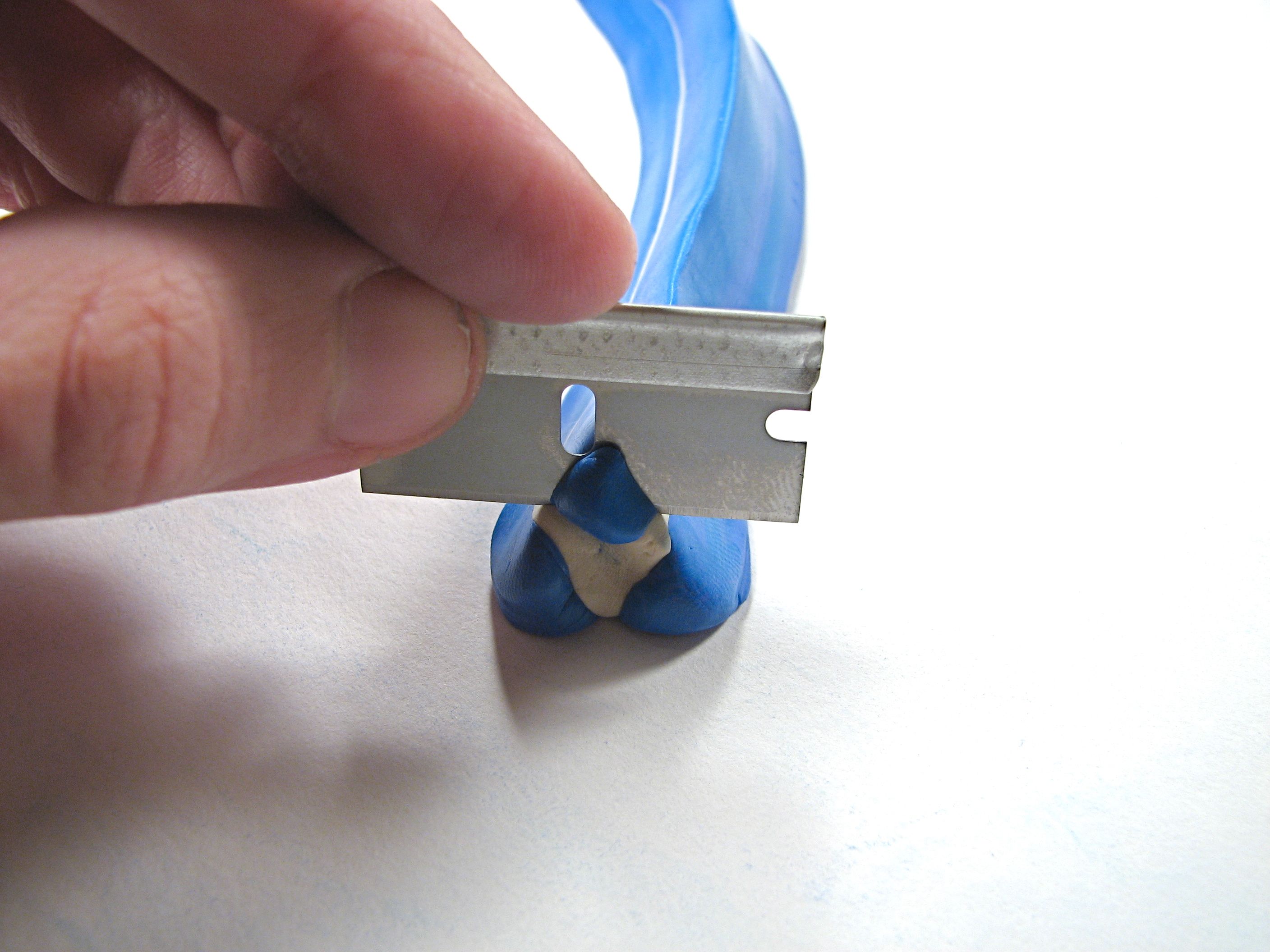
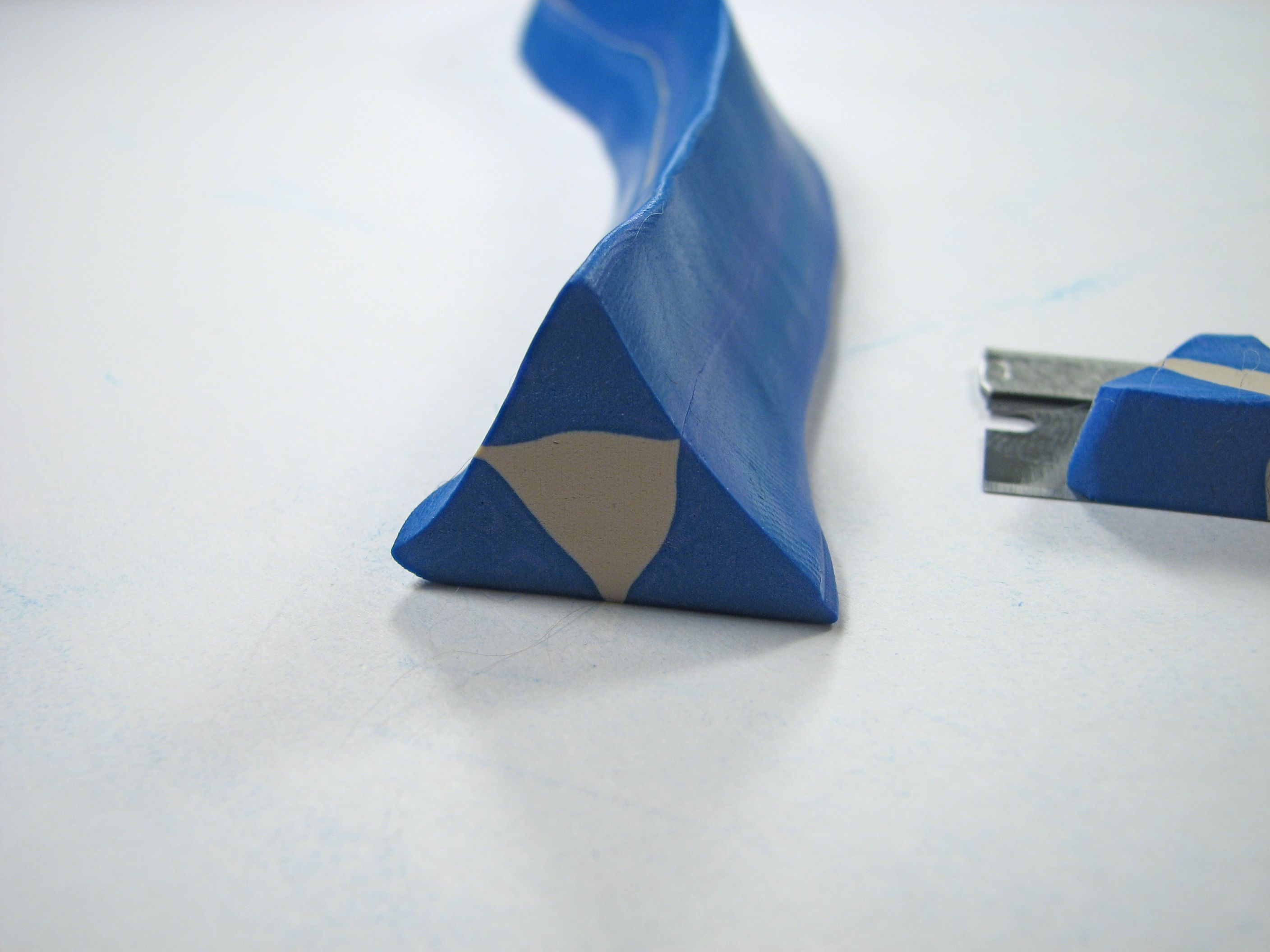
Press the stack of triangles together to make sure that the edges fuse well. Carefully and deliberately lengthen the triangle to at least 4 times its original length, taking care to preserve the triangular shape and keep the size of the cross section uniform along the whole length as you reduce it. Using a sharp knife, trim off the rough edges, which may not preserve the cross section as well as you would like.
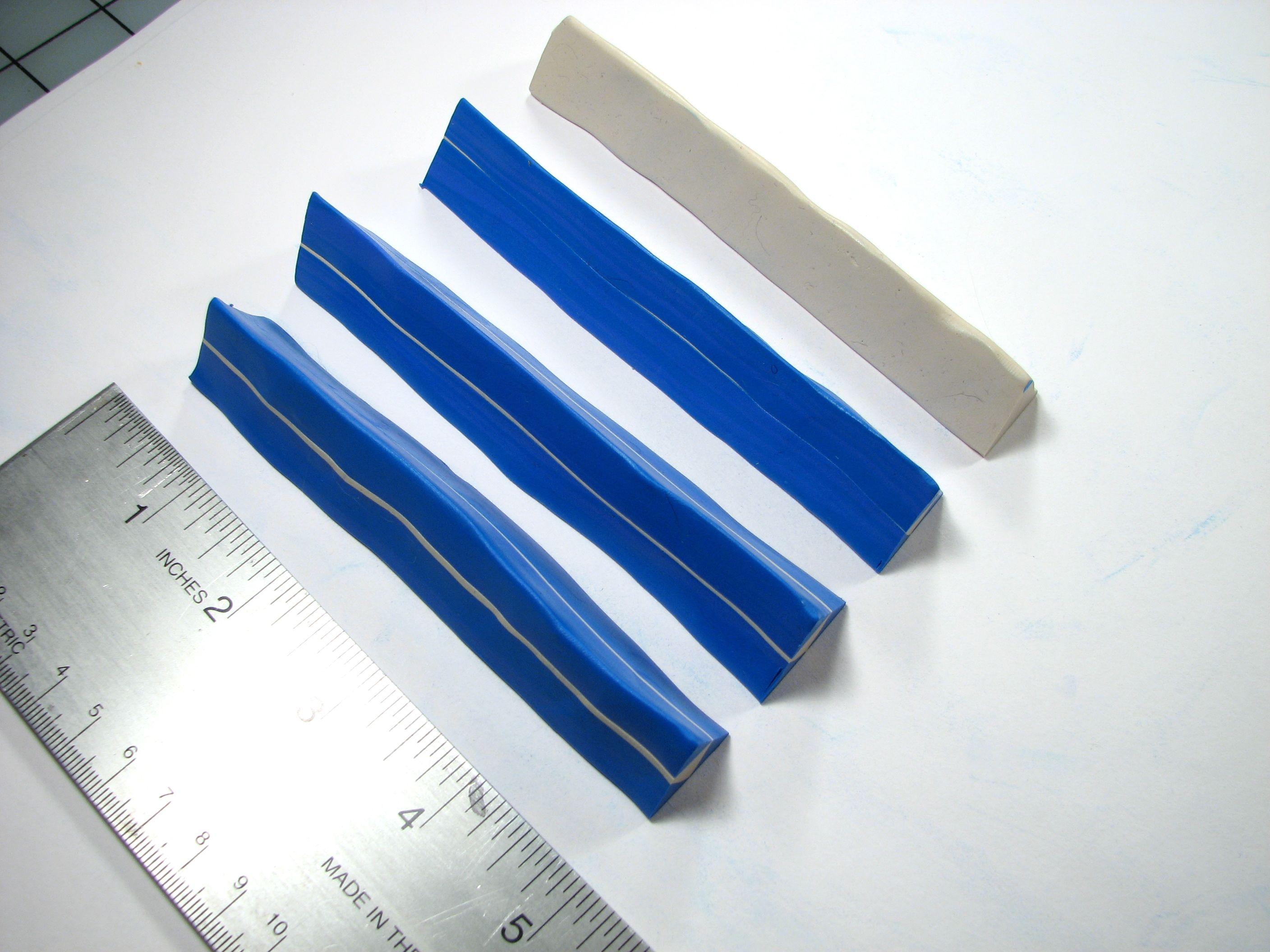
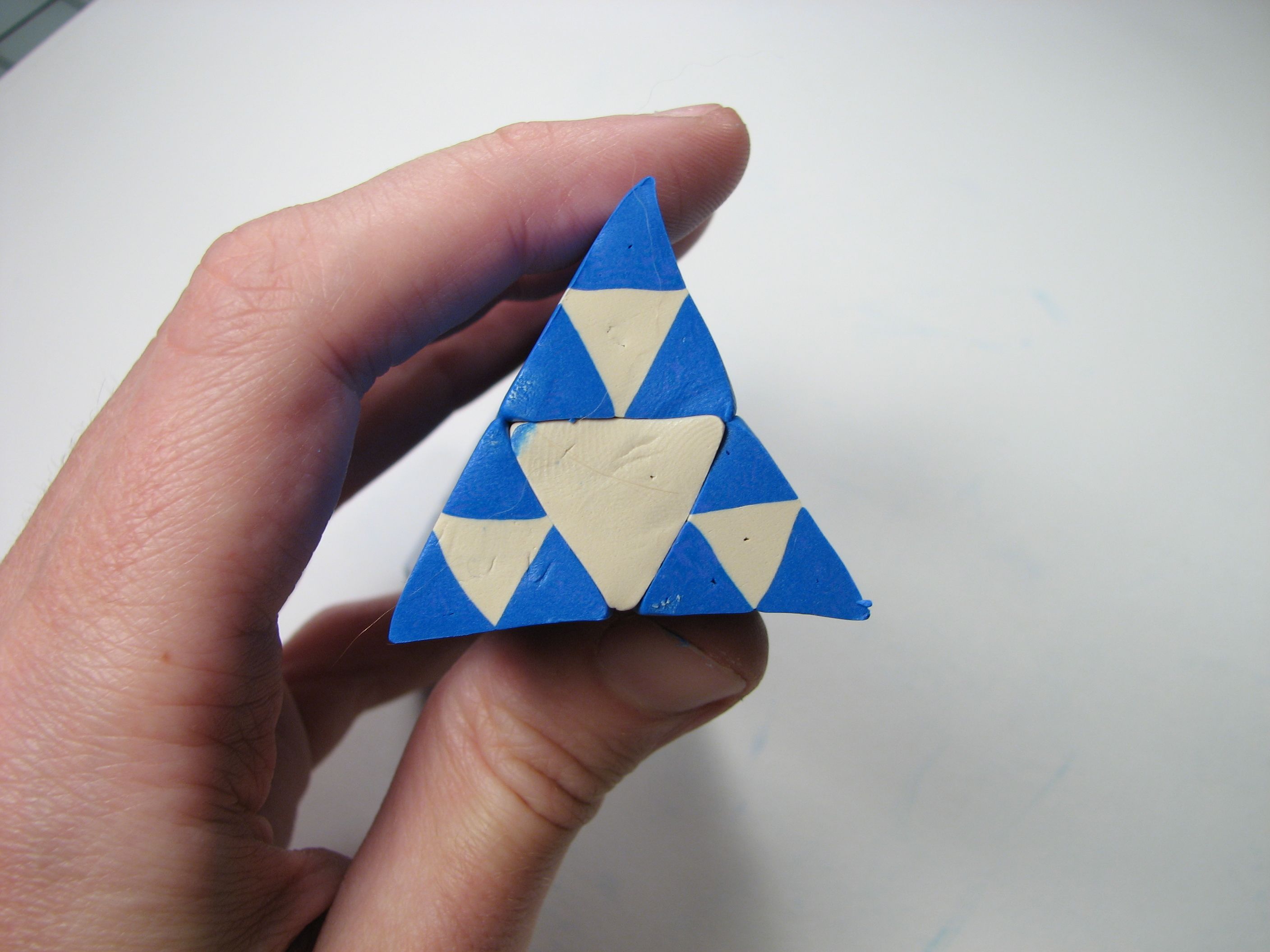
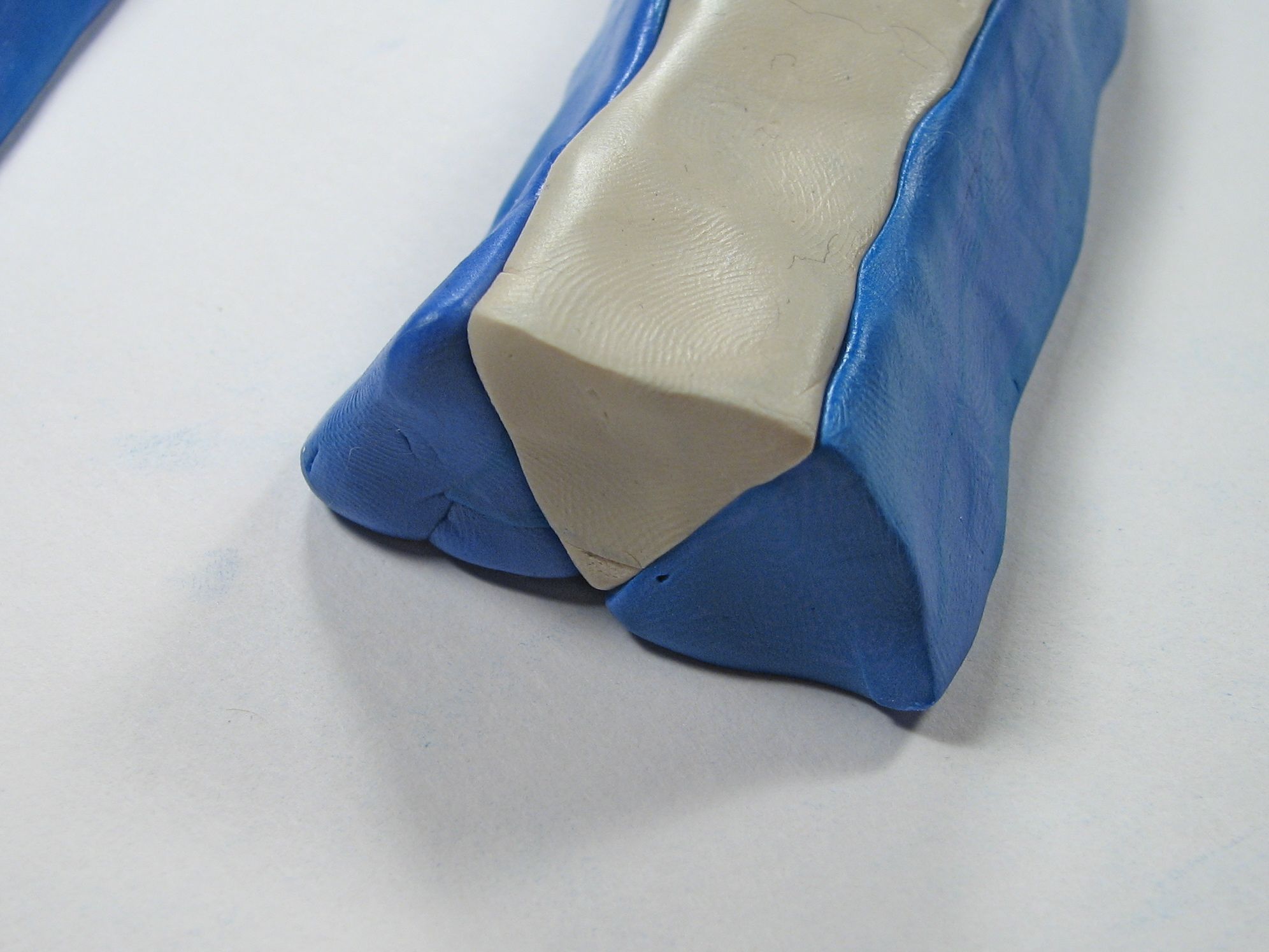
Cut the stretched “first iteration” piece into four pieces of equal length. Set one of the four pieces aside so that you will have a piece of “first iteration” material when you are done. Make a triangular prism out of the light colored material that matches the shape and size of the three main pieces, and again mate the three dark pieces to the sides of the light piece. The stack is now a realization of the second iteration of the Sierpinski triangle, with a total of nine dark triangles.
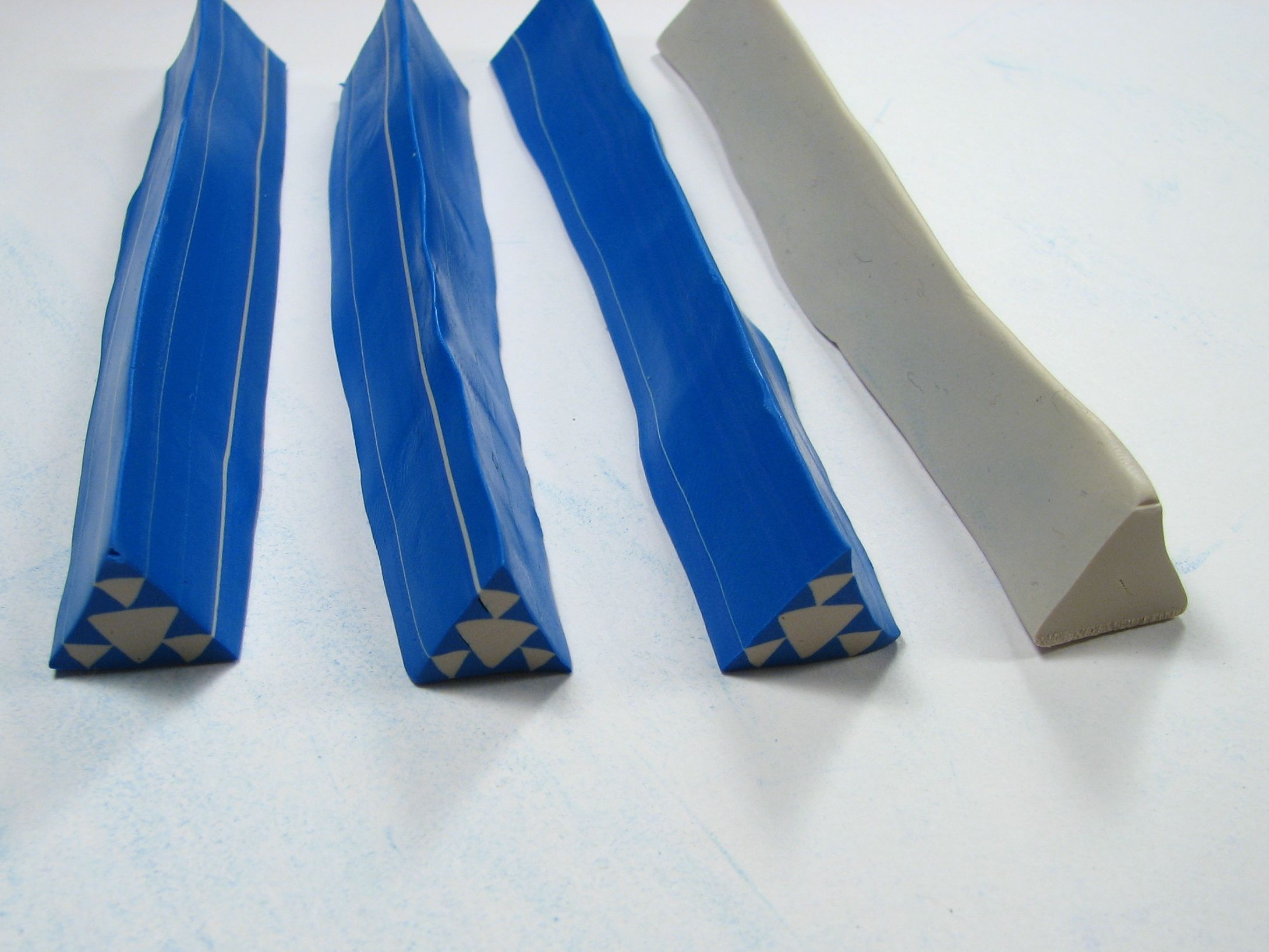
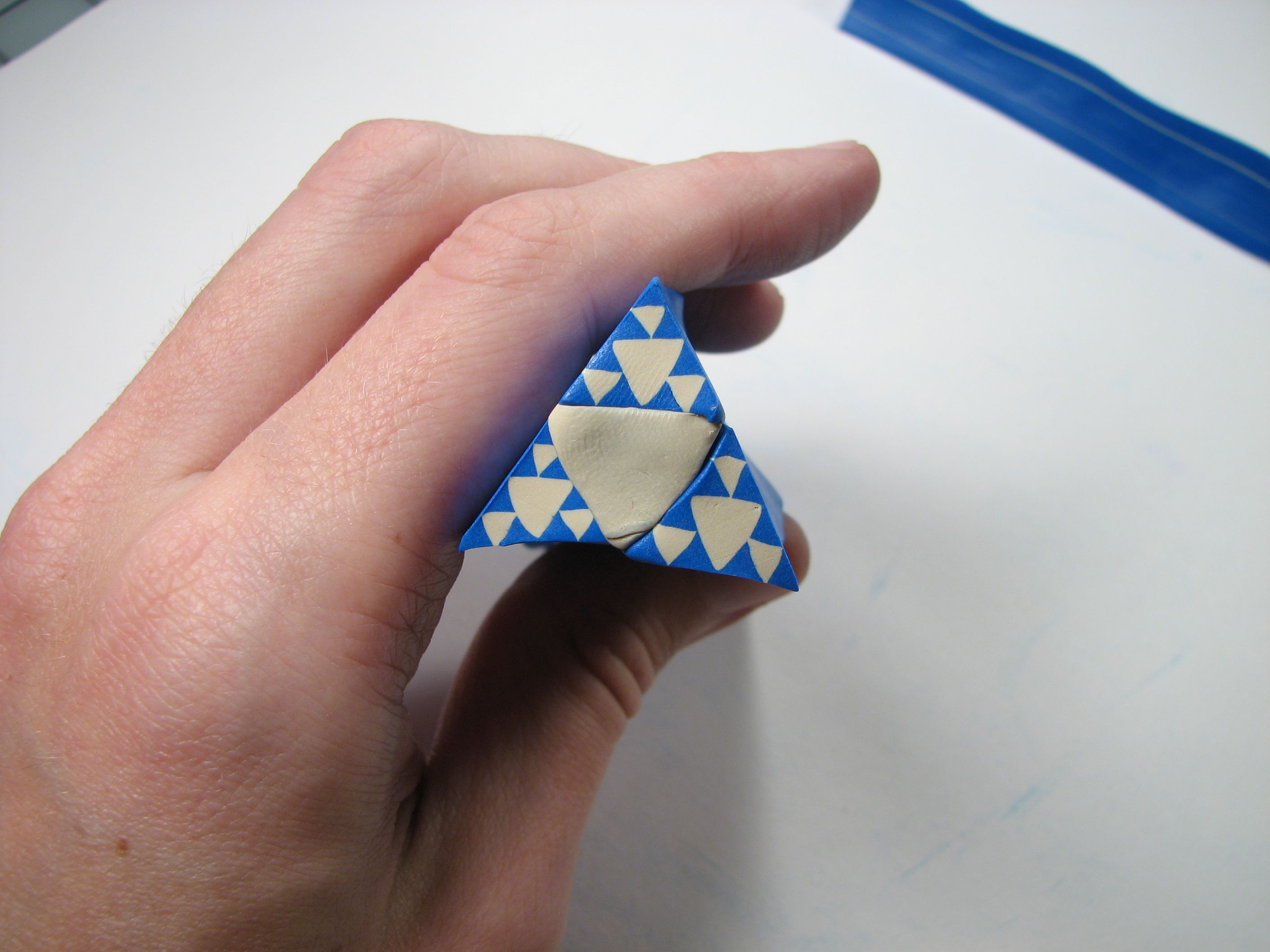
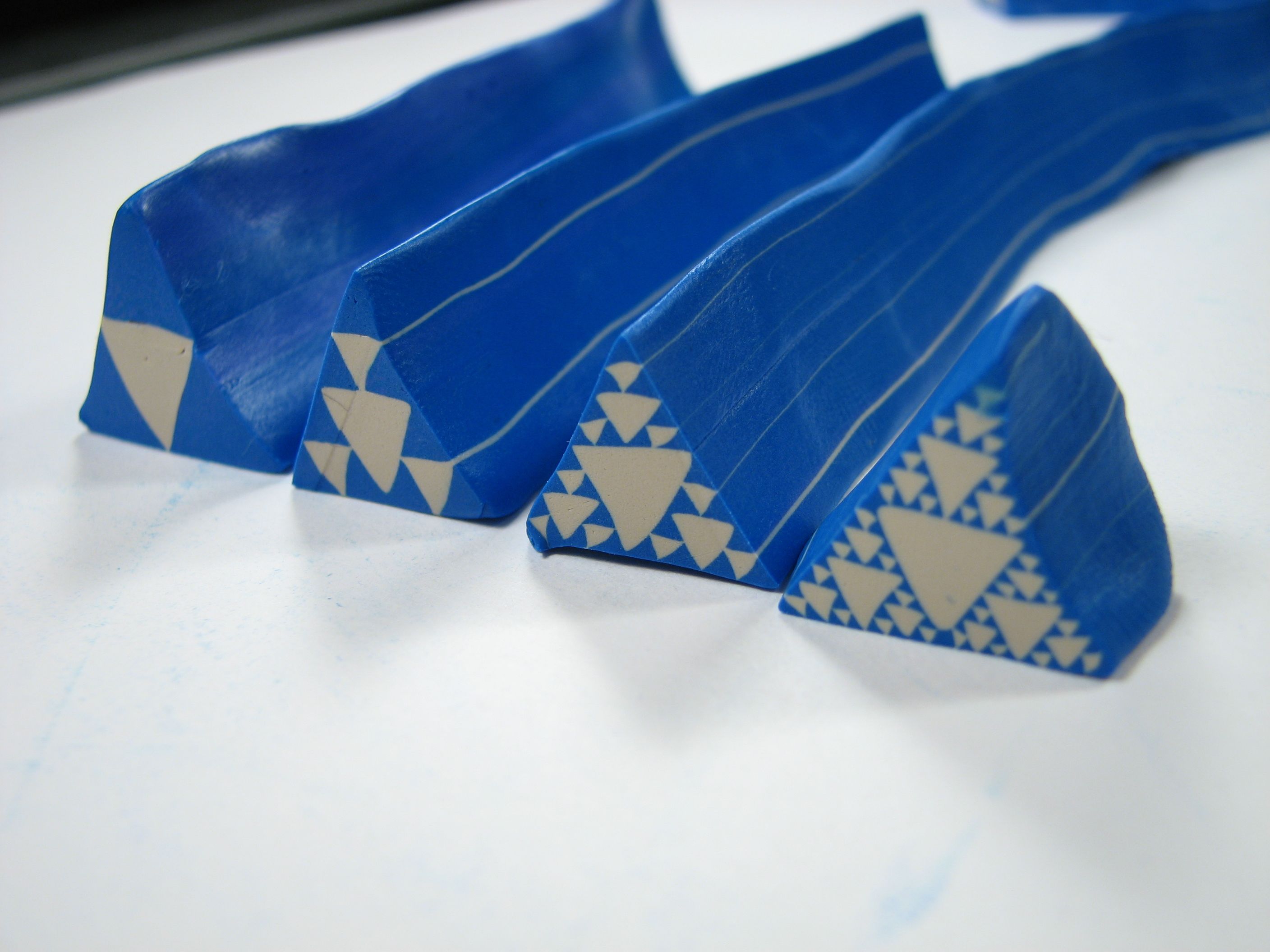
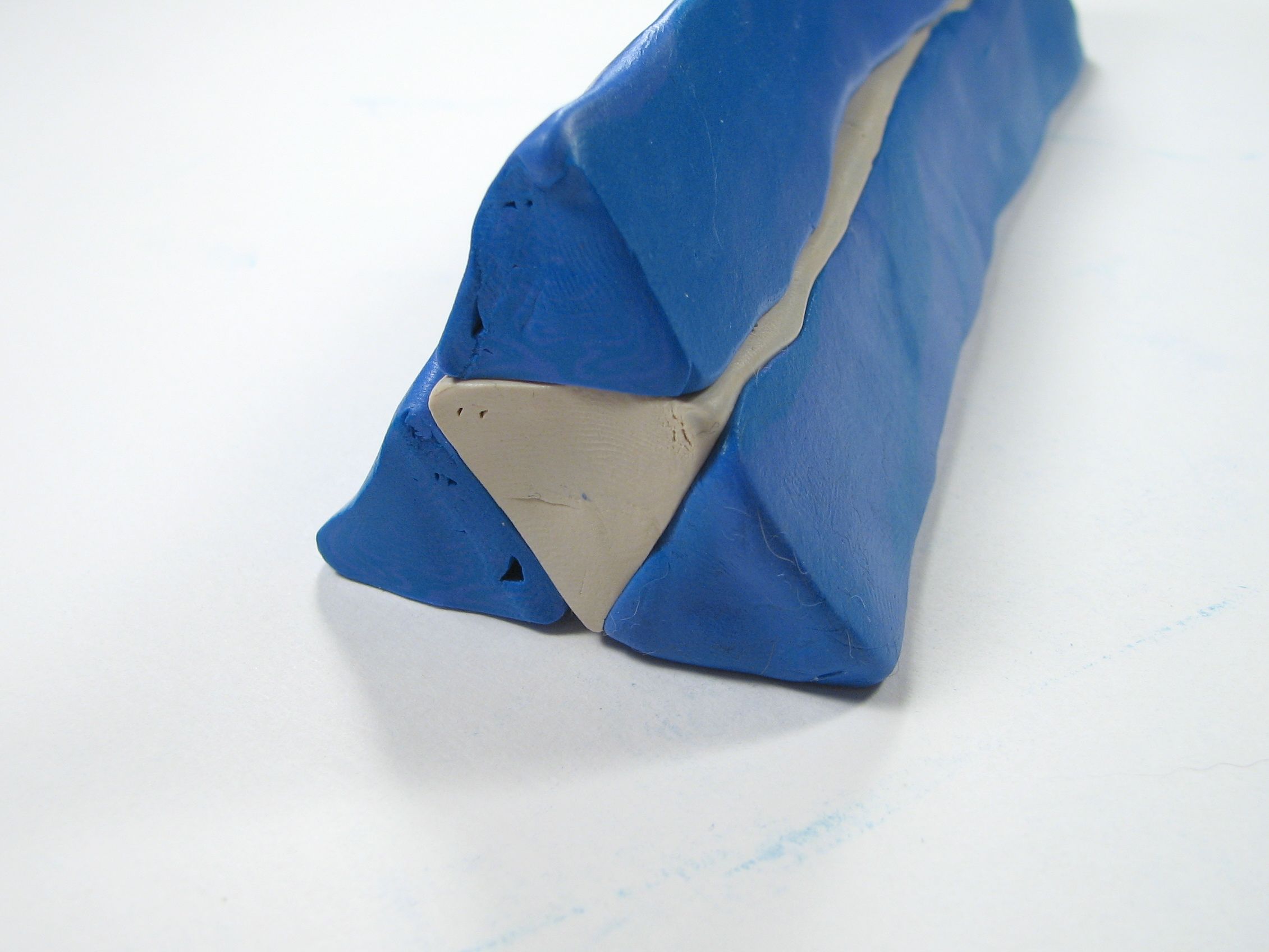
Again stretch the result from the previous iteration, cut into four pieces of equal length and set one aside. Make a new light colored prism the size of one of the quarters, and mate the three dark pieces to the edges of the light colored piece. The third iteration, shown here, now has a total of 27 dark triangles.
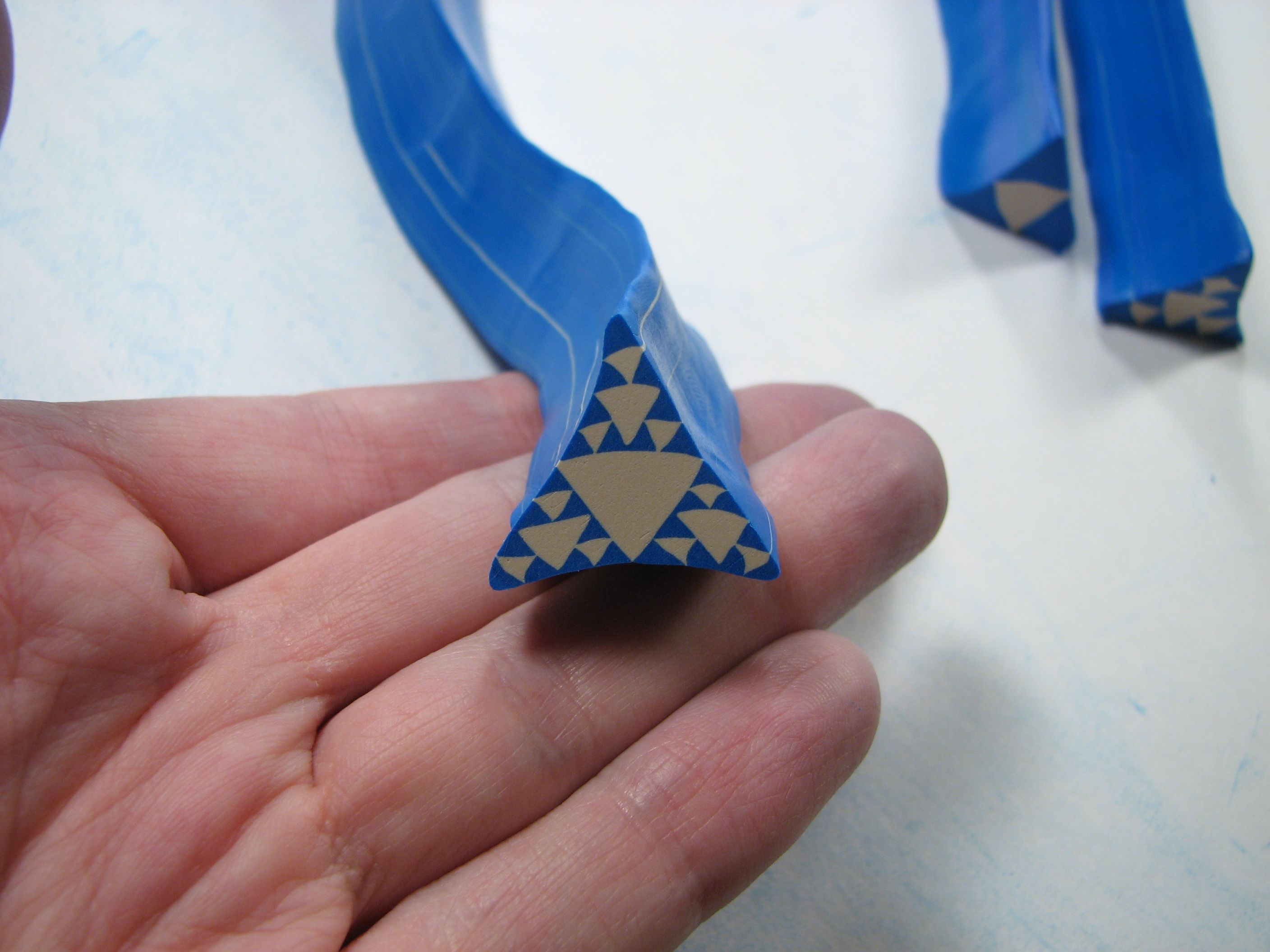
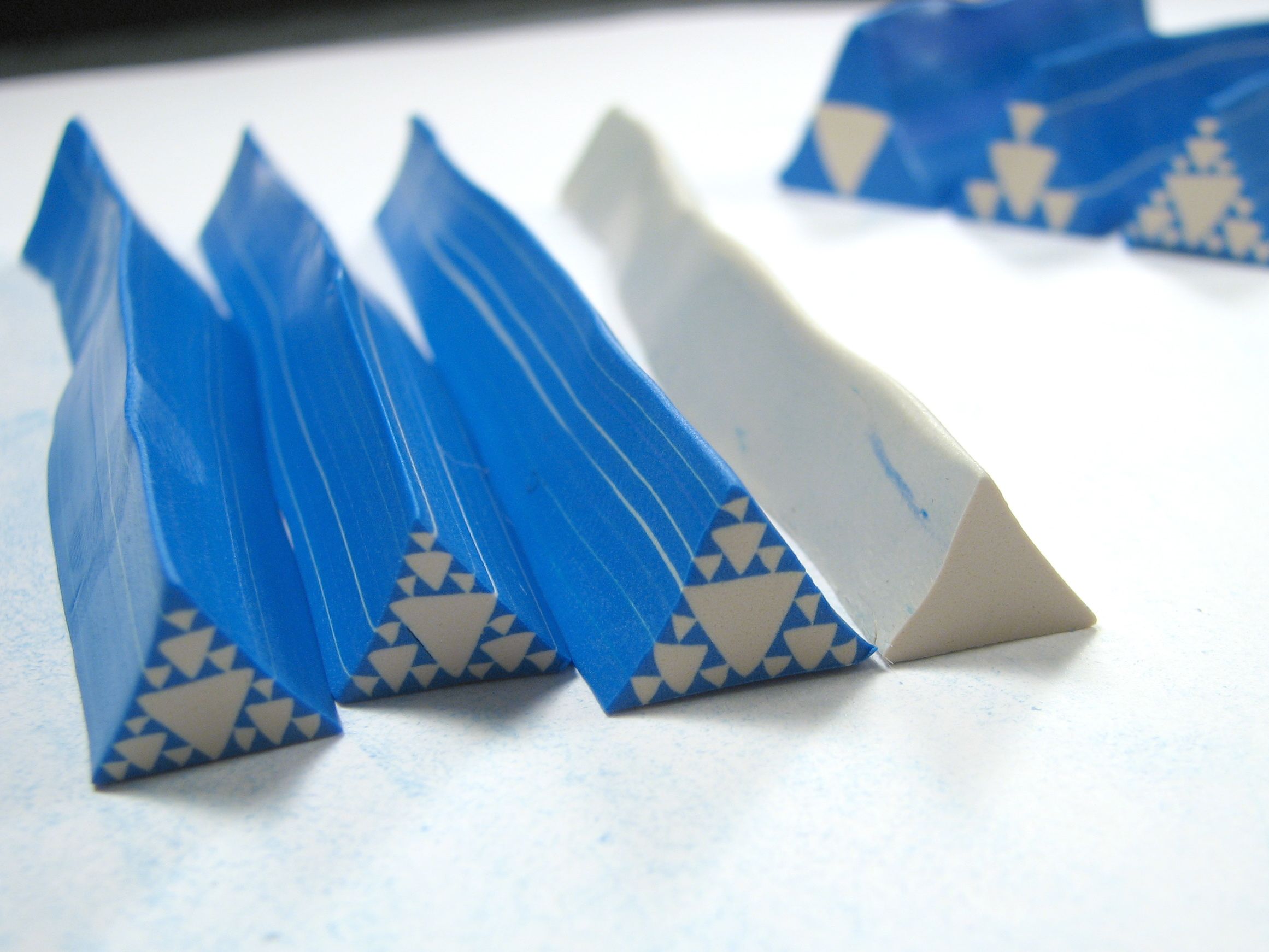
By now, you should have the hang of the iterative algorithm for making the fractal. Again, stretch and cut the result from the previous iteration, and mount it to the sides of a new light-colored prism piece. The fourth iteration, lower left, has 81 dark triangles. On the lower right you can see a piece of fourth-iteration material next to the set-aside pieces from the first three iterations.
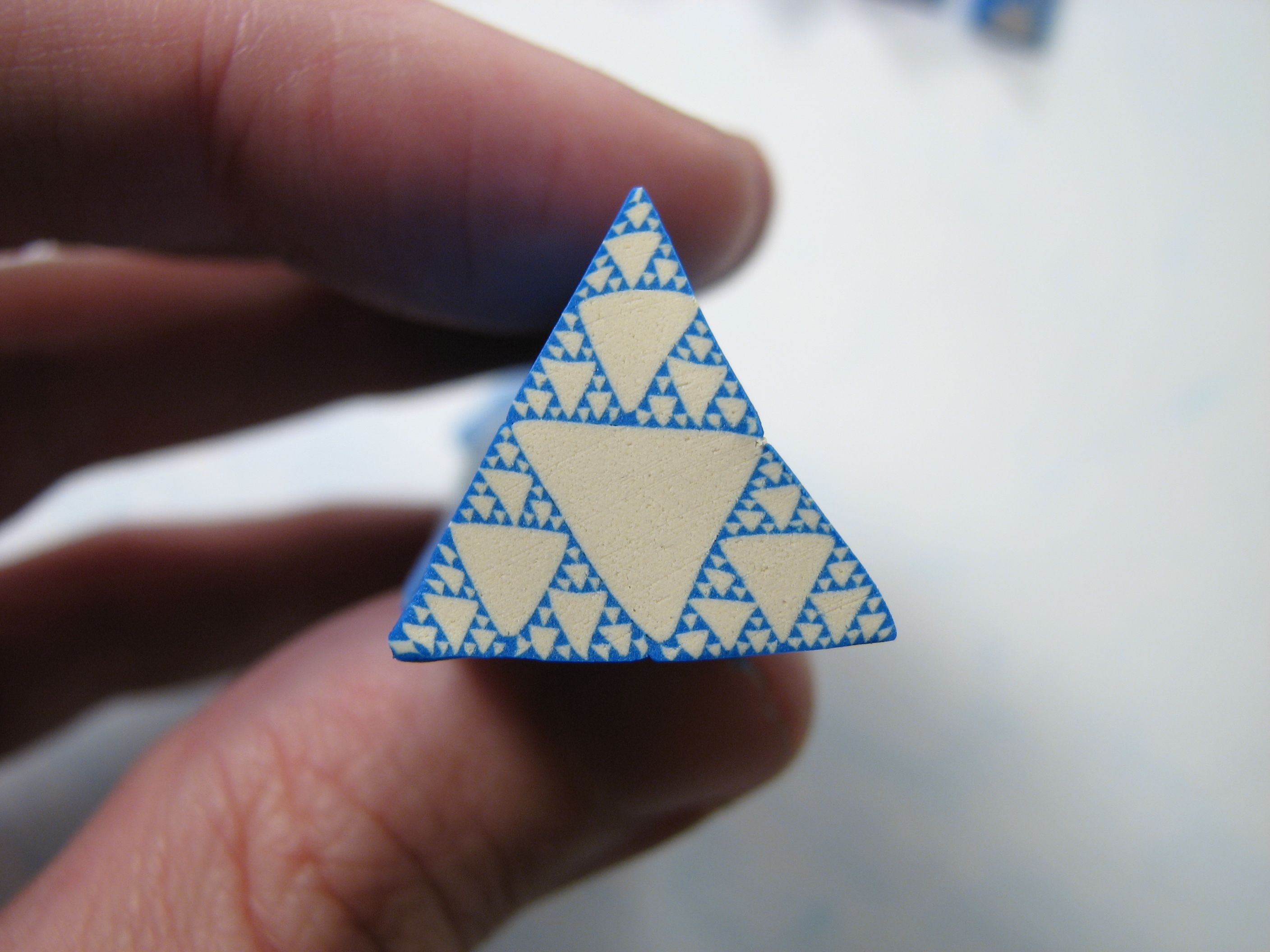
The fifth iteration has 243 dark triangles. Starting to get interesting, no?
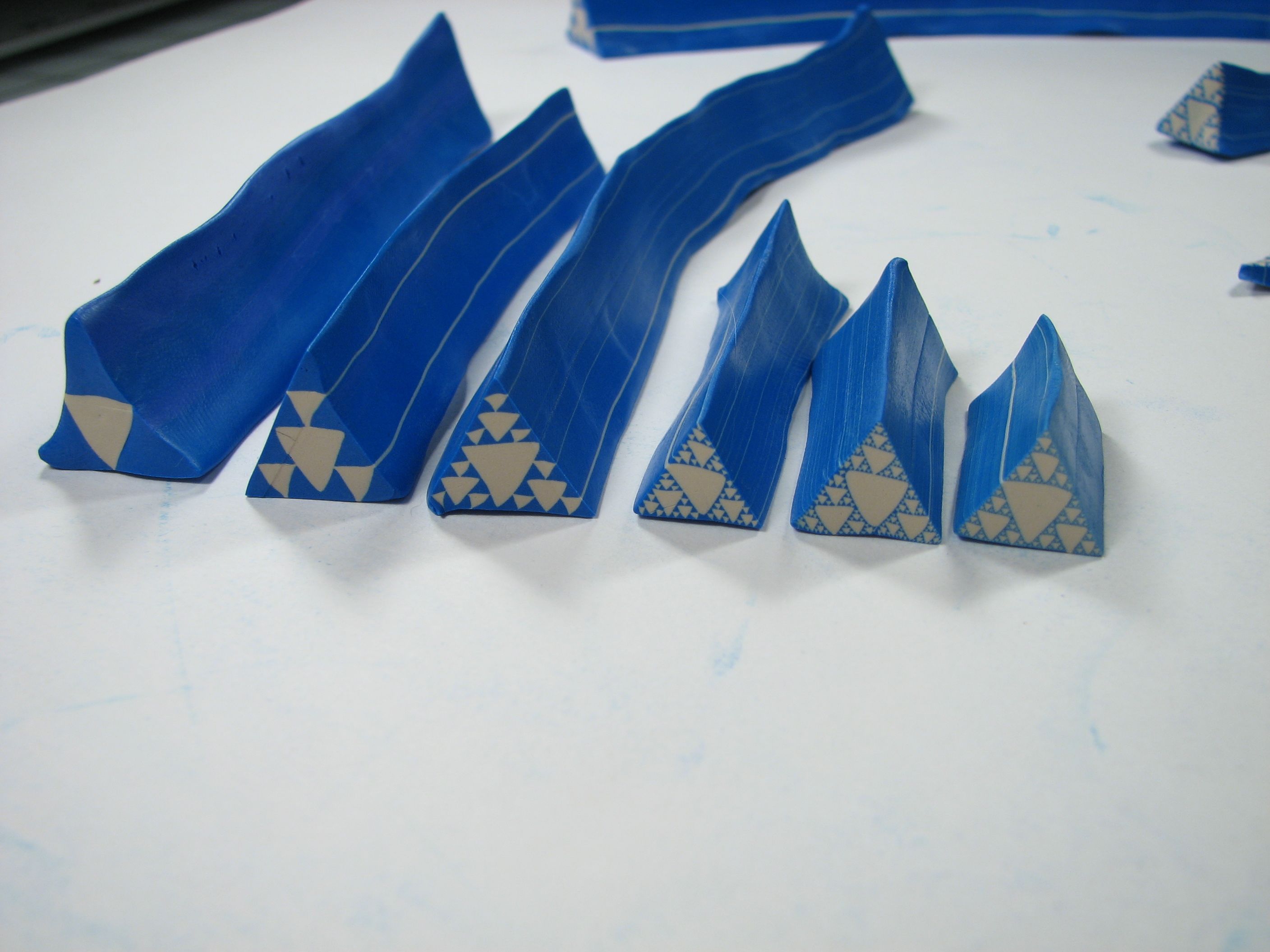
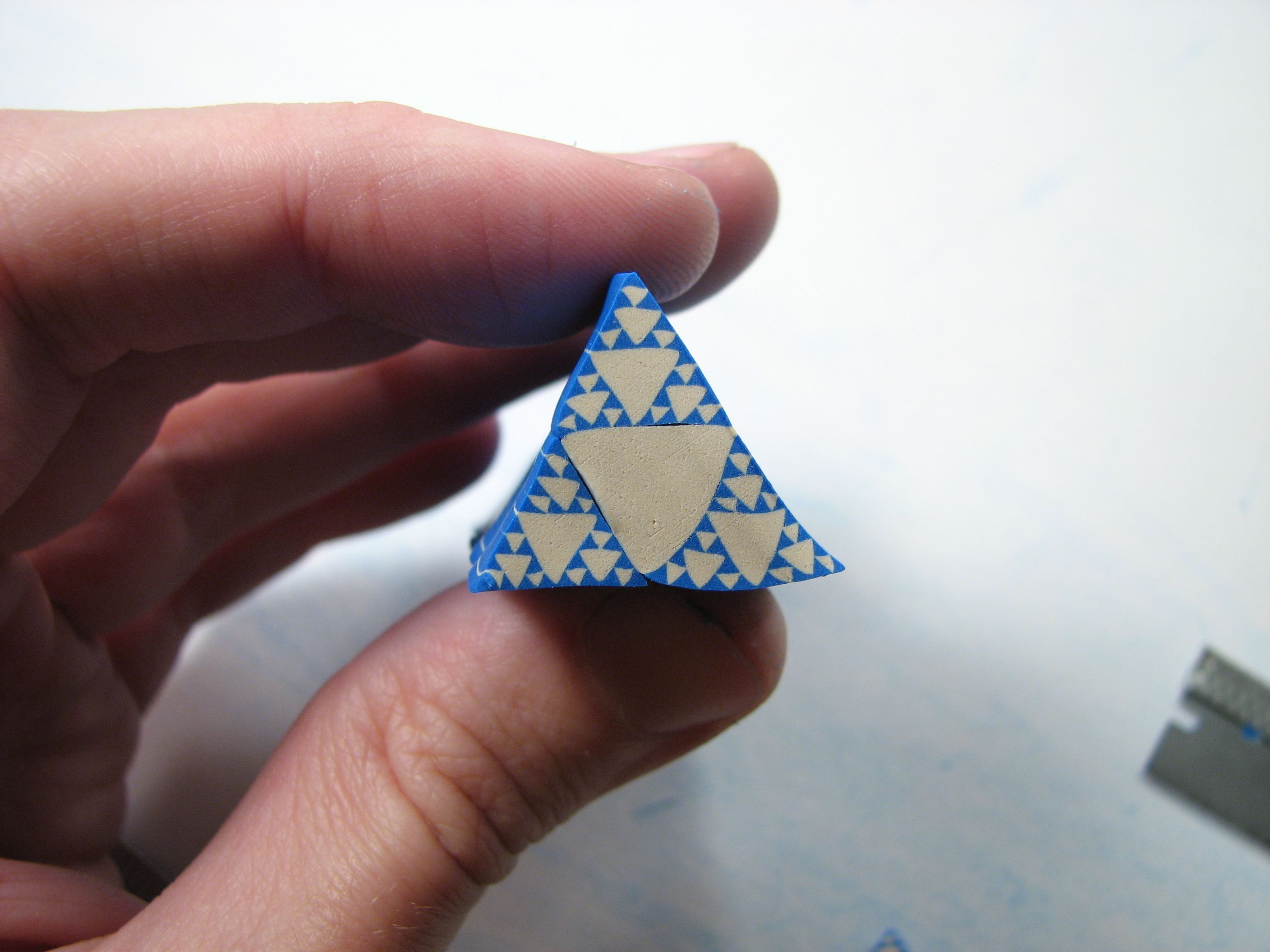
The sixth iteration, on the far right has 729 dark triangles; it’s really looking excellent now.
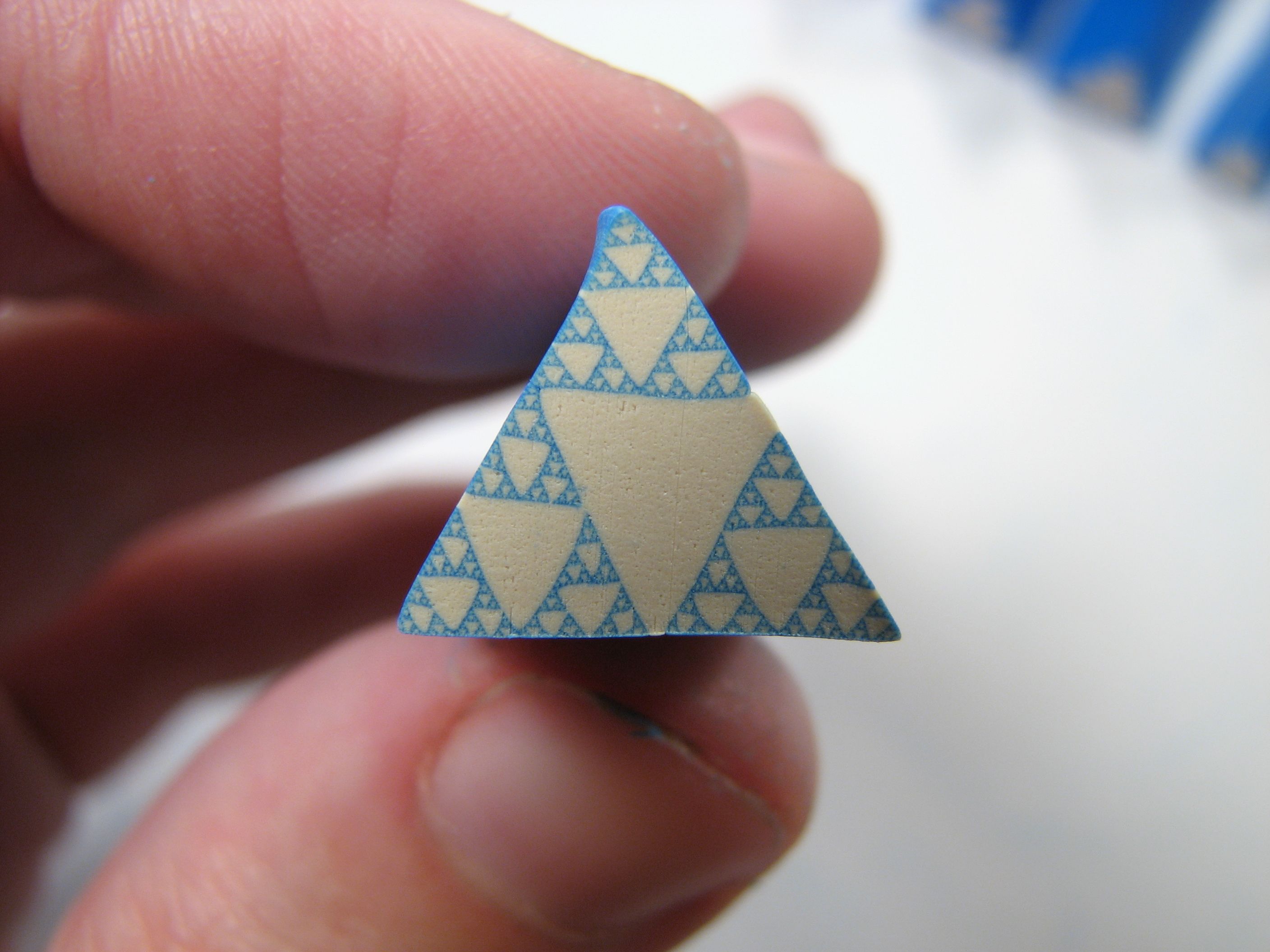
By the time that we get to the 2187 triangles of the seventh iteration, we begin to reach the point of diminishing returns; it becomes harder to see the wispy blue lines that remain, and be begin to lose contrast. Using a color combination with better yet contrast might make another iteration or two more impressive.
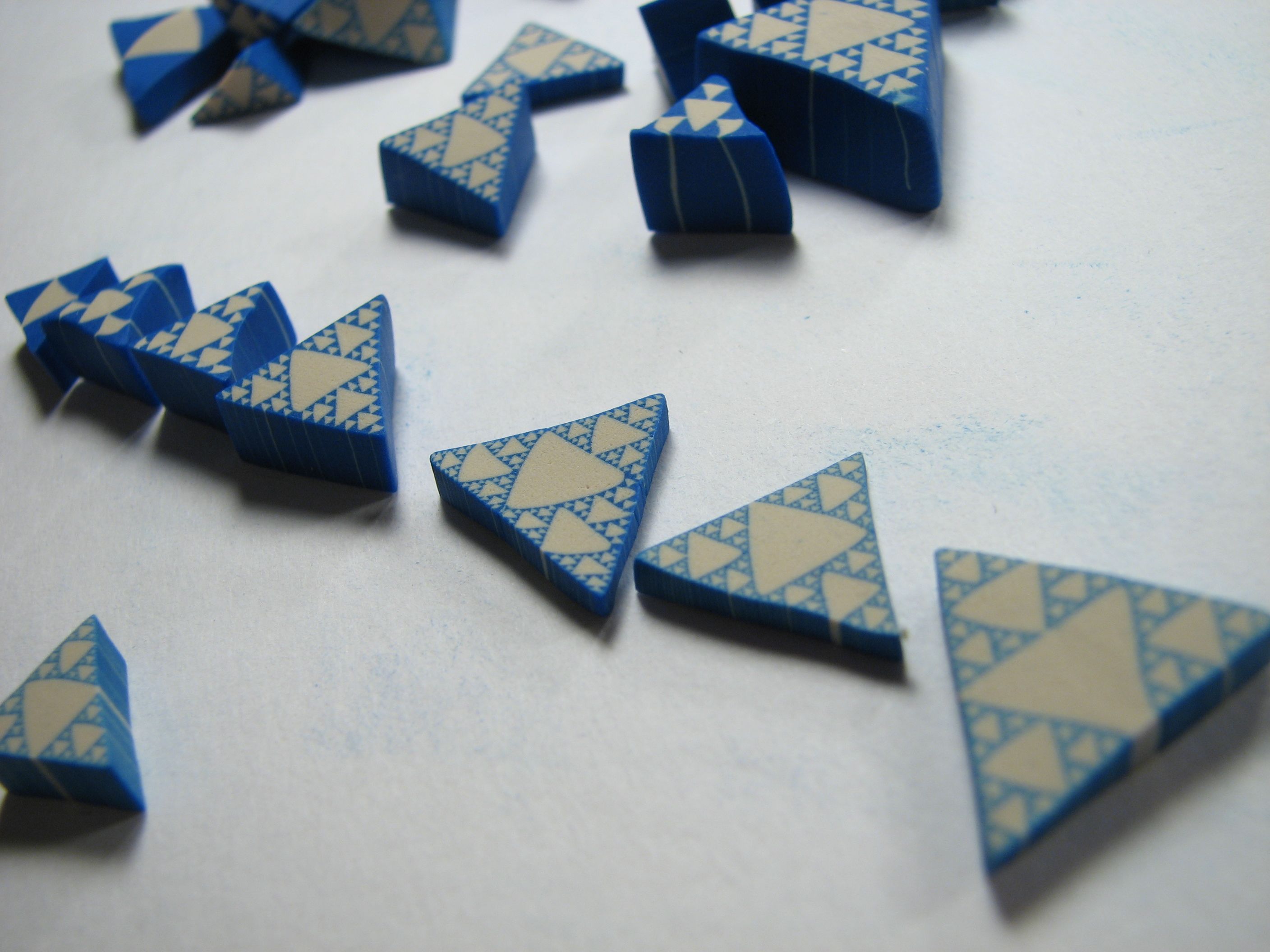
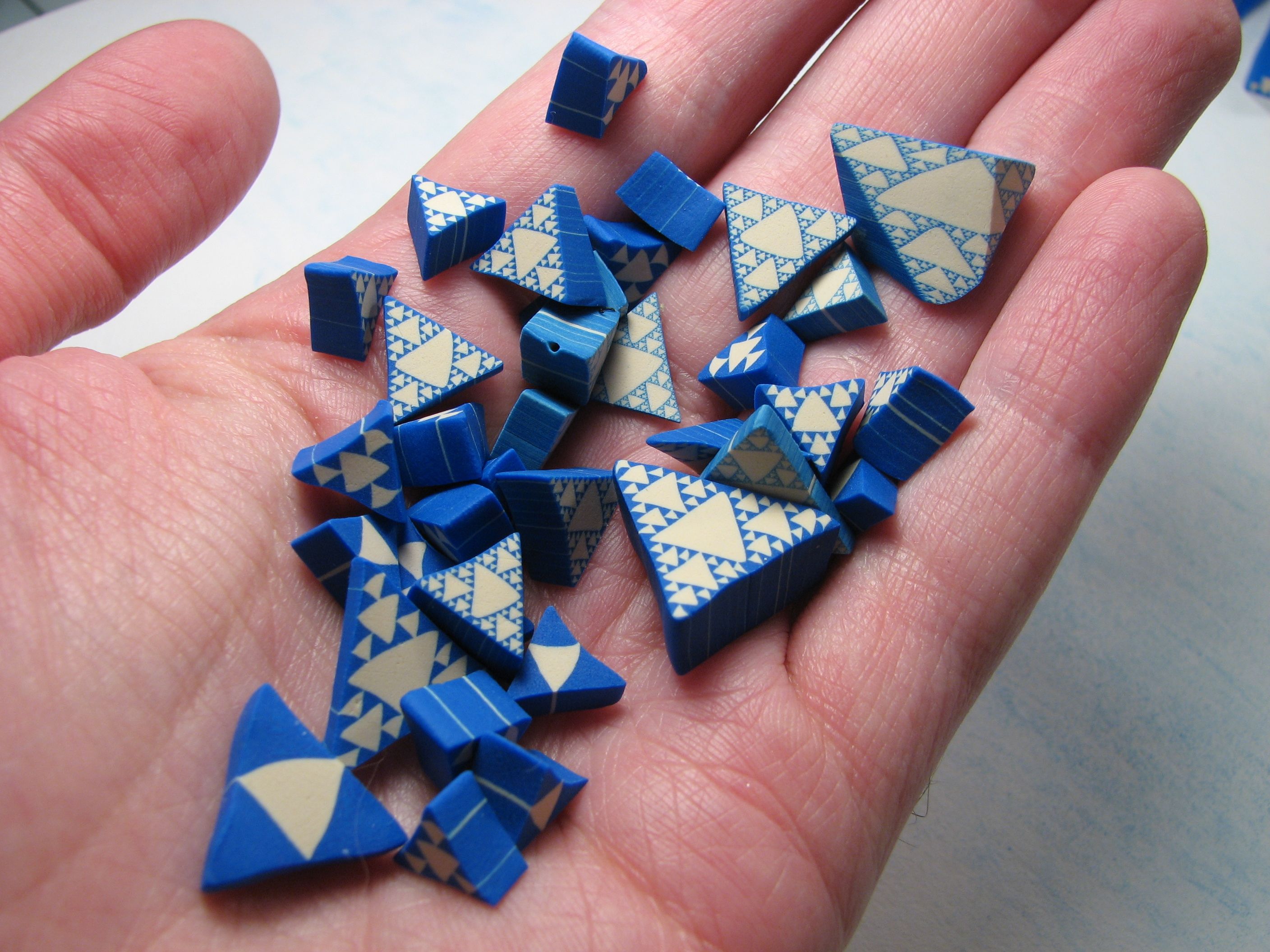
The next step is to cut, drill, or otherwise prepare the material as desired and bake to harden the clay. The set of earrings was made with the sixth iteration material, with its great detail and contrast. A set of little tiles showing the different iterations also makes a great little handful of fractals. (You can see more pictures of this project and our results in this photo set.)
These, and the process of making them, are great visual aids for iterative processes, fractals and self-similarity.
This construction process is certainly one that could be adapted to iterate slightly different generating functions; it will be interesting to see what else can be generated by this method– What kinds of fractals can you produce in clay?

Awesome. That’s definitely one of the coolest crafts I’ve seen.
—
– Creech
Man! You are my hero…
This is a bit similar to how glass beads were created with pictures, portraits, or entire Bible verses on them. Tinted glass rods were made and bound together, then heated and stretched. Once the rods cooled, the middle stretched portion was cut to form beads, and I guess they had to re-melt the ends and use them for something else.
I was impressed by the glass beads, but there was no way I could do that at home. After reading this, I’m quite excited to try it out myself. I think I’m going to go with a square instead of a triangle, as the angles will probably be easier for my craft-disadvantaged self to handle. Awesome tutorial!
Just wanting to point out that this tecnique is called millefiore. Just FIY :)
koch island possibly?
I think that that particular mod is unnecessary– you can do it on your own if you like.
—
Windell H. Oskay
drwho(at)evilmadscientist.com
http://www.evilmadscientist.com/
This is also done in candy making. Hard candies or toffes with designes are made exactly like this. The medium is the only difference.
>This is also done in candy making. Hard candies or toffes with designes are made exactly
>like
this. The medium is the only difference.
I have never seen fractal candy. Do you actually have an example of fractal candy being produced with an iterative algorithm, or are you just referring to regular millefiori and basic stuff like this?
—
Windell H. Oskay
drwho(at)evilmadscientist.com
http://www.evilmadscientist.com/
This is beautiful. I know I would have a problem with evenly stretching it out. Thats the point I would mangle.
Thanks!
It’s actually remarkably easy with this material; a little gentle squeezing and it pulls out marvelously. I only spent about two hours playing with clay for all of these pictures.
—
Windell H. Oskay
drwho(at)evilmadscientist.com
http://www.evilmadscientist.com/
I’m wondering if this would work with chocolate paste.
http://www.recipezaar.com/108481
it looks awesome! but I haven’t understood how is the 4th iteration and the 1st are almopst the same size…
Ditto on that. Can’t see how.
In each iteration, you add material (the white center core), which brings the outer "diameter" up to twice that of the outer triangles that you started with. You then *stretch* the bundle out to four times the length, which reduces the "diameter" by a factor of two, bringing it back to the original size of the dark part.
(Really, we mean half the length of the side of the triangle, not diameter– it’s not a circle.)
—
Windell H. Oskay
drwho(at)evilmadscientist.com
http://www.evilmadscientist.com/
I’d like to see
executed in Fimo.
There is an episode of “How It’s Made” that uses a similar techique to create the pictures in hard candy on Youtube at http://www.youtube.com/watch?v=uep6FKZWRsY
Neat video. What we’re showing off in this project is a way to generate fractals by observing the emergent behavior as a function is iterated– I don’t see anything like that in the video. The candy making video shows standard techniques that are usually used for glass, fimo, and candy, without any iterative component.
—
Windell H. Oskay
drwho(at)evilmadscientist.com
http://www.evilmadscientist.com/
Very cool idea. Did a few today during compiles/DLs with sculpey, a much cheaper hardening clay. The second color was the same with some red food coloring mixed in (hey, it survives baking in foods, right?) which worked worse then I thought but enough to make it stand out from the non-colored sculpey. Picture of them post baking. I’ll have to do this again some time, they got a bit distorted and smashed but all in all not bad for “stuff within arms reach at the work desk” playing around.
Yup, works remarkably well, doesn’t it? I’m still wondering what other kinds of fractals we can make with similar algorithms.
—
Windell H. Oskay
drwho(at)evilmadscientist.com
http://www.evilmadscientist.com/
Managed, kind of, to make a Koch Snowflake. As I continually say sorry for in the text (published as an instructable, had no better format) it didn’t turn out too well but I think the theory is solid and I think it ought to work if I were less clumsy. And had a camera with macro. And wishes were horses.
That’s really clever– Great work!
—
Windell H. Oskay
drwho(at)evilmadscientist.com
http://www.evilmadscientist.com/
Yes but what about Mandelbrot Sets?
Sure!
(If you figure out how, let us know.)
—
Windell H. Oskay
drwho(at)evilmadscientist.com
http://www.evilmadscientist.com/
That is pretty much the coolest thing I’ve seen all day. I want to make me some.
I can haz tri-force?
zelda dont know how to do this but the evil mad scientist figured out how to make triforce now link dont haz to look anymore
Stuff like this has been occuring for centuries with glass and ceramics. If you enjoy this stuff take a look at moretti glass. Its commonly called millefori ( thousand flowers ).
This article is about using the process of mathematical iteration to create emergent behavior within millefiori, not about millefiori in general. I think that this should be pretty clear from the context and our discussion above.
Windell H. Oskay
drwho(at)evilmadscientist.com
http://www.evilmadscientist.com/
this is amazing and awesome, and you are amazing and awesome, and thank you so much for sharing; this really makes my day. i am researching fractal art for a school project (proposing a gallery design). obviously, i would include a case of your work. : )
TRIFORCE!!!!!
Apres une longue recherche sur Internet je n’ai pas pu trouver un site sérieux expliquant comment associer pate à modeler et art fractal. Très intéressant.
[link:Art Fractal
]