



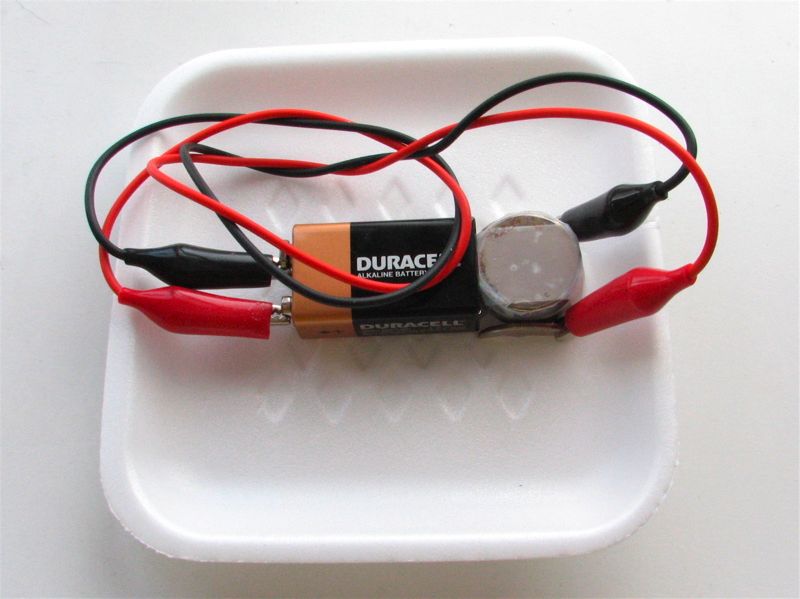
After trying out our simple demonstration of magnetohydrodynamic (MHD) propulsion, you might want to make something a little more “practical.” Here’s how to build a simple little boat that moves through salt water (at a snail’s pace) via MHD propulsion.
The craft is not designed for performance; it’s designed to demonstrate a functional MHD craft made with inexpensive, easily available materials. While it may move slowly, hey, it moves, and you can make it in about five minutes.
[This is the second in a series of three articles on building simple magnetohydrodynamic (MHD) propulsion systems.]
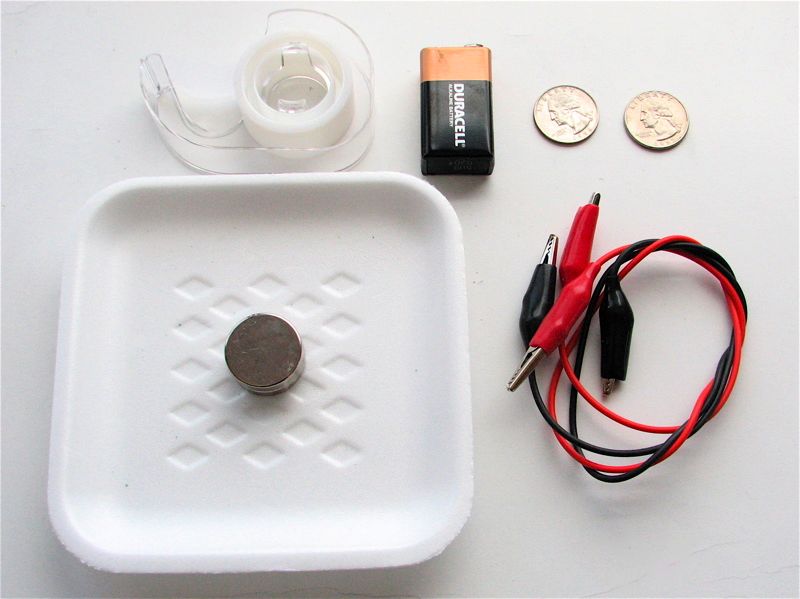
Materials, clockwise from noon:
- 9V batteries. Plural, because they will get used up very quickly. Rechargables would be nice.
- Two quarters (or similar coins)
- Two short cables with alligator clips on the ends
- A sturdy foamtray, like the kind that meat or vegetables are sometimes packed in
- a strong neodymium magnet (I suggest one about an inch in diameter
by half an inch thick) - Regular transparent tape.Tools: a small knife.Optional: Double-sided tape.Since your vehicle requires salt water to run, you will also need to provide that. Grab some salt, water, and a nonmagneticbasin that’s at least several times as wide as your craft. A plastic storage bin or kiddie pool works well. If your bathtub is nonmagnetic (check it!) you can use that. While the craft could (in principle) run in the ocean, wind and water currents will make it hard to see the small propulsion effect.
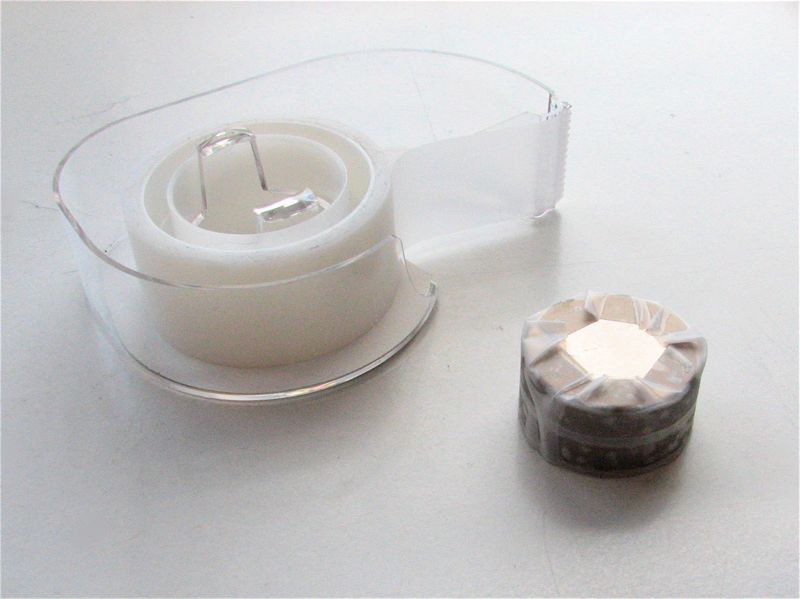
First step: Wrap the outside of your magnet with a single layer of tape to electrically insulate it. Electrical tape, packing tape, or other types of insulating tape will also work for this job.In the photo, you can see that my half-inch thick “magnet” is actually a stack of two 1/4″ thick magnets.
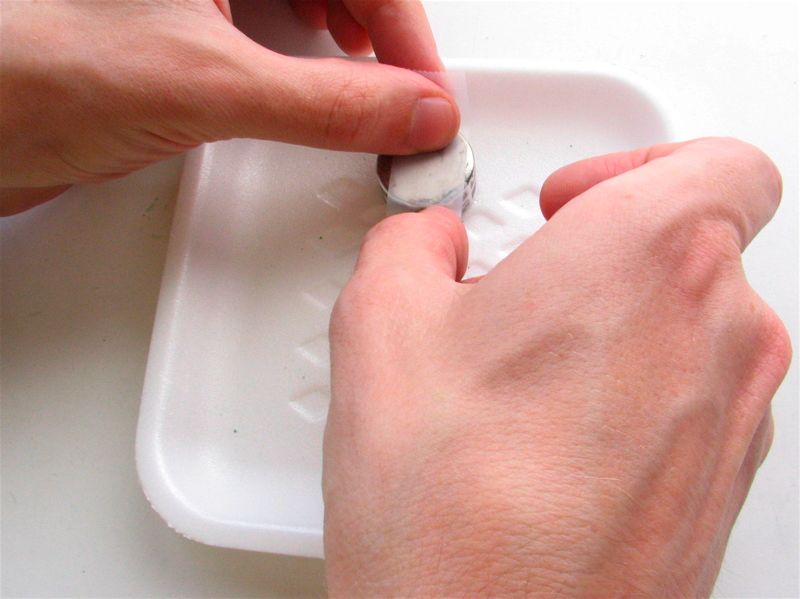
Step 2: Using more tape, attach the magnet to the tray. You can see in the first photo where the magnet will end up: towards one end of the tray and centered in the other direction.If you have double-sided tape, use a piece below the magnet to help hold it in place.
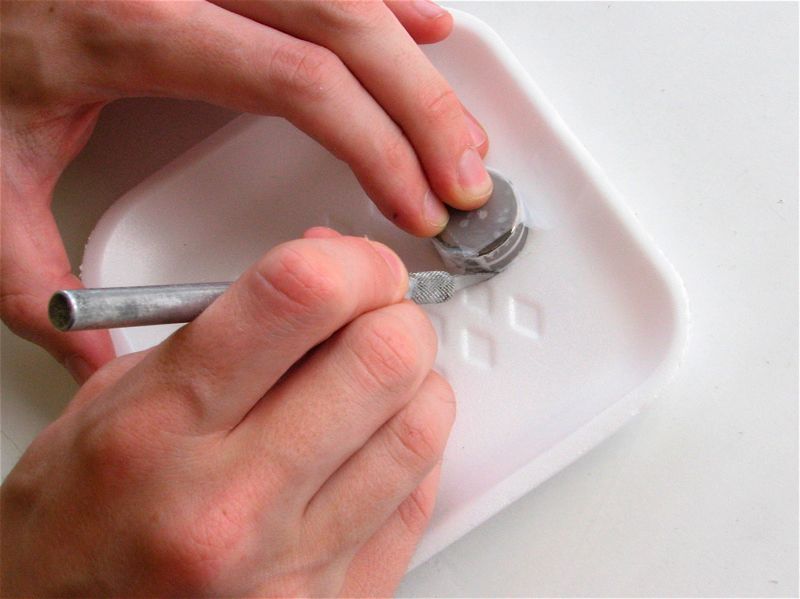
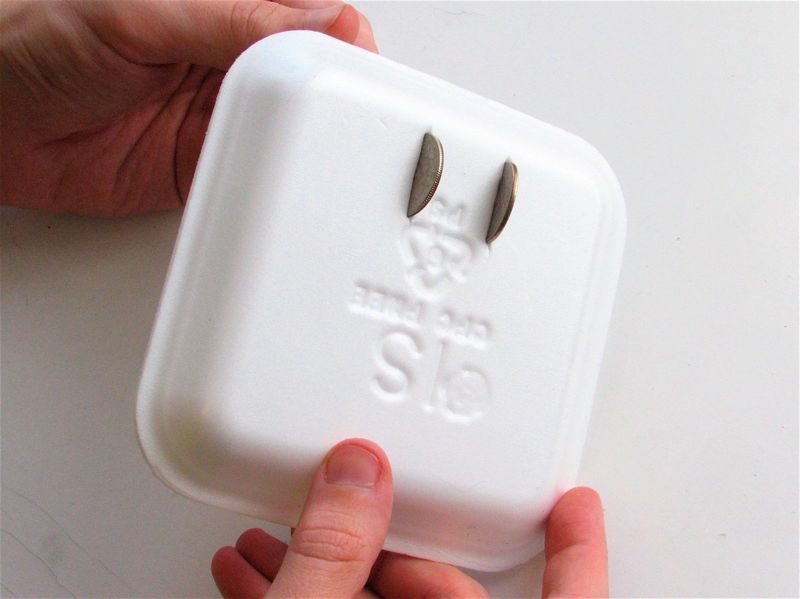
Make the incisions. Use a knife to score a short, narrow slit along two sides of the magnet as shown. The slits should be allow you to push the two quarters into the foam tray where they are held in place by friction. It’s a good idea to make the initial slits narrow and short (shorter than a quarter) so that the quarters will be held in place securely and the seal will be water tight. The quarters should be parallel, centered around the magnet, and as close to the magnet as possible.Danger: You must exercise extreme caution when handling a sharp knife near a strong magnet like this. The safe way to cut these slits is to first mark where the magnet goes, take the magnet off, cut the slits, and thentape the magnet on.
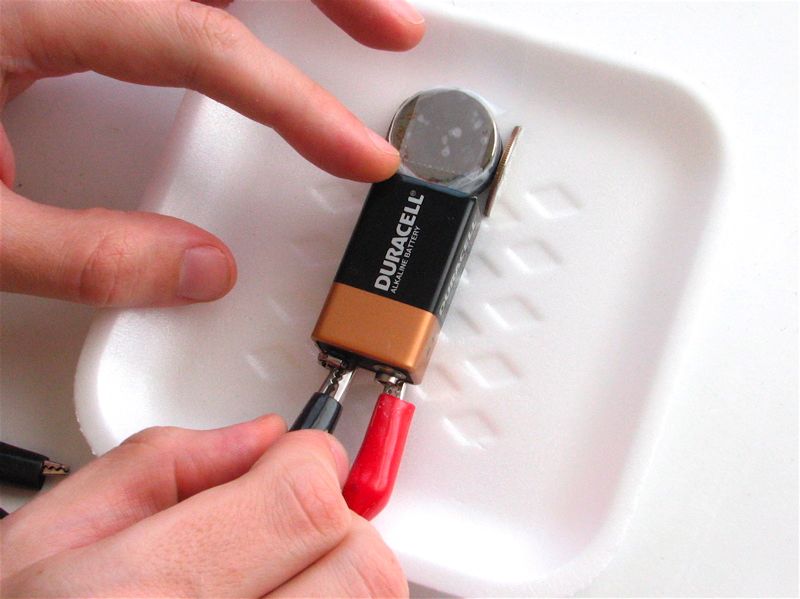
Carefully attach the 9V battery to the craft, it should happily stick to the magnet.Begin wiring up the craft: Hook one end of each of the two alligator cables to the battery terminals. (Don’t hook the terminals to each other.)If you don’t already have any alligator clip cables, this is a great excuse to make or buy some.
To complete your MHD boat, clip the other ends of the two alligator cables to the two quarters. Go get the Dom, it’s time for the maiden voyage.When you float the craft in salt water, the water completes the electric circuit, allowing electricity to flow between the two exposed half-quarters on the bottom side of the tray. As in the case of the simple MHD demonstration, the electric current flows perpendicularly to the magnetic field, so a force is produced, which will push the craft along.
Avoid getting salt water in the top of the tray; it will short out the circuit and drain your battery without giving you any propulsion.
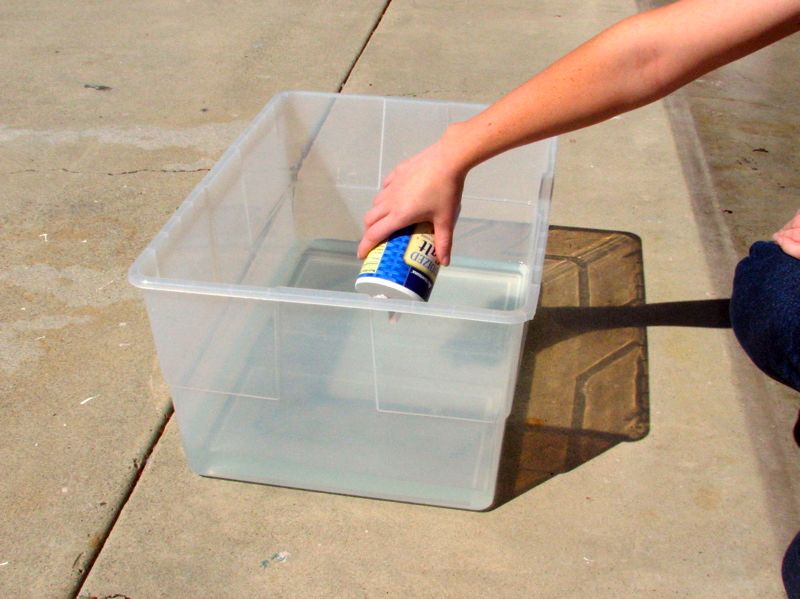
Get your basin ready and salt the water.We used this clear storage bin to test out our little boat. The water is a couple of inches deep, so that the quarters won’t touch bottom. We emptied that container of salt into it, but I’m not convinced that we needed quite that much.
Because we’re using such a small battery, the total thrust is not very high. To see it, you will need to avoid other factors that can move the boat. Most importantly, you need to avoid water currents, wind currents, and nearby magnets or ferromagnetic items.
We had an early shipwreck with this design when we tried to test it out in our bathtub. It turns out that our bathtub is magnetic. The boat was almost instantly yanked to the bottom. Oops. A more subtle problem is that your craft may slowly float towards the nearest giant chunk of steel, so don’t try this right next to your car. Once you eliminate major magnetic interference, you may find that your craft still acts as a weak compass. (If your magnet pointed horizontally instead of vertically, it would make a
very good compass.)The compass effect will only mess with your steering, not the thrust direction. If you’re careful, you should then be able to tell compass steering from attraction towards metal objects.
To check for magnetic interference without eating up batteries, disconnect one of the alligator clips from the battery and set the craft in the basin of water. If it starts drifting (not turning), then you need to put your basin somewhere else. Once you’ve found an interference-free test site, reconnect your battery.
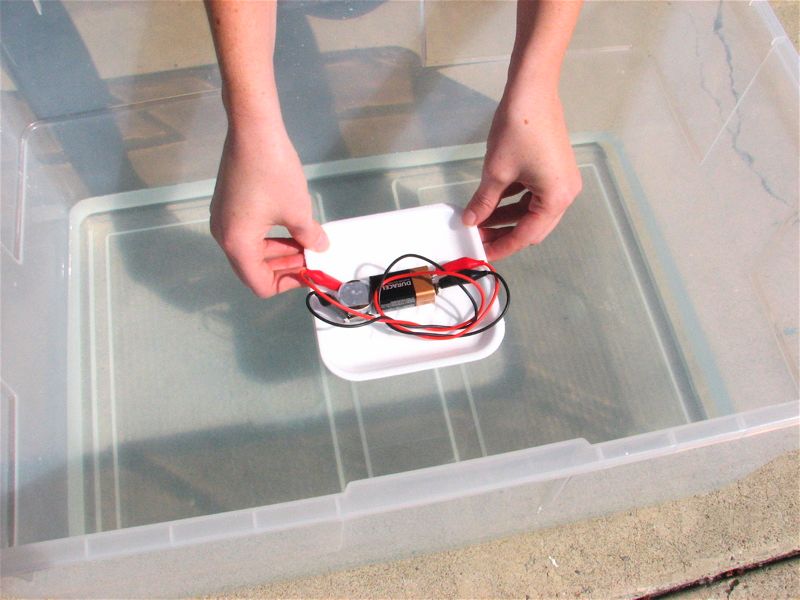
To test your MHD craft, place it in the center of your salt water basin. Assuming that you’ve removed magnetic interference, the craft will begin to move forward. However, without knowing which pole of your magnet is which, you can’t tell which way forward will be. The end with the magnet is either the bow or the stern. If you’d like it to go the other way, swap the role of the two alligator clips at the battery end.
To prolong battery life, always take the craft out of the water as soon as it hits one of the walls. Disconnect the battery if it’s going to spend any significant time sitting out before the next run.
Short movie (43 s, no sound), demonstrating this magnetohydrodynamic propulsion craft on YouTube.
Troubleshooting
If you have trouble getting your craft to work, the first suspect should be the battery; try a new one. There’s very little to go wrong in this circuit, so it should (in principle) be easy to debug. If the battery is hot and the craft doesn’t move, then you may have a short circuit. Check to make sure that you don’t have any water leaks (remember that salt water is a conductor!) and make sure that the insulating wrap around your magnet is intact.
What’s next?
This might be a good starting point for a larger vehicle, as a classroom
demonstration, or a science fair project. That’s up to you. Right now, I’m making radio controlled versions. How will it turn out? Time will tell!

While I absolutely agree that sharp steel and strong magnets do not mix, a good solution would be "plastic razor blades" as sold (for instance) by Lee Valley.
http://www.leevalley.com/garden/page.aspx?c=1&p=53612&cat=2,42194,40727
They are, of course, not as sharp as the real thing by a wide margin, but they would do for many jobs (including cutting foam) and are both nonmagnetic and nonconducting.
Lee Valley, by the way, also sell a range of rare earth magnets.
-Robert Dawson
Hi Thanks for showing this I had hoped to replicate this test myself and see some astounding movement in water, I had hoped to build a fast motor model but I am blowed if I can get any speed out of the setup.
David
I’m currently in a MHD boat competition, and I would like to know of a better electrolyte that can be used in water.
Thanks
Try using Dilute Hydrochloric Acid . I amn’t sure if it would work.
tempered aluminum blades work too
And make sure the coins aren’t magnetic.