



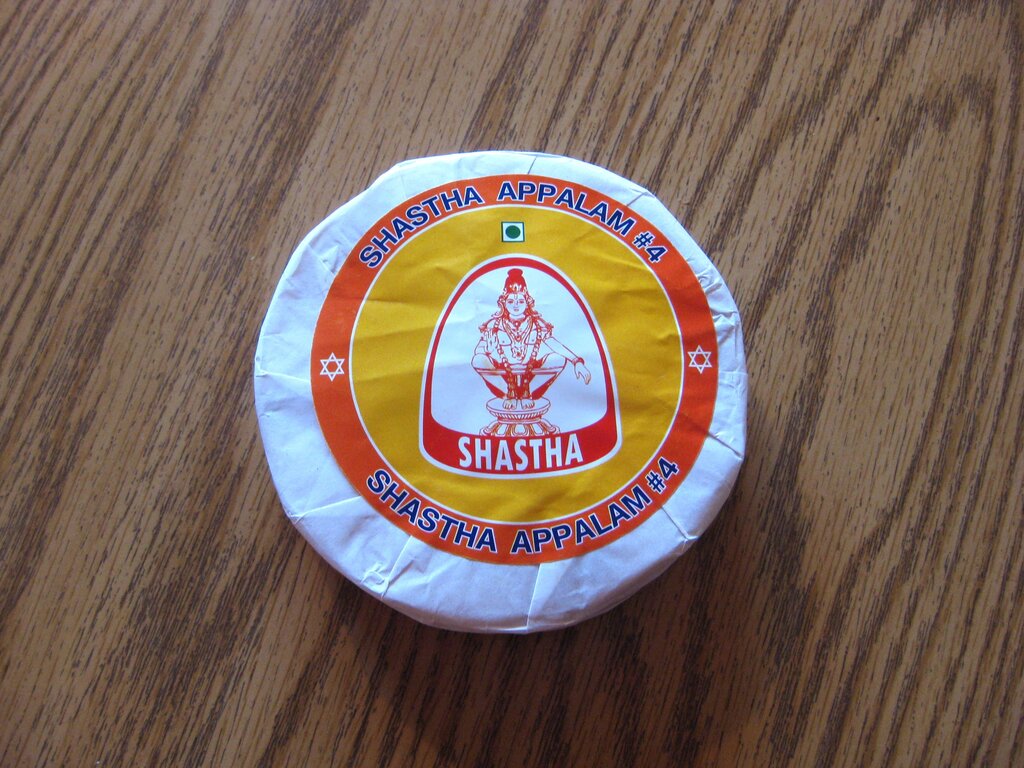
 As we have written about, we enjoy roasting papadums (a type of Indian cracker) on the stovetop. Appalams are a closely related cracker made with rice flour in addition to the usual lentil flour that can be cooked in the same ways, but just happen to be significantly more flammable.
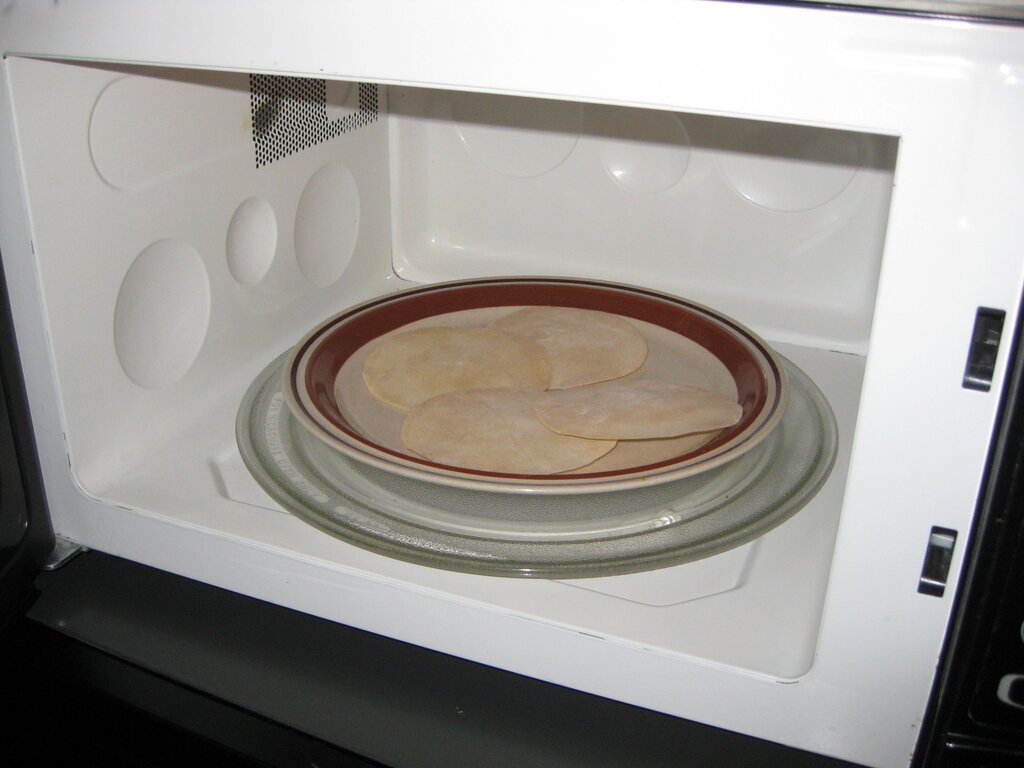
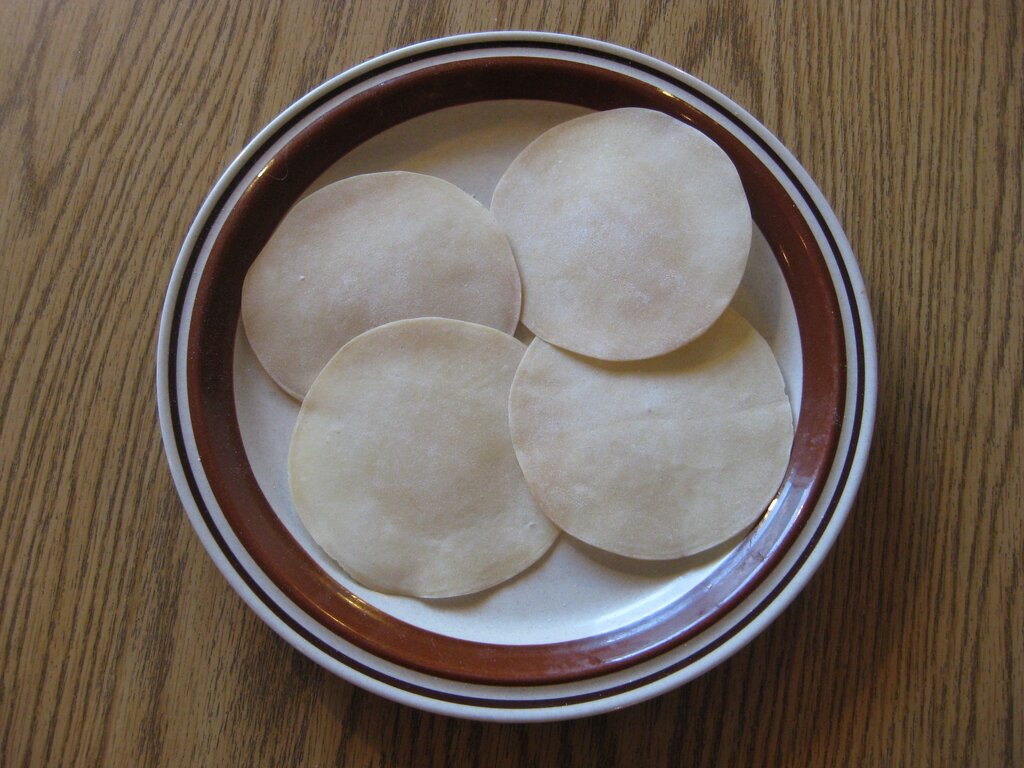 So, while you can (with great care and a nearby fire extinguisher) roast appalams on the stovetop, we decided to try out the microwave method. We put several of the appalams on a plate. They start out as plasticky brittle wafers like you see above.
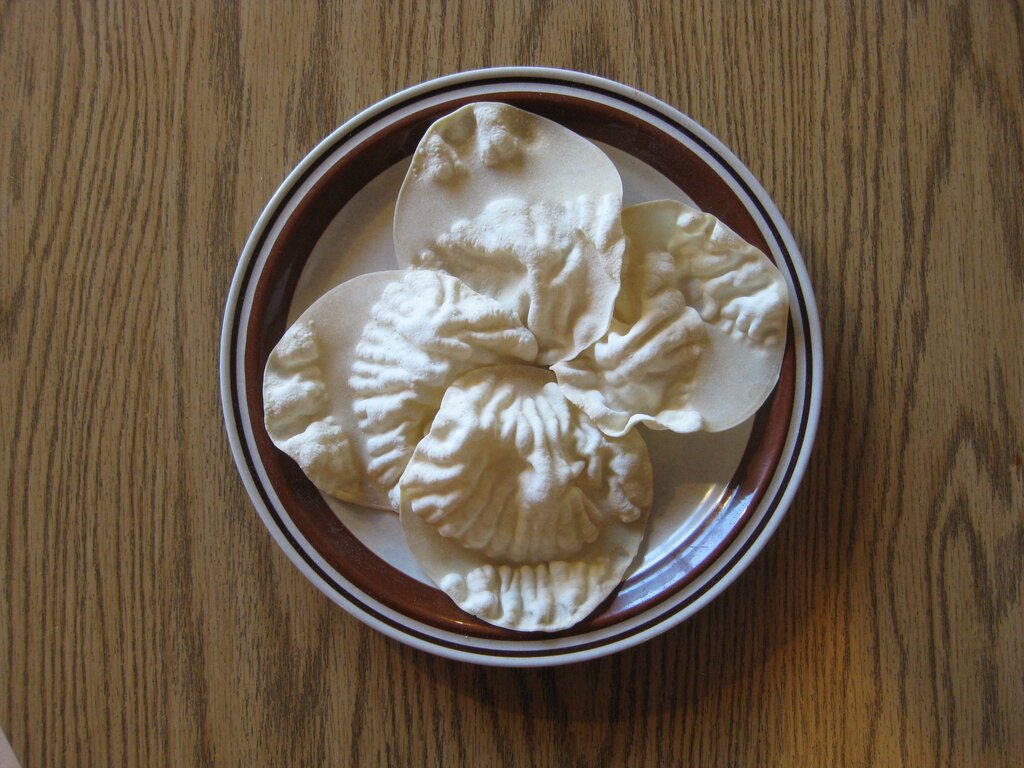
And then, after 30 seconds in the microwave, here is what we saw:
So, while you can (with great care and a nearby fire extinguisher) roast appalams on the stovetop, we decided to try out the microwave method. We put several of the appalams on a plate. They start out as plasticky brittle wafers like you see above.
And then, after 30 seconds in the microwave, here is what we saw:
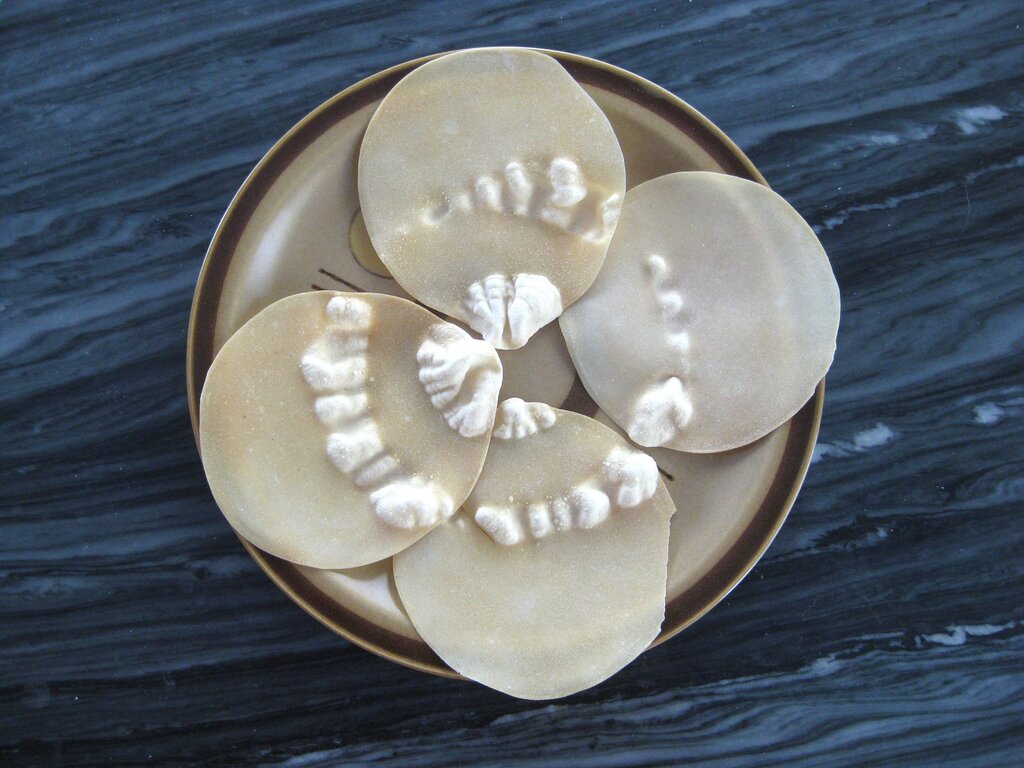 Holy crap!
As an area of the cracker cooks, it bubbles up in just a few seconds, leaving clear marks as to where there is microwave power and where there isn’t. For this particular microwave, Saturn-shaped objects will cook evenly.
Obviously what is happening is that there are two hotspots in this microwave: one in the center, and one offset from center which traces out a circle thanks to the rotating plate in the bottom.
We have access to four other microwave ovens. Are they all this bad?For each microwave, we spread out four appalams on a plate and cooked them for 30 seconds.
Holy crap!
As an area of the cracker cooks, it bubbles up in just a few seconds, leaving clear marks as to where there is microwave power and where there isn’t. For this particular microwave, Saturn-shaped objects will cook evenly.
Obviously what is happening is that there are two hotspots in this microwave: one in the center, and one offset from center which traces out a circle thanks to the rotating plate in the bottom.
We have access to four other microwave ovens. Are they all this bad?For each microwave, we spread out four appalams on a plate and cooked them for 30 seconds.
 Microwave #2: This microwave cooked much more evenly, but is better suited for reheating donuts: it has a dead zone in the very center, a central ring that cooks well, and an outer dead ring with hotspots beyond that.
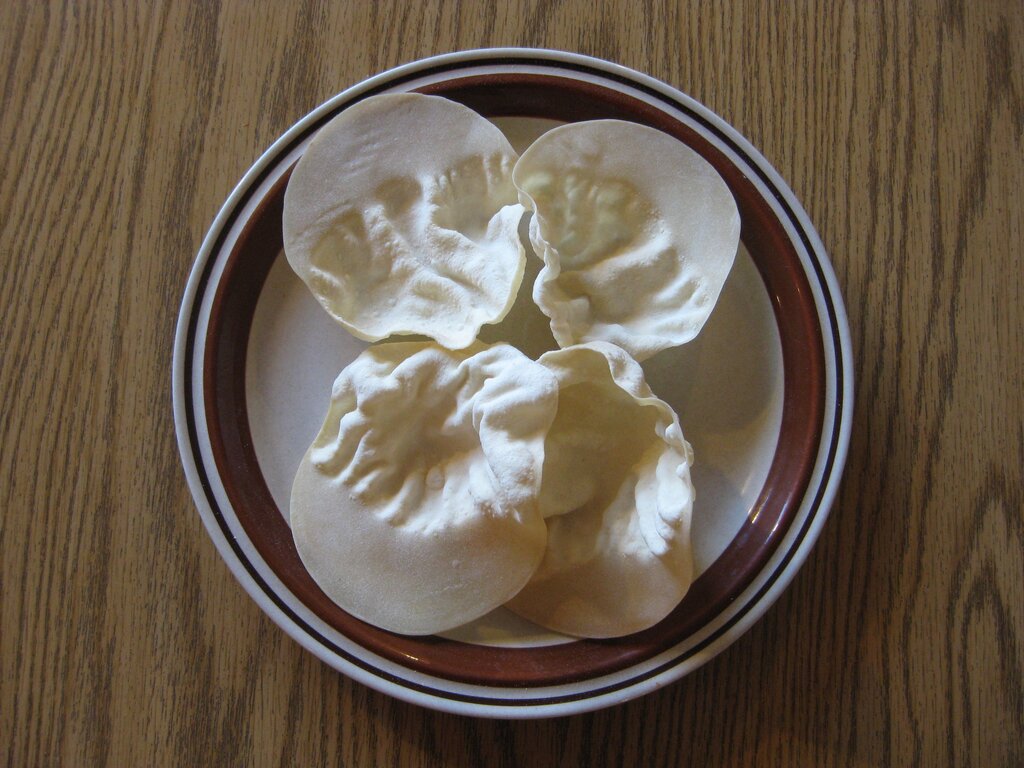 Microwave #3: This is a very large microwave–the kind that a turkey would fit in. It is extremely powerful, but strangely, the cooking is confined to a single central area that is much smaller than its rotating tray. This is the one you should use to heat your soup for lunch. Alternately, an appalam placed dead-center cooks beautifully in 30 seconds.
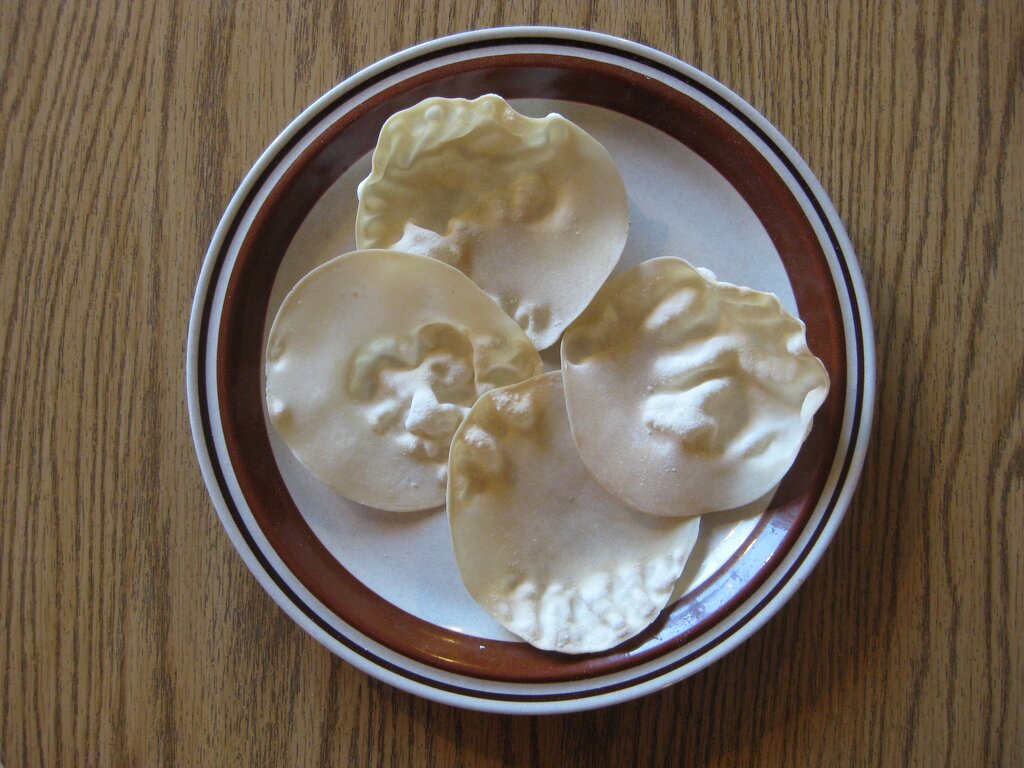 Microwave #4: Significantly underpowered, with a hotspot way off center and an outer ring of uneven distribution. Wondering why part of your lunch is steaming and part is still icy? Blame this microwave.
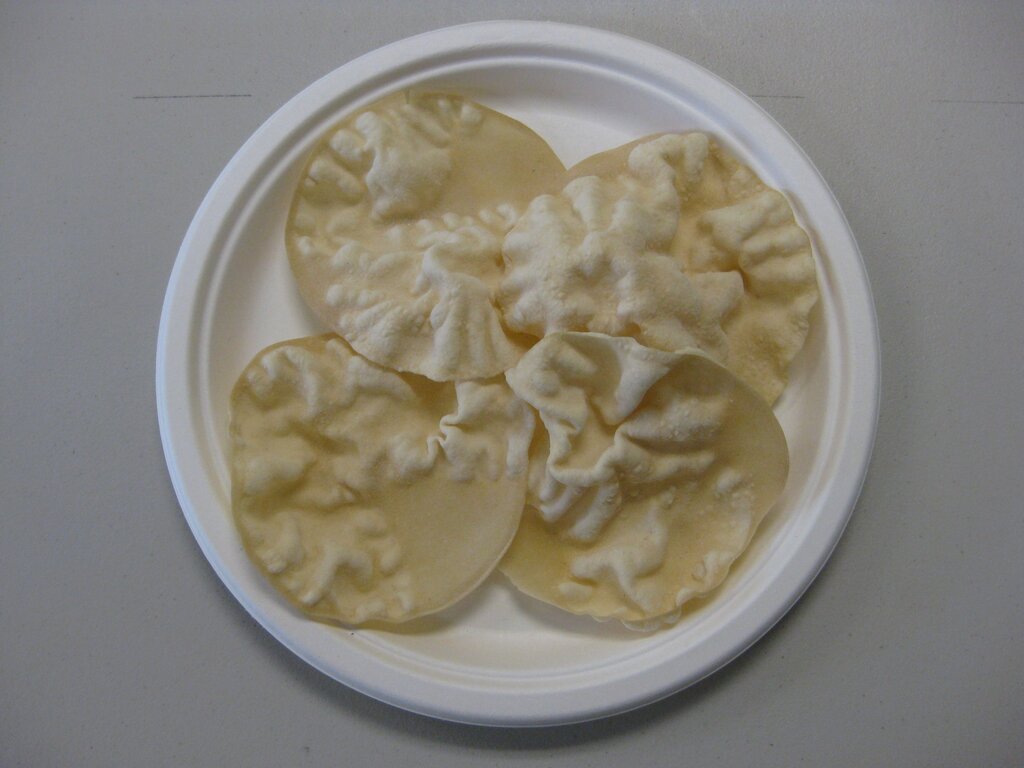 Microwave #5: This microwave has adequate power, but an absolutely baffling radiation pattern. Even though it has a rotating tray, there are two angular sections that are still plasticky raw. How can this happen? Our guess: the rotating tray is driven by a synchronous motor, while the magnetron is driven in pulses that are several seconds long. The resulting beat frequency shows up on your crackers. Consider this microwave a good candidate for firmware replacement.
Microwave #1 is clearly the worst of the bunch. One tiny warm spot in the center, and a narrow ring of mediocrity around it. Did you know that if you take apart microwave ovens, there is a really great ceramic magnet inside of the magnetron? And when we’re shopping for our next microwave, where can we go with our stack of appalams to try out prospective replacements?
Microwave #5: This microwave has adequate power, but an absolutely baffling radiation pattern. Even though it has a rotating tray, there are two angular sections that are still plasticky raw. How can this happen? Our guess: the rotating tray is driven by a synchronous motor, while the magnetron is driven in pulses that are several seconds long. The resulting beat frequency shows up on your crackers. Consider this microwave a good candidate for firmware replacement.
Microwave #1 is clearly the worst of the bunch. One tiny warm spot in the center, and a narrow ring of mediocrity around it. Did you know that if you take apart microwave ovens, there is a really great ceramic magnet inside of the magnetron? And when we’re shopping for our next microwave, where can we go with our stack of appalams to try out prospective replacements?
One nice thing about this testing method: the cooked portion of the output makes for a great snack. Serve with chutney, pickles or other preserves.

But does power distribution depend on what is inside a microwave?
As far as I know, microwaves send electromagnetic radiation at 2.45GHz into a fan, which redirects the rays randomly towards the food. This can then reflect off the metal interior of the microwave towards the food if it doesn’t hit the first time. You might be able to change the speed of the fan with a resistor to get a more random result.
WTB Fan capable of blowing photons in random directions.
In all seriousness, the fan is there to cool the magnetron.
While photons aren’t “blown” around, there is a kernel of accuracy there.
The magnetron often does point at (or through) a fan with metal blades in the top of the microwave, called the “mode stirrer.” It serves to “randomize” the direction of the microwaves, and hopefully reduce the effect of standing waves in the microwave cavity.
See here for an illustration.
Windell H. Oskay
drwho(at)evilmadscientist.com
http://www.evilmadscientist.com/
This is fascinating. To get a full picture though, what happens if you elevate the plate 1, 2, or 3 inches? Does it matter if the support is solid or not?
Nice visual aids :)
This reminds me of experiments that measure the Speed of Light using a microwave oven and a bar of chocolate (or mini marshmallows). That experiment also depends on finding the hot spots due to constructive interference of the waves.
A link for the speed of light & marshmallow experiment is here: http://www.physics.umd.edu/icpe/newsletters/n34/marshmal.htm
Rather than putting things in the direct center of the microwave, what happens if you put them on the turntable off-center and then run the turntable while cooking?
Simple geometry: the pattern will look the same, but it won’t be centered on the center of the plate. E.g., the "hot spot" formerly in the center of the plate will be shifted by an inch in one direction if the plate was placed with its center an inch away from the center of the rotating disc.
It would also be interesting to disable the turntable, to see what the pattern is without any plate rotation.
How about stacking them many layers deep so you can try to see a 3D path of the radiation?
That’s an awesome idea!
Windell H. Oskay
drwho(at)evilmadscientist.com
http://www.evilmadscientist.com/
Maybe use some of your old Lexan scrap to make corner legs to hold a tray above the turntable, so you can combine this with the "skip the rotating" idea above…
I think I am, therefore I am… I think
So, bringing these to the store when buying a microwave is clearly necessary… wonder how the sales people are going to feel about that? Someone who knows someone at Consumer’s Reports should send them a link to this post, they need to be doing this testing for us :-D
Wow really nice way to ilistrate this, however I don’t thinkyou have two hot spots being draged in a circle, when I look at these images they seam to be the result of standing waves. Microwave #5 appears to be multinodal. I would love to see a fallow up post with images without the house induced by the rotation of the plate.
All of these microwaves have turntables– even where there is a standing wave pattern, it is still being dragged in a circle, as we visualize it here.
Windell H. Oskay
drwho(at)evilmadscientist.com
http://www.evilmadscientist.com/
For better results in microwave pattern research, the attentive reader recommends the use of thermopaper. Have fun!
rotfl
A cheap microwave with a rotating plate has a very simple distribution pattern. If the item has a very low moisture content then it becomes clear. Now what I used to do for the very expensive microwaves to test the distribution patter is to take 20 -24 mini marshmallows and place them on a piece of wax paper that covers the entire bottom of the microwave. Heat for say 45 seconds I think and then remove the wax paper. The marshmallows will stay on the wax paper and on the bottom you can see which are brown and which are not. This will tell you how well the microwaves are distributed. This will work to a limited degree with a rotating plate microwave.
What a waste of marshmellows.
SCNR. ;-)
I thought microwaves heated by exciting water molecules. Thermo-paper doesn’t have any moisture, so I think it wouldn’t work. It’s worth a try though.
Well, a damp piece of thermal fax paper should do the trick.
The widely-reported water molecule resonant frequency thing is incorrect. The oscillating field created by the microwaves tends to yank most kinds of molecules around to some extent. With some molecules the energy transfer is much efficient than with others. There are many water-free substances that will still get very hot in a microwave.
This is a way of measuring the speed of light. Take your poppadoms or similar, measure the distance between them and multiply by two (to get the wavelength) then get the frequency of your microwave from the plate at the back. Multiply all together in consistent units and there you are – the speed of light.
Not related to the science, but if you apply a little oil to them they cook a lot better, regardless of the oven. I find that 20sec completely cooks them if they’ve been coated with oil. You don’t need much, just a teaspoon or so’s worth, then spread it over them.
If you have a Maytag store in your area, they let you test their appliances out in the store.
Sorry to go all non-engineery on you, but the results are quite visually pleasing too.
Very cool article.
I have tried this and not only does it work really well, as has been mentioned visually it looks great.