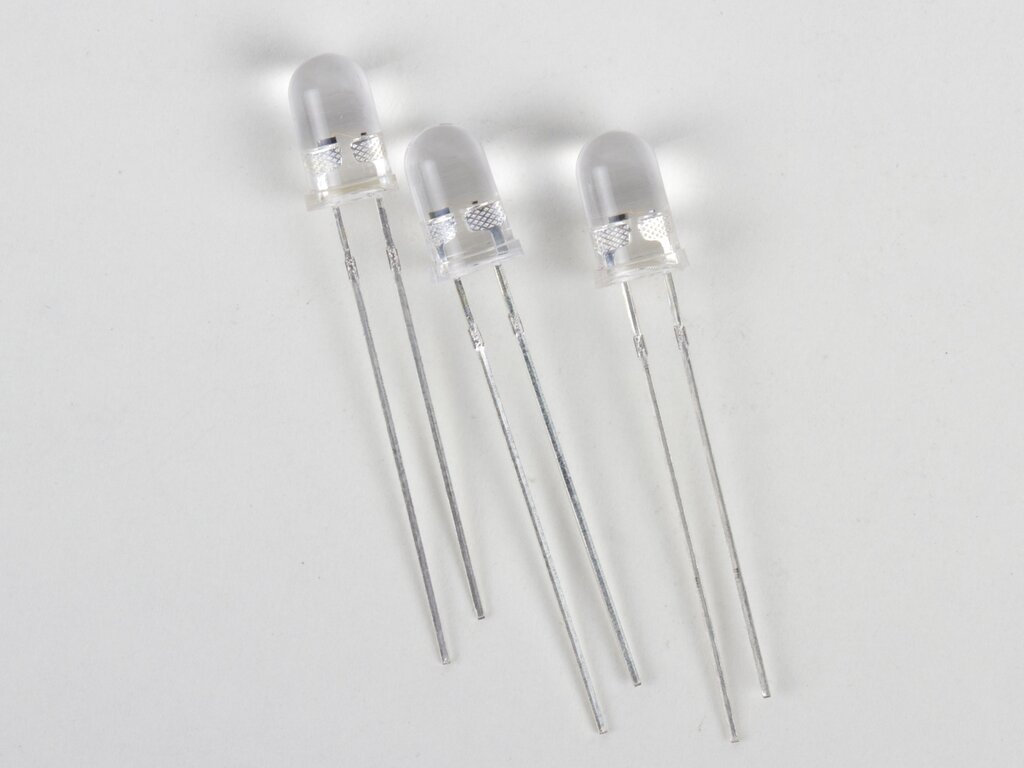
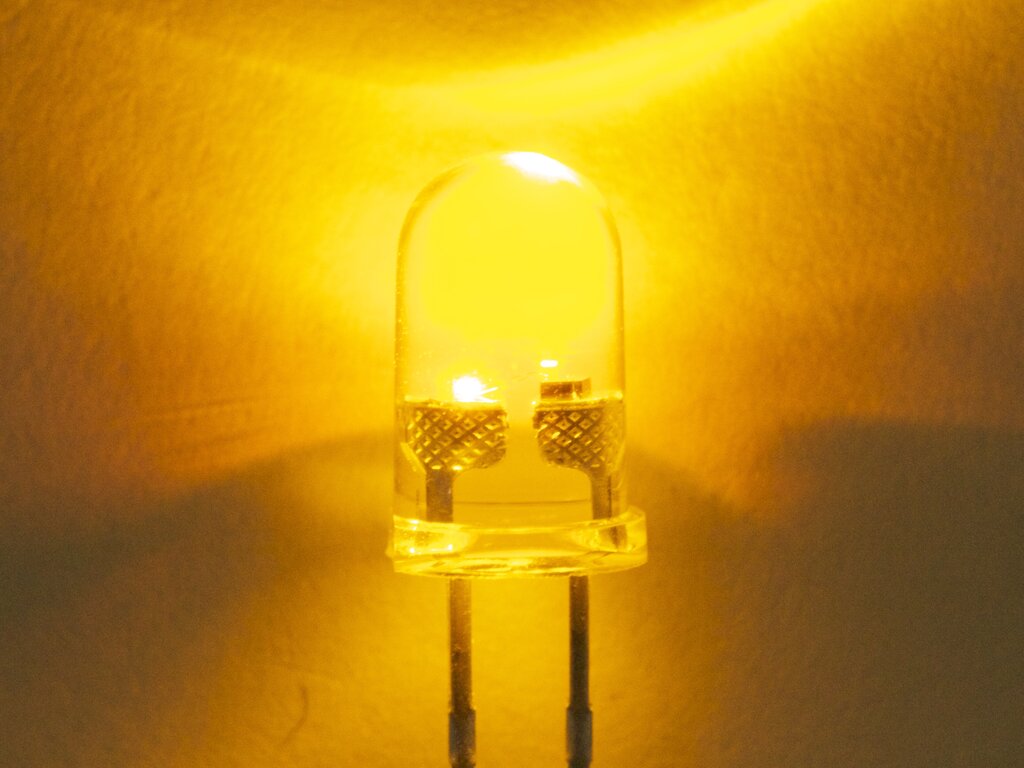
At first glance, these might appear to be normal 5 mm (“T-1 3/4”) clear lens ultrabright yellow LEDs. However, they’re actually “candle flicker” LEDs— self-flickering LEDs with a built-in flicker circuit that emulates the seemingly-random behavior of a candle flame.
In the close-up photo above, you can actually make out the glowing LED die on the left side, and a corresponding-but-not-glowing block on the right: the flicker circuit itself. In what follows, we’ll take a much closer look, and even use that little flicker chip to drive larger circuitry.
Tracing the bonds
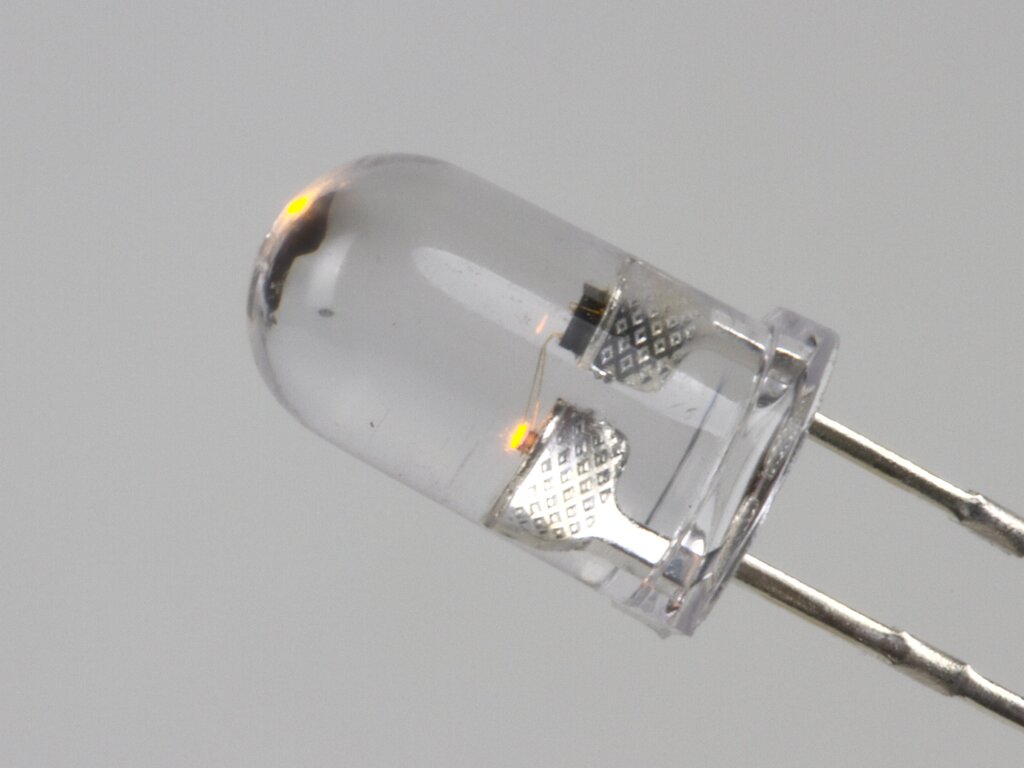
With the LED turned down, we can start to see things a little more clearly. The glowing LED die is still visible on the left, and on the right is the little integrated circuit (chip) that controls the flickering.
There are three gold wire bonds clearly visible. One goes from the top of the chip to the anode (right) leg of the LED package. Two other wire bonds span the two legs of the LED package: one goes from the flicker chip to the LED die, and the other goes from the flicker chip to the cathode (left) leg of the LED package.
There may also be a fourth wire bond, less visible, from the LED die to the cathode.
(You can view this image larger here.)
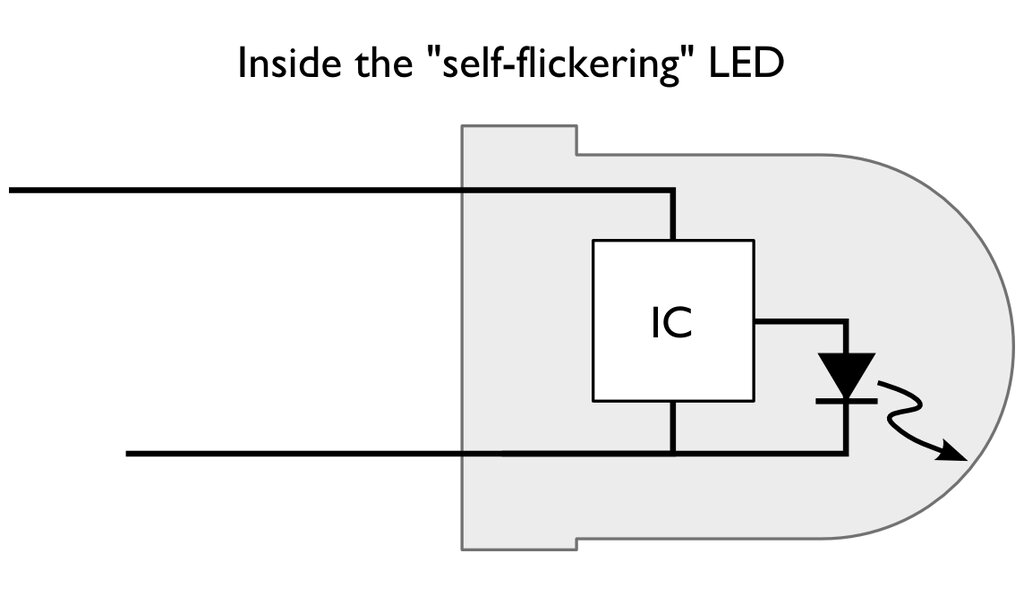
The arrangement of the wiring leads to a clear picture of what’s going on in that little LED package:
The “flicker” integrated circuit connects to both the anode and cathode legs of the LED to provide its power supply. Its output goes to the anode of the LED die itself, and the other side of that LED die is connected to the cathode leg of the LED. The flicker IC contains both the logic for the flickering and some kind of switch that is able to turn the LED element on and off.
The presence of the flicker chip has remarkably little effect on the electrical characteristics of the LED besides the flickering. The forward voltage and current are similar to a yellow LED without the chip, and the LED still works down to microamps of current– still flickering, just dimmer. This suggests that the chip may contain some sort of charge-pump power supply that allows it to work at a wide range of input voltages, and also that its output switch is very efficient.
Through the lens
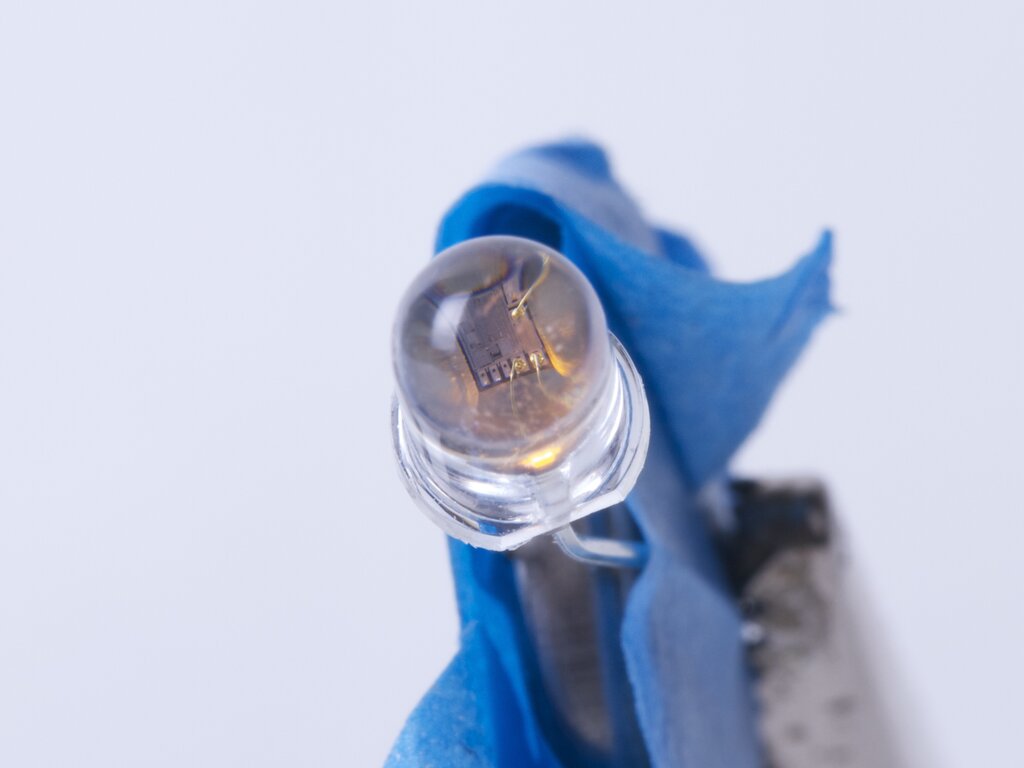
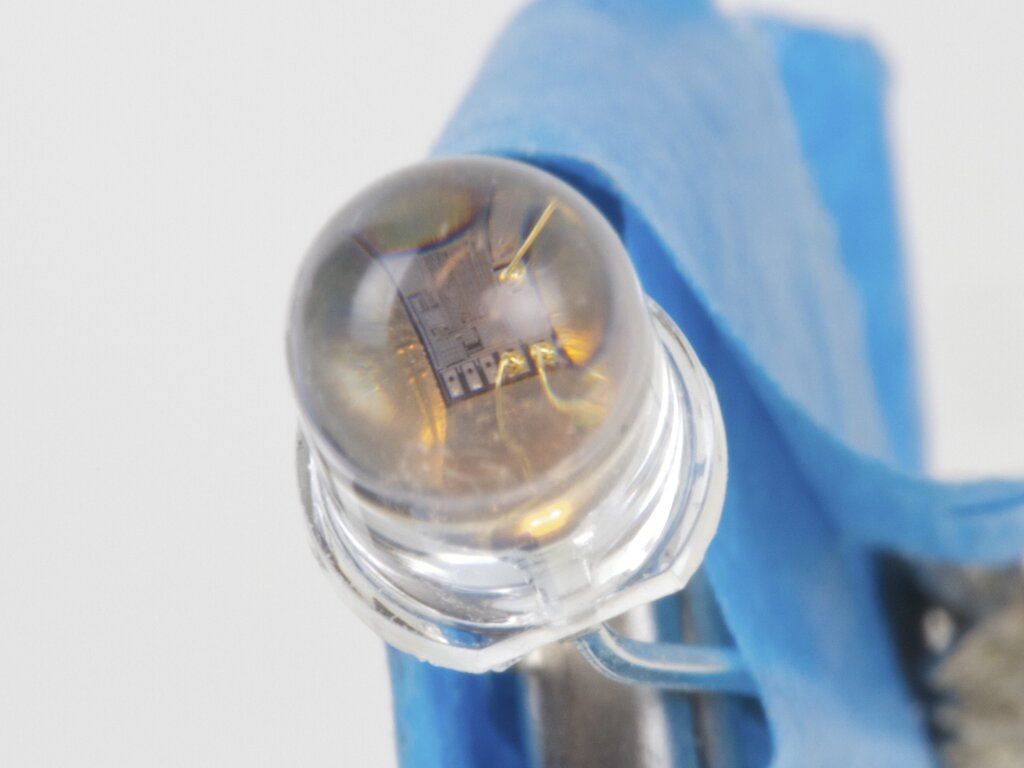
Looking down into the barrel of the LED (at an angle), you can actually use the LED’s lens as a magnifying glass to look at the flicker chip itself. Previously, we’ve used this kind of technique to take a close-up look at LEDs.
From the top here, the flicker-chip surface is clearly visible, as are the three gold wire bonds.
One curious thing: it looks like there are additional unbonded pads on the chip. It’s not obvious what those are for, but here’s a guess: This little “candle flicker” chip has other functions as well, which could be selected by hooking up a wire bond to one of those other pads. Perhaps this chip is also used (for example) in simple “self blinking” LEDs that flash at a steady rate.
There is an interesting consequence of the way that the flicker chip works. There are only two leads, and when the LED is turned on or off, the total current through the legs of the LED is switched as well. This means that– even ignoring the yellow light coming out –we have an unusual electronic component that produces a seemingly-random sequence of currents when voltage is applied. We can use that current to control other circuitry.
A 1 Watt Candle-Flicker LED
The flickering current produced by the little yellow LED can be used to drive the base of a transistor, to switch a larger current. Here, we use a transistor to amplify that current, and drive a 1-watt white LED.
Here’s how it looks. The “2 ohm” resistor from the circuit diagram has been improvised with some 10 ohm resistors in parallel.
And here it is, all lit up. (Need video? Scroll down a paragraph or two!)
Several of these– with high power red, orange and yellow (and maybe blue) LEDs might combine to make a pretty nice LED fireplace.
Circuit bending the single LED
Finally, whatever you hook up to the transistor doesn’t need to be another LED. What if you drove a speaker, for example? In our video, embedded here, we show off the high-power blinking LED and also hook up a little magnetic speaker to see what our candle LEDs really sound like.
I am not sure what you mean by "says" but there is definitely order behind the flickering :-D
You could achieve the same effect by writing a pseudorandom number generator (http://en.wikipedia.org/wiki/Linear_feedback_shift_register) with a little bit of low pass filtering in the output (either digitally, for example a moving average filter or even more quickly with a suitable RC in the output).
So, yes, it would be interesting to obtain the LED’s output for a really long time (say 5 minutes) and then check how often does the waveform repeats itself to infer from that, which polyonym does their number generator uses! :-D
Where did you guys found the actual device though? I can’t seem to find any supplier in the UK :-(
I was about to suggest the LFSR idea, too, but you beat me to it. What may be interesting is to monitor the output (e.g., phototransistor, current probe, etc.), and try to determine how many bits are in the LFSR, if that is what it is. Might also be interesting to see what the frequency of the driving circuit is, too.
I tried several variations of yellow, yellow and red, multiple yellow to get a pleasing flicker in the garden lights, and the best is a single yellow. I’m really glad I found this method of driving a higher power LED, will be trying to boost the brightness of the garden lights.
Interestingly, several of the multiple LED setups I tried stopped working after a few weeks. I don’t know if the extra pulsed power loading on the solar lights existing circuit killed the LED’s through overvoltage, or killed the circuitry.
Cheers,
Phil
Curse you, Windell! I haven’t even assembled my Interactive LED Panels yet, and now you throw the possibility of a full-bore LED fireplace around? Where will I find the time and money for all of these projects rattling around in my head?!? ;)
However, +1,000 cool factor! :)
There are also LED tealights with a standard LED and a chip on board driver (black blob on the circuit board). At least the ones I got in my hands made noise too, in fact they played a melody that sounded a bit chinese. The speaker (piezo disc in that case) was put on instead of the LED.
Maybe it’s the same with your LEDs, if you take the flickering through an phototransistor and turn it into sound. The current through the LED and the IC might be different.
I wonder if the chip is the same one used in those RGB "self changing" lights? And if so I wonder which one came first…
Could certainly be a similar chip if not this same one. I’d really like to get in there and see what the other pads on that chip do.
A good place to start might be finding out what kind of plastic the lens is made out of. To the dismay of many, acetone as found in some cleaners is pretty good at eating away plastics, especially ABS.
That’s what I was thinking. I have a RGB led which just blinks colors sequentially, then blends them gradually. I’ve noticed you have 5 pads on one side of the chip, being two used (yellow die + IC ground), while my led just have 4 pads, all being used (RGB dies + IC ground).
Now I was just thinking if is there any chance these chips are actually MCUs instead of ASICs. Would make much more sense to make a huge batch of mcus and use them on all kinds of blinking leds, instead of a different batch of asics for each different effect wanted on a led. Surely they would still have to program the MCUs, so maybe the ASIC could be a cheaper and quicker method after all. If this is a mcu after all, I believe it would make more sense for them to drive and program the mcu through the same leads used to power the led – which means we might be able to do so, with a proper square wave or current signaling. Just imagine the possibilities if these little chips are actually driven by MCUs. It blows my mind.
I got one out – looks to be intact. Lost the thin wire connections (perhaps obviously) but you can still see three bristles on the surface where they were so the surface seems unscathed.
Capsule is epoxy, which as a cross-linked polymer is not really soluble in anything and doesn’t melt below its decomposition temperature. However, it does become quite brittle in dichloromethane. Method was to grind down as close as you dare, then soak for a few hours in DCM & chip gradually closer to the, erm, chip. Finally once you are as close as you dare, a long soak and the last of the resin falls away.
My issue now is that I can barely see the chip, far less solder to it so I’ve learned little from this exercise.
Want to have a go at it Wendel? Let me know where & I’ll post it to you.
Ugi
Please excuse typo above.
At last, a source for these flickering LEDs! Very difficult to find a source without buying >10000x at a time directly from China. I’ve been resorting to buying dollar store tea lights and disassembling them to get the component out.
RGB leds make funny sounds too. Several years ago I made an musical artbot that uses a trio of RGB leds. I called them "The Singing RGBs" and was shown at Robogames 2005. http://home.comcast.net/~botronics/index.html#rgb
LOL My ears are bleeding!
Connect a speaker to the chip itself instead of a led. Someone did this once and the chip played Happy Birthday to You. So the chip was really one of those greeting card music generators.
I did this in reverse with a card playing a sample (also some kind of happy birthday sample) thinking it might make an ok flickering LED. Or.. something – I really had no particular expectation either way just ripped the circuit out of a card someone gotten and had an LED laying around (clearly from China, IC direct on board with an epoxy blob, a CR2032 and a few surface mount transistors/resistors to drive a small membrane speaker). It didn’t look natural in the slightest, mostly semi-lighted states changing now and then with a quick flicker over it (looking very obviously like someone playing a data stream into an LED). I could imagine tone generators might work better though, especially if it’s not that picky. Don’t think it’d look as uneven as this circuit.
Great video — very interesting observation.
So it is entirely in the realm of possibility to have a normal looking two lead led with a chip inside that detects when a person touches the led… or an led that sends and receives packets to other like minded leds… or a three color led that reads a digital signal….
Neat!
Yes, it leads to *all sorts* of interesting possibilities. :)
shine a laser on the IC inside the laser. I bet it will change how the laser behaves.
I did this to a blinking green LED from radioshack with a ~5mw red laser
The flickering IC wouldn’t need a charge pump. I’ve tested 74HCxx and other CMOS chips at low voltages. The basic logic chips still work down to ~0.8v and are able to source a few micro amps while still switching pretty fast. I’ve taken the Parallax Propeller down to 0.9v on it’s internal slow clock. It retained memory contents and I assume it was still running. At 1.1v was the lowest I could get output from the pins. About 1.45v was the lowest I could get it to boot from an EEPROM. (I’m pretty sure this is a limit of the EEPROM) Given this, the ~1.4v across the LED would be plenty for the flickering chip.
One thing to be careful of is the power on reset circuit, it seems to arm below about 1.4 volts, and fires if the power supply voltage raises quickly.
Do you know of any other transistors that would work to produce this effect? I’m interested in making three to five banks of LEDs run in this manner to create a glowing ember effect for an indoor fireplace.
The transistor does not control the flickering, the LED does. Just about any transistor type (that can handle the current) will work, with an appropriate design of transistor switching circuit.
The "620" in the diagram above does not specify Ohms or ?
what would the restistor values for 12V power source?
It does depend a little on the qualities of your LEDs but roughly:
Assuming the flickering LED has a forward voltage around 2.5V you would want 1-2K to limit the current through that to around 5-10 mA.
Assuming the 1W LED drops around 3.5V and takes 300mA you would want around 10 Ohms for that. YMMV
PS remember that you are taking about 3W of power off using the 10 Ohm resistor so you will need on (or a cluster of them) with a suitable power rating. A 1/4 W resistor is not going to cut it.



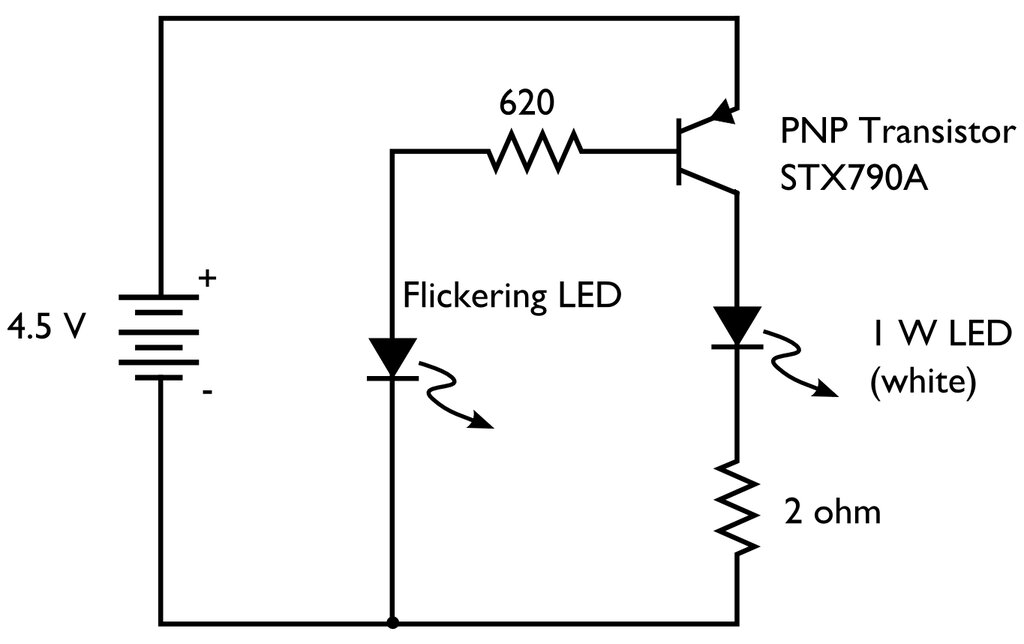 The flickering current produced by the little yellow LED can be used to drive the base of a transistor, to switch a larger current. Here, we use a transistor to amplify that current, and drive a 1-watt white LED.
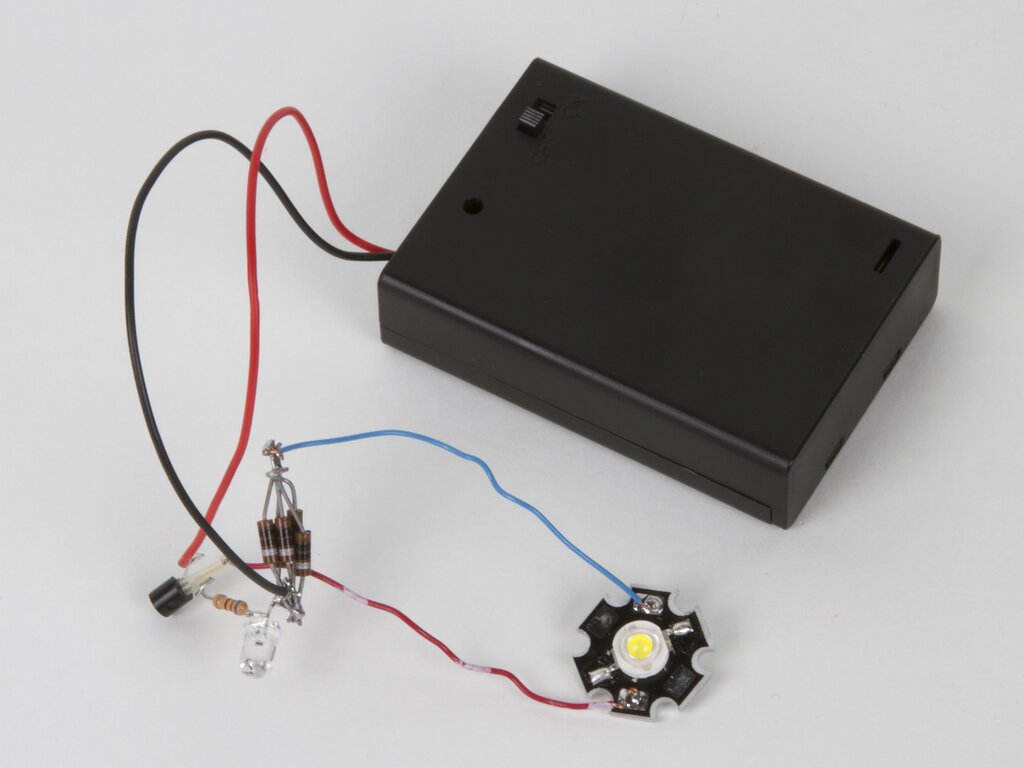 Here’s how it looks. The “2 ohm” resistor from the circuit diagram has been improvised with some 10 ohm resistors in parallel.
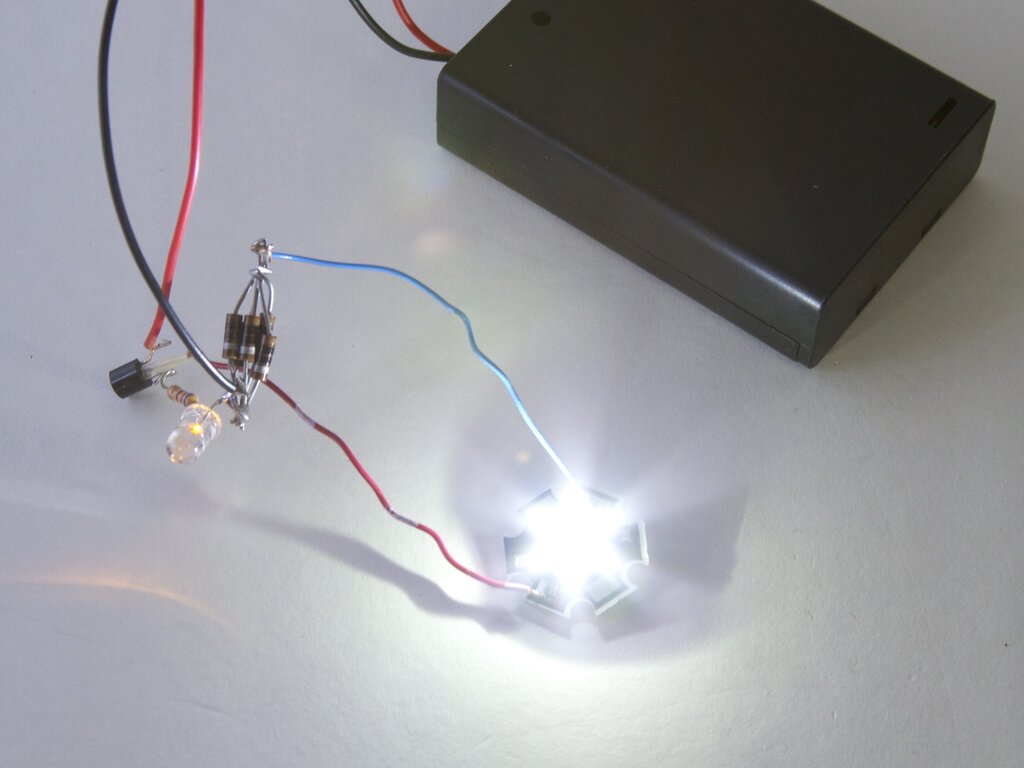 And here it is, all lit up. (Need video? Scroll down a paragraph or two!)
Several of these– with high power red, orange and yellow (and maybe blue) LEDs might combine to make a pretty nice LED fireplace.
And here it is, all lit up. (Need video? Scroll down a paragraph or two!)
Several of these– with high power red, orange and yellow (and maybe blue) LEDs might combine to make a pretty nice LED fireplace.

I wonder if it *says* anything. do the output values read back as anything if you measure them on an arduino input pin?
Interesting idea. I haven’t looked at the pattern on a DSO yet, but it should be immediately obvious if there’s data in standard formats.
Windell H. Oskay
drwho(at)evilmadscientist.com
http://www.evilmadscientist.com/
I am not sure what you mean by "says" but there is definitely order behind the flickering :-D
You could achieve the same effect by writing a pseudorandom number generator (http://en.wikipedia.org/wiki/Linear_feedback_shift_register) with a little bit of low pass filtering in the output (either digitally, for example a moving average filter or even more quickly with a suitable RC in the output).
So, yes, it would be interesting to obtain the LED’s output for a really long time (say 5 minutes) and then check how often does the waveform repeats itself to infer from that, which polyonym does their number generator uses! :-D
Where did you guys found the actual device though? I can’t seem to find any supplier in the UK :-(
I was about to suggest the LFSR idea, too, but you beat me to it. What may be interesting is to monitor the output (e.g., phototransistor, current probe, etc.), and try to determine how many bits are in the LFSR, if that is what it is. Might also be interesting to see what the frequency of the driving circuit is, too.
Dave
eBay seller ‘narkuk’ has 3mm yellow or red flickering LEDs, I bought some a few months ago to put in my solar garden lights.
http://www.ebay.co.uk/itm/10-Random-Flickering-LEDs-3mm-3V-Bright-Yellow-/200661049517
this auction finished today, but I’m sure he’ll put some more up soon.
I tried several variations of yellow, yellow and red, multiple yellow to get a pleasing flicker in the garden lights, and the best is a single yellow. I’m really glad I found this method of driving a higher power LED, will be trying to boost the brightness of the garden lights.
Interestingly, several of the multiple LED setups I tried stopped working after a few weeks. I don’t know if the extra pulsed power loading on the solar lights existing circuit killed the LED’s through overvoltage, or killed the circuitry.
Cheers,
Phil
http://www.ebay.co.uk/itm/10-Random-Flickering-LEDs-3mm-3V-Bright-Yellow-/200673387255
New auction running now.
Cheers,
Phil
Curse you, Windell! I haven’t even assembled my Interactive LED Panels yet, and now you throw the possibility of a full-bore LED fireplace around? Where will I find the time and money for all of these projects rattling around in my head?!? ;)
However, +1,000 cool factor! :)
There are also LED tealights with a standard LED and a chip on board driver (black blob on the circuit board). At least the ones I got in my hands made noise too, in fact they played a melody that sounded a bit chinese. The speaker (piezo disc in that case) was put on instead of the LED.
Maybe it’s the same with your LEDs, if you take the flickering through an phototransistor and turn it into sound. The current through the LED and the IC might be different.
I wonder if the chip is the same one used in those RGB "self changing" lights? And if so I wonder which one came first…
Could certainly be a similar chip if not this same one. I’d really like to get in there and see what the other pads on that chip do.
Windell H. Oskay
drwho(at)evilmadscientist.com
http://www.evilmadscientist.com/
Ok, so how do you remove the epoxy? RFNA (Red Fuming Nitric Acid)? Mechanical machining? Something else?
Dave
This I don’t know. Certainly could try a few. I just don’t want to damage the chip when we do so…
Windell H. Oskay
drwho(at)evilmadscientist.com
http://www.evilmadscientist.com/
A good place to start might be finding out what kind of plastic the lens is made out of. To the dismay of many, acetone as found in some cleaners is pretty good at eating away plastics, especially ABS.
That’s what I was thinking. I have a RGB led which just blinks colors sequentially, then blends them gradually. I’ve noticed you have 5 pads on one side of the chip, being two used (yellow die + IC ground), while my led just have 4 pads, all being used (RGB dies + IC ground).
Now I was just thinking if is there any chance these chips are actually MCUs instead of ASICs. Would make much more sense to make a huge batch of mcus and use them on all kinds of blinking leds, instead of a different batch of asics for each different effect wanted on a led. Surely they would still have to program the MCUs, so maybe the ASIC could be a cheaper and quicker method after all. If this is a mcu after all, I believe it would make more sense for them to drive and program the mcu through the same leads used to power the led – which means we might be able to do so, with a proper square wave or current signaling. Just imagine the possibilities if these little chips are actually driven by MCUs. It blows my mind.
I got one out – looks to be intact. Lost the thin wire connections (perhaps obviously) but you can still see three bristles on the surface where they were so the surface seems unscathed.
Capsule is epoxy, which as a cross-linked polymer is not really soluble in anything and doesn’t melt below its decomposition temperature. However, it does become quite brittle in dichloromethane. Method was to grind down as close as you dare, then soak for a few hours in DCM & chip gradually closer to the, erm, chip. Finally once you are as close as you dare, a long soak and the last of the resin falls away.
My issue now is that I can barely see the chip, far less solder to it so I’ve learned little from this exercise.
Want to have a go at it Wendel? Let me know where & I’ll post it to you.
Ugi
Please excuse typo above.
At last, a source for these flickering LEDs! Very difficult to find a source without buying >10000x at a time directly from China. I’ve been resorting to buying dollar store tea lights and disassembling them to get the component out.
RGB leds make funny sounds too. Several years ago I made an musical artbot that uses a trio of RGB leds. I called them "The Singing RGBs" and was shown at Robogames 2005. http://home.comcast.net/~botronics/index.html#rgb
LOL My ears are bleeding!
Connect a speaker to the chip itself instead of a led. Someone did this once and the chip played Happy Birthday to You. So the chip was really one of those greeting card music generators.
We did so in the video; no obvious music here.
Windell H. Oskay
drwho(at)evilmadscientist.com
http://www.evilmadscientist.com/
I did this in reverse with a card playing a sample (also some kind of happy birthday sample) thinking it might make an ok flickering LED. Or.. something – I really had no particular expectation either way just ripped the circuit out of a card someone gotten and had an LED laying around (clearly from China, IC direct on board with an epoxy blob, a CR2032 and a few surface mount transistors/resistors to drive a small membrane speaker). It didn’t look natural in the slightest, mostly semi-lighted states changing now and then with a quick flicker over it (looking very obviously like someone playing a data stream into an LED). I could imagine tone generators might work better though, especially if it’s not that picky. Don’t think it’d look as uneven as this circuit.
Great video — very interesting observation.
So it is entirely in the realm of possibility to have a normal looking two lead led with a chip inside that detects when a person touches the led… or an led that sends and receives packets to other like minded leds… or a three color led that reads a digital signal….
Neat!
Yes, it leads to *all sorts* of interesting possibilities. :)
Windell H. Oskay
drwho(at)evilmadscientist.com
http://www.evilmadscientist.com/
shine a laser on the IC inside the laser. I bet it will change how the laser behaves.
I did this to a blinking green LED from radioshack with a ~5mw red laser
The flickering IC wouldn’t need a charge pump. I’ve tested 74HCxx and other CMOS chips at low voltages. The basic logic chips still work down to ~0.8v and are able to source a few micro amps while still switching pretty fast. I’ve taken the Parallax Propeller down to 0.9v on it’s internal slow clock. It retained memory contents and I assume it was still running. At 1.1v was the lowest I could get output from the pins. About 1.45v was the lowest I could get it to boot from an EEPROM. (I’m pretty sure this is a limit of the EEPROM) Given this, the ~1.4v across the LED would be plenty for the flickering chip.
One thing to be careful of is the power on reset circuit, it seems to arm below about 1.4 volts, and fires if the power supply voltage raises quickly.
Do you know of any other transistors that would work to produce this effect? I’m interested in making three to five banks of LEDs run in this manner to create a glowing ember effect for an indoor fireplace.
The transistor does not control the flickering, the LED does. Just about any transistor type (that can handle the current) will work, with an appropriate design of transistor switching circuit.
Windell H. Oskay
drwho(at)evilmadscientist.com
http://www.evilmadscientist.com/
The "620" in the diagram above does not specify Ohms or ?
what would the restistor values for 12V power source?
It does depend a little on the qualities of your LEDs but roughly:
Assuming the flickering LED has a forward voltage around 2.5V you would want 1-2K to limit the current through that to around 5-10 mA.
Assuming the 1W LED drops around 3.5V and takes 300mA you would want around 10 Ohms for that. YMMV
PS remember that you are taking about 3W of power off using the 10 Ohm resistor so you will need on (or a cluster of them) with a suitable power rating. A 1/4 W resistor is not going to cut it.