



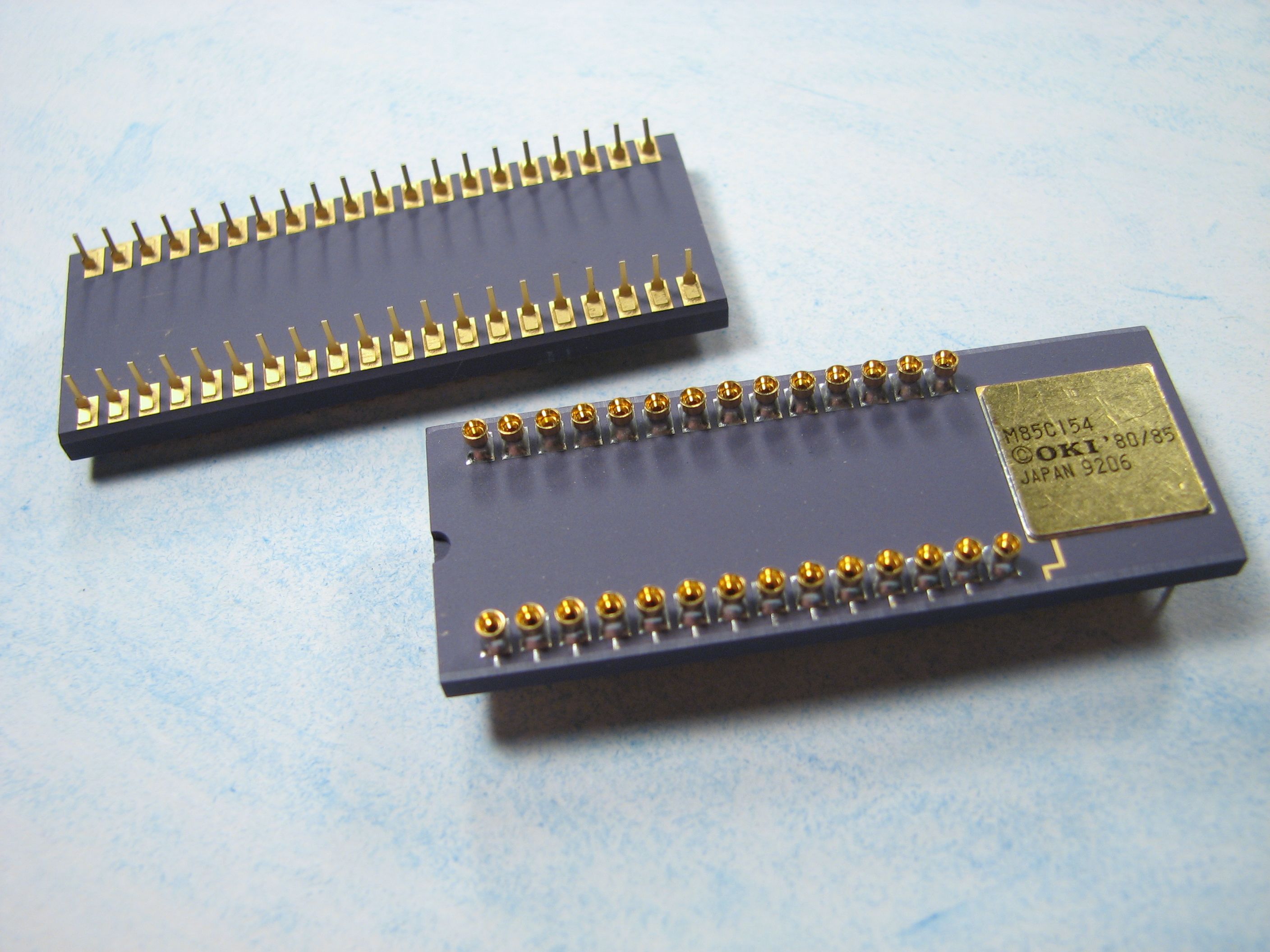
Check out these neat chips that I picked up at a Silicon Valley junk shop.
They’ve got pins on the bottom and a socket on top. Wait– what?!?
Ever seen anything like it? Me neither. (Or, if you have, let’s hear your story in the comments!)
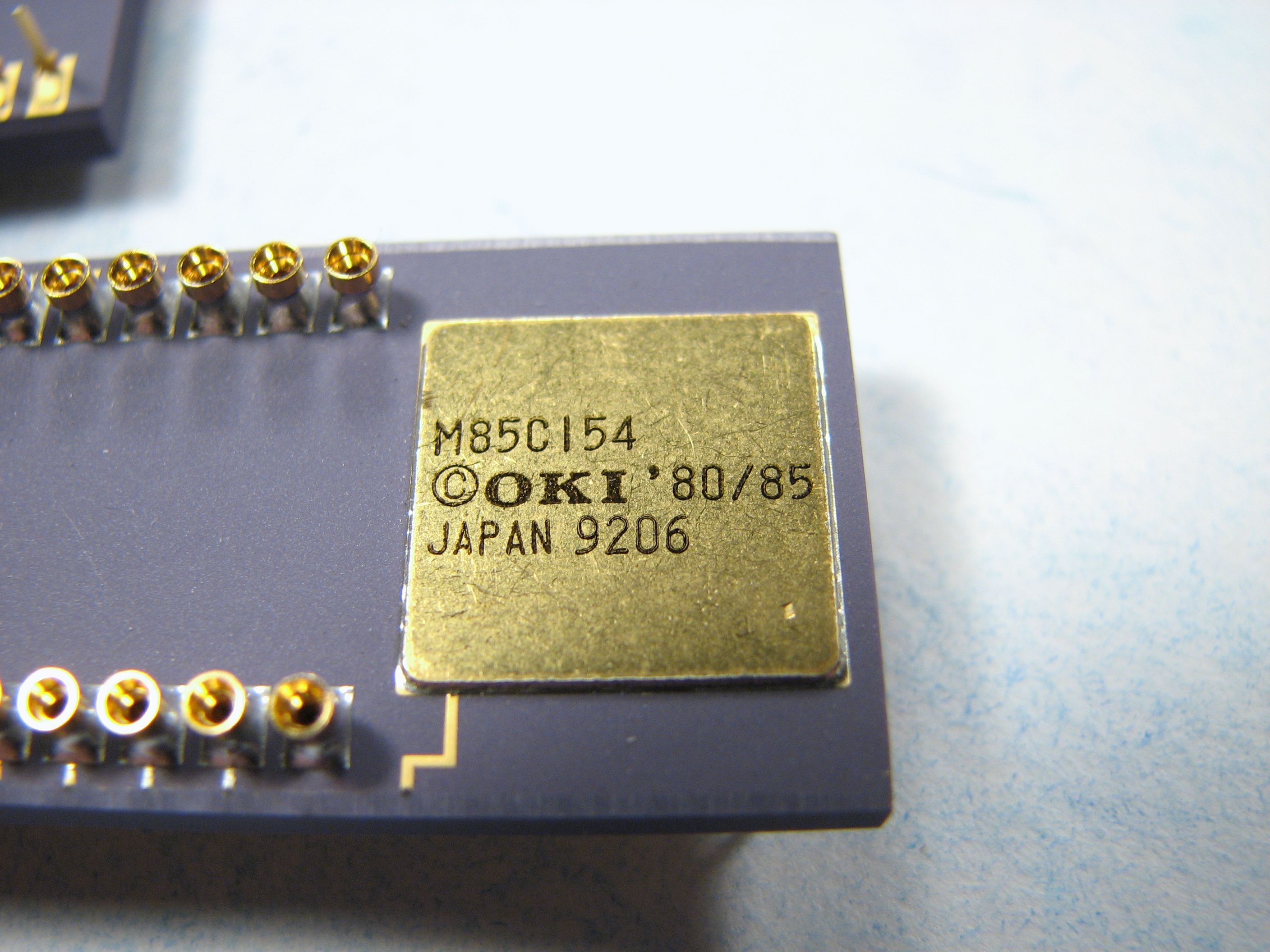
This IC is an M85C154 from OKI. While it’s an “old” device (old in computer years), you can still find the datasheet from various sources of varying mediocrity.
The M85C154 is an 8-bit microcontroller in a “piggyback” package that allows you to add an external 16 kB EPROM memory chip to store the program memory for the chip. This was never a real mass production device, but rather an tool to help engineers try out new microcontroller programs without using up a chip each time.
Here is how it would work: An engineer would write a program on their computer, write it onto the EPROM, plug that into the piggyback socket of the microcontroller, and test it out. To change the program on the chip, the EPROM would be removed, erased, and reprogrammed. (Erasing these is actually an annoying process– so most often a pile of blank EPROM chips would be used, and all erased as a batch at some point.) After everything was working well, the program could be instead written directly into “production” microcontrollers that have integrated write-once memory but no socket.
While this device is only fifteen years old (and they were made at least as recently as 1998), it is still a relic because new-generation microcontrollers use integrated “flash” memory that can be reprogrammed over and over again without much difficulty. Still, it’s a neat find, and an unusual looking chip.

> picked up at a Silicon Valley junk shop.
Which one? Enquiring minds would like to know!
It was at the HSC annual sale. (I didn’t want to refer to HSC as a junk shop– it isn’t in general and we like it a lot– but some parts of their annual sale certainly amount to that.)
—
Windell H. Oskay
drwho(at)evilmadscientist.com
http://www.evilmadscientist.com/
A company called Parallax currently makes a chip that has the piggyback functionality, similar to the chip you found, thought used for a different purpose. They currently still make and sell it.
Parallax – PWMPAL
That’s not a chip– that’s a module on a printed circuit board. There are countless examples of circuit boards that take plugins on top– including the motherboard in every desktop (and almost every laptop) computer.
—
Windell H. Oskay
drwho(at)evilmadscientist.com
http://www.evilmadscientist.com/
Hey there…
I’ve seen this sort of stuff several times before… in Ampex VTR’s, ADO’s, switchers, BTS CG’s, and some Abacus disk recorders A55, A66, etc… as you said I’ve seen them mostly as RAM, but also battery backup static rams and some dallas RTC’s… The GOOD ‘ole days of BIG IRON!!!
Fun stuff indeed… until you have to fix it on a deadline… I use to fix this stuff in a Video Post production house, and currently work for a broadcaster in Toronto Canada…
Dan (t e k v a x @ g m a i l . c o m )
8 Bit processor chip with piggyback (for ROM presumbably):
http://pdf1.alldatasheet.com/datasheet-pdf/view/11409/OKI/MSM85C154HVS.html
It is a bond-out microcontroller. The bottom row of pins are set up just like the production microcontroller, the top pins are connections that the microcontroller otherwise wouldn’t have and are used for development.
Probably control/address/data lines suitable for a ROM chip or a rom emulator device. These were high $$ low-production qty parts used for development. When the ROM code was developed, then the production version of the micro was made either as OTP ROM, or as a mask ROM.
The ROM that is plugged in the top is the ROM that the production microcontroller (without the top pins) would have inside it.
I take it you only read the intro to the article and skipped the body?
—
Windell H. Oskay
drwho(at)evilmadscientist.com
http://www.evilmadscientist.com/
Sorry to have repeated the description. I didn’t see all of this page’s text.
I used Zilog Z8 versions of this device with a "ROMulator". The ROM emulator could load serially from the PC in just seconds. Much better than the EEPROM erase process. That setup was very much like using an ISP/ICP today.
Cool!
If I understand correctly, the ROMulator was basically an in-circuit emulator that plugged right into a piggyback port on the chip? I might have to go find some pictures….
—
Windell H. Oskay
drwho(at)evilmadscientist.com
http://www.evilmadscientist.com/
Something like this, Windell:
http://www.hondata.com/romulator.html
I used it for piggy-back bond-out chips like this, and for equipment built with Zilog Z80s (microprocessor) and with microcontrollers that had address/data lines. I still have it _somewhere_. *looks at piles and piles of stuff*
The setup that I had costs lots of $$ and is was still less than a full emulator. Now a $2 AVR and a $5 cable is all you need to do much the same thing.
IIRC, this was pretty common for the old Zilog Z8 microcontrollers (the only way to get an eraseable prototype version of the normally mask-programmed chip.) http://www.cpu-world.com/CPUs/Z8/MANUF-Zilog.html
Although a search for "piggyback microcontroller" turns up quite a few devices offered like this. I think you left out a stage of development, though. Most of the piggyback chips were replaced by micros with UV
eraseable ROM directly on the die with the microprocessor, and THOSE were later replaced with Flash. The windowed packages needed for UV earaseability were a lot more expensive than the normal package, but not nearly as expensive as the piggyback package.
BTW, this site: http://www.faqs.org/faqs/microcontroller-faq/8051/ claims your chip is an 8051 compatible, which means it shouldn’t be too hard to write live code for it!
In addition to what you said, I would add that I’ve seen some hints that there may even be descendants of this chip still available today. (I haven’t followed through to identify them.)
—
Windell H. Oskay
drwho(at)evilmadscientist.com
http://www.evilmadscientist.com/
Believe it or not, Intel had some sort of stackable module for one of their CPU’s. I encountered this while at a part-time job at a fix-it shop probably around 1996 or 1997, so the modules must have been released before that. They were some sort of optional co-processor, and after you installed them you had to set some jumpers on the motherboard. If I’m not mistaken the actual CPU simply didn’t use all of its pins, and the piggyback board just used the unused pins and operated as a pass-through for the rest. I can’t remember what these modules were called, but the first thing that came into my head when I remembered them was "overdrive". Unfortunately, a search for "intel overdrive" revealed no results that would indicate my memory is correct. Does anybody know what this was and what it was called?
Haha, my Mum used to work for that company, they make office printers.
Oki makes more than just printers.
I saw this post some days ago. Now I’m sitting in the library doing some work for my bachelor thesis and looking through "The Art of Electronics" (very useful book, I think) – what do I see in Figure 11.33: 8-bit microcontroller with "piggyback" EPROM
Holy cow– that book’s on my desk, and the figure is indeed there. Looks vaguely familiar, actually– I must have seen it at some point.
—
Windell H. Oskay
drwho(at)evilmadscientist.com
http://www.evilmadscientist.com/
if only this could be used for modern CPUs, the connections from the CPU to ram would be really short if ram modules were the same shape, and just sat on top of it. cooling would be an issue though, but maybe you could use water cooling in the gap between modules.
Yup! description is accurate. I worked with one of these back in the summer of ’87. The socket seems fragile, so we’d put a milled-pins socket in the socket of the chip.
The pins of the eproms (we used 27C64’s meaning only 8kb, instead of the max of 16 that this chip supports) are also fragile. So we’d put them in a replacable socket, and then mate the sockets. When a pin broke, we’d replace the socket, providing only "once in a while" wear-and-tear on the chips themselves….
I had one of these, which I never used. And I had another that had the same principle (DIP40 pins on bottom, DIP28 socket on the back), but was made of a small printed circuit board and a black epoxi dot to hold the chip. It was a bit bigger than a DIP40 chip. I used it with an EPROM emulator on the printer port, and I could download new firmware in 3 seconds.