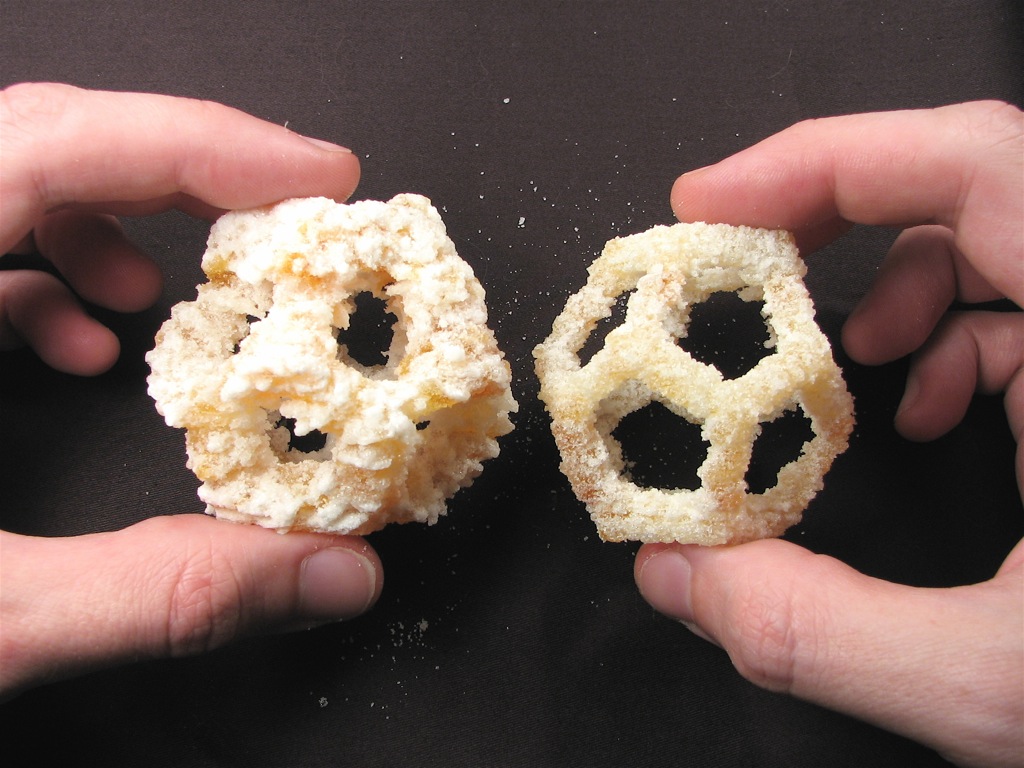

Over at candyfab.org, things are getting sweeter all the time. Link.



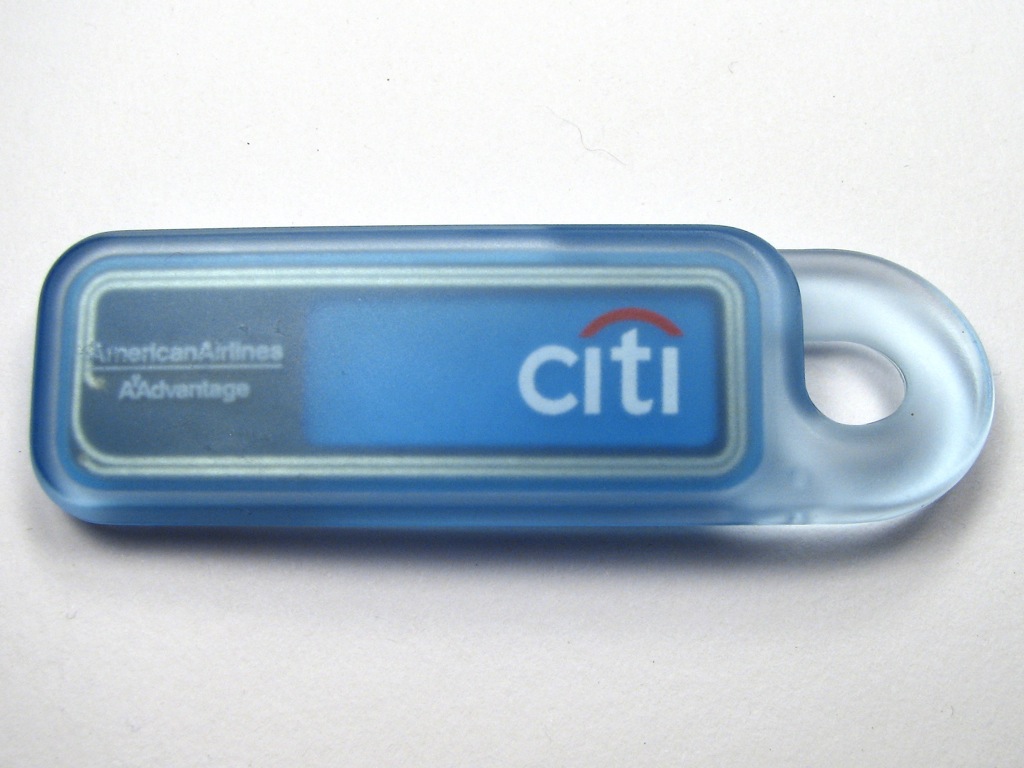
The PayPass is an RFID version of the MasterCard credit card. It is often available as a keychain “fob,” like the one shown above.
This particular one is from Citibank and is– as far as I can tell– a free optional addition to any Citibank Mastercard account. These have been in the wild for about a year now, and seem pretty handy. The obvious downside is that the RFID readers are far from ubiquitous. Still, things are improving and there are now quite literally dozens of places where you can use them.
From a hardware perspective it’s easy to see that this fob consists of the RFID element itself encased in a big block of plastic. And of course, plastic can be removed.

What does one do 434 discarded Itanium CPUs? Matt Tovey was inspired by our Chip Trivet, and used them to make this awesome computer desk.

The CPU modules were scrapped as the result of a supercomputer upgrade, and were presumably functional before having their heat sinks taken off– a herculean effort for that many CPUs! Matt says that the list price for the lot of chips was over US$800,000 in 2006 and that the desk contains about 2.8 TFLOPs of computing power, about the same
as 900 3.2GHz P4s.
Matt started with a plain desk, tiled in the CPUs, and added wooden edging and a beveled glass top. Nice work!
I just love the way that this desk looks. But it gives me an idea too– take it one step further, and what if it worked? You could use a single, giant PCB for the motherboard which sat underneath the glass surface of the desk. With that much area, you could fit in a lot of processing power. On the cheap (or moderately cheap), one could imagine instead filling the inside of a desk top with low-cost (even last-generation) PC motherboards to make a great looking beowulf cluster or render farm that doesn’t take up any desktop or rack-mount space.
Sadly, Matt’s page has moved on to the great /dev/null in the sky, but the mirror still shows some of the build photos.
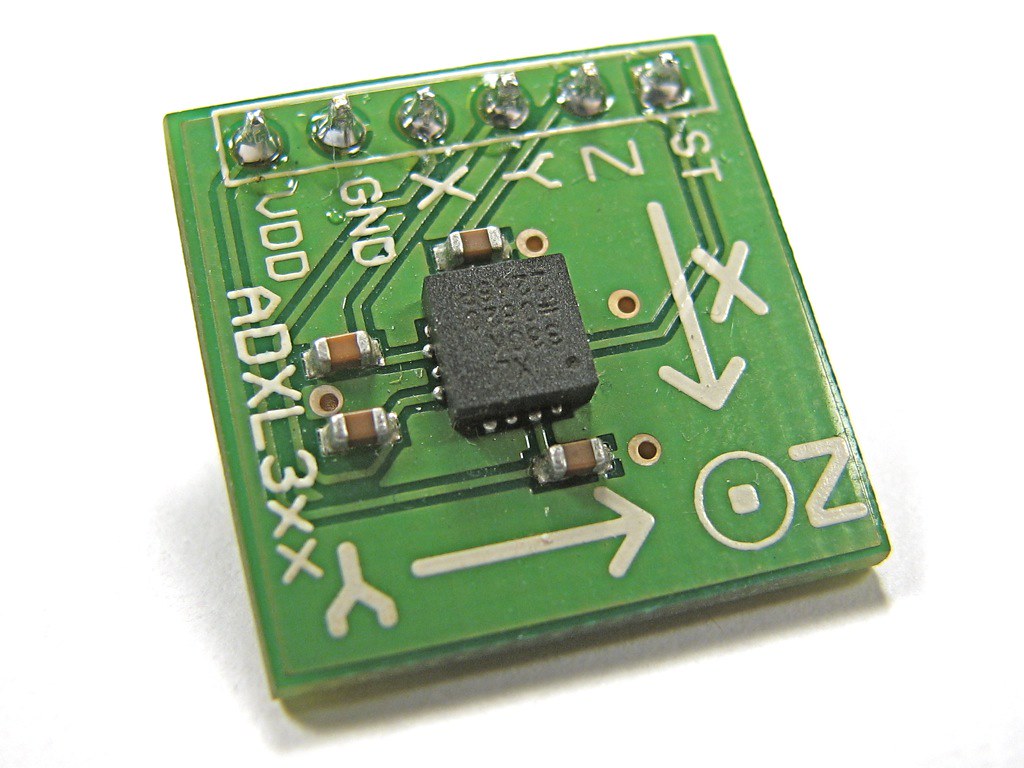
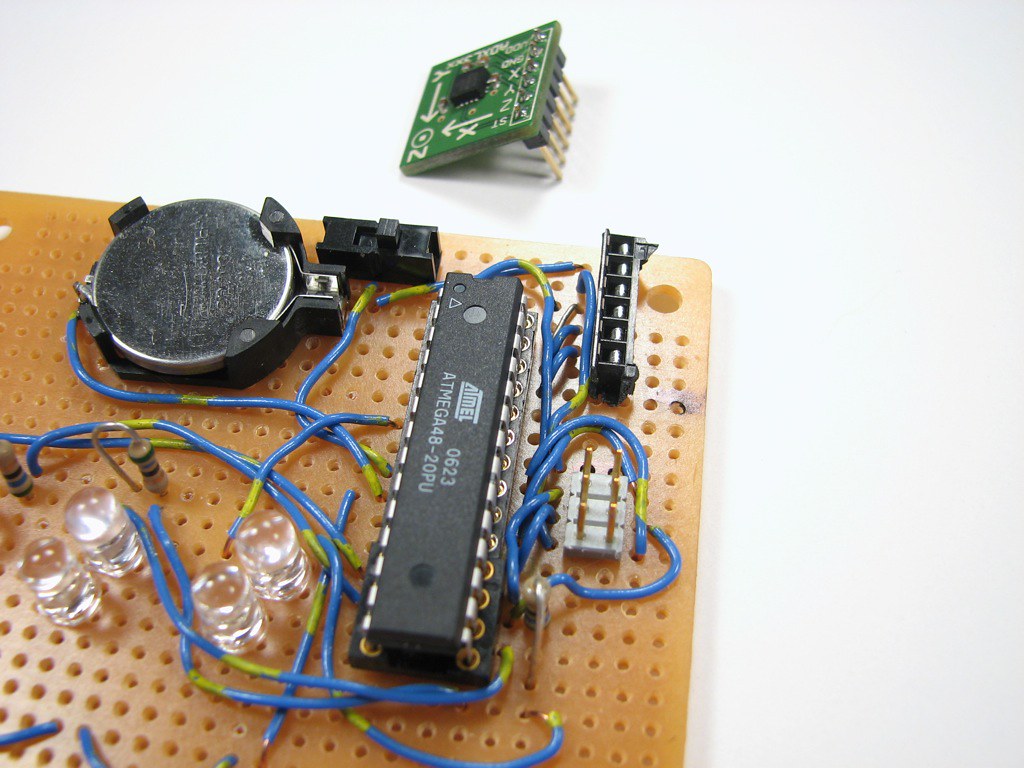
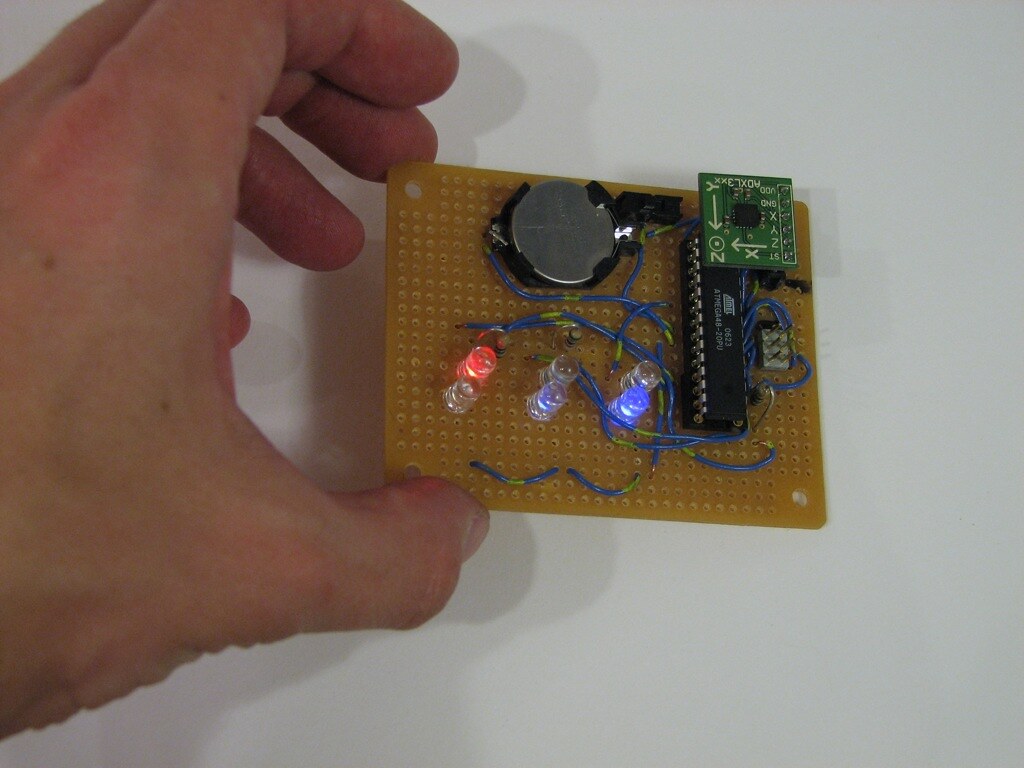
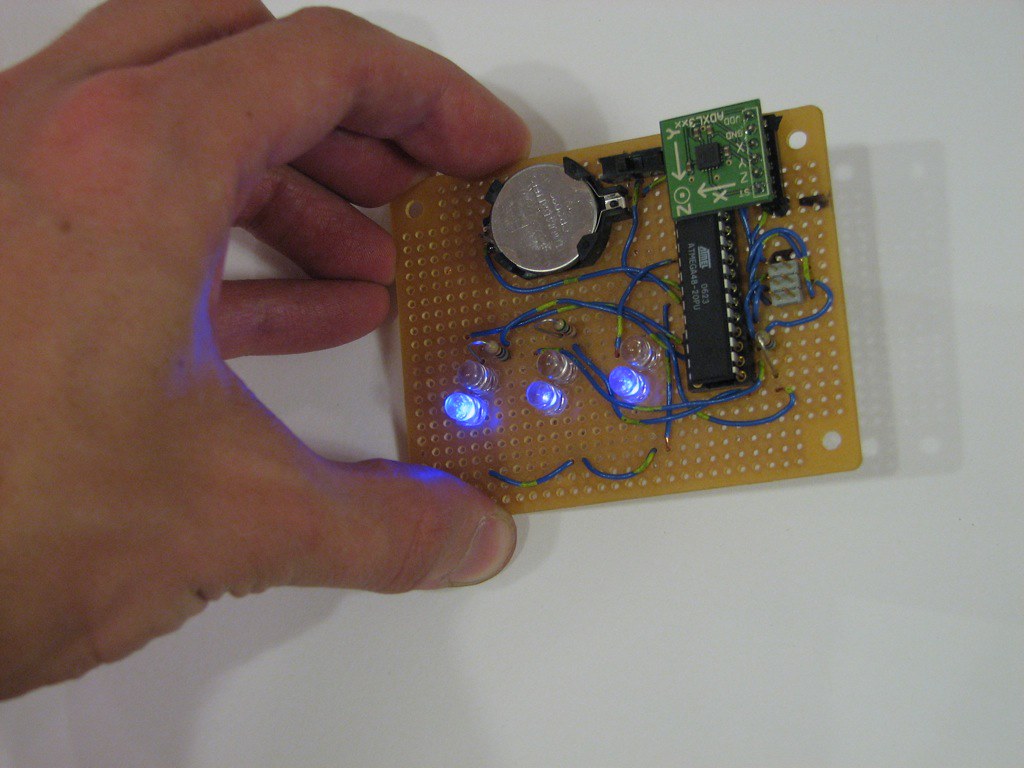
The last decade has seen more than an order of magnitude drop in the price of
accelerometers, devices capable of measuring physical acceleration (often in more than one direction). History suggests that whenever a useful technology makes a precipitous drop in price, unexpected applications follow, and that’s exactly what has happened in this case.
Starting from zero and summing up acceleration, you can use an accelerometer to find velocity, and from that derive relative position information. By measuring the acceleration due to gravity, one can also determine orientation (technically, inclination)– you can tell which way it’s pointing. Those are pretty useful skills for a chip! And so as bulk prices for tiny chip-scale three-axis accelerometers have begun to approach $5, they have started to appear in all kinds of mass-market applications that you might not have predicted: laptop computers (for hard drive protection), smart phones and cameras (for orientation– e.g., portrait vs. landscape on the iPhone), cameras for image stabilization, and quite visibly in the controllers for Nintendo’s Wii system.
With all that promise, you might think that an accelerometer is a difficult beast to harness. That turns out not to be the case. In this little project we demystify the mighty accelerometer and show you how to get started playing with one. In the spirit of hobbyist electronics we do this the easy way– without designing a PCB or even soldering any surface-mount components.
Note: An updated version of this article is now available here.
Continue reading Using an ADXL330 accelerometer with an AVR microcontroller

It was on the 12th of March this year that I first heard about, and placed my order for, Forbidden Lego, a new book by Ulrik Pilegaard and Mike Dooley, $24.95 from No Starch Press. It’s finally here, and yes, you want a copy.
Forbidden Lego was written by a pair of Lego master builders, who used to work in designing advanced Lego sets (e.g., Mindstorms). While they obviously got to work on lots of cool things while they were there, there were certain projects that just turned out not to be suitable to be made into kits released by the Lego company. They wrote the book to give some kind of a tantalizing hint at the kinds of things that go on behind the scenes at Lego, and the kinds of neat things that might get released in a world without product liability suits.
Continue reading Book Review (and build!): Forbidden Lego

Supposing that you’re less than omnivorous, you may not always be in the mood to eat insects. You might be vegetarian, or your religion tells you that you shouldn’t eat insects, or maybe you’re just on a strict non-bug-eating diet. Here are a couple of simple hints to help you identify foods that contain bugs, illustrated with a few common supermarket candy items.
(Note: This article has been moved here from Instructables, where it was previously published. It has also been slightly updated.)
Continue reading How to Eat Fewer Insects (formerly on Instructables)
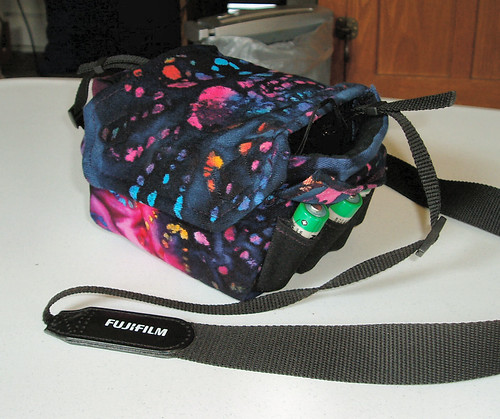
Sandra (flickr user lilysecret42) made a camera cozy based on our pattern. She added fleece padding and a velcro closure to make it just right for her. Awesome job! Thanks for putting it in the photo group so we could see it.
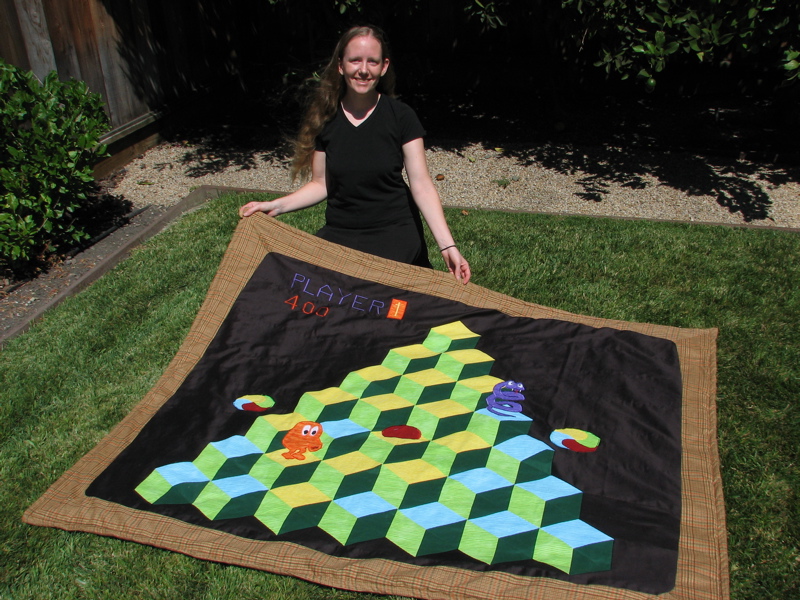
QuiltBert is based on the traditional tumbling blocks pattern and the video game Q*bert. It is a lap-sized quilt, ideal for hanging out on the couch playing vintage video games.
A while back, our junior mad scientist brought home a geometry / art assignment from school based on designing a quilt. The kids were given a small grid which they filled in with a pattern. They then rotated and copied the pattern several times into a larger grid. His design looked like it would be very complicated to make into a real quilt, with curved pieces, applique and embroidery all needed.
That started us all looking at quilt patterns so he could get an idea of what goes into making a quilt. When we found the “tumbling blocks” quilts which are made with rhombi the question came up as to whether anyone had ever made a Q*bert quilt.
Although there are many tumbling block quilts that are referred to as Q*bert quilts, we couldn’t find any genuine Q*bert quilts. We did find Tetris, Space Invaders, and Mario, Mario, Mario, and more Mario. Also the tangentially related but incredibly inspired Color Bars quilt. Clearly, someone needed to make a real Q*bert quilt.
Continue reading Quiltbert: a Q*bert Quilt
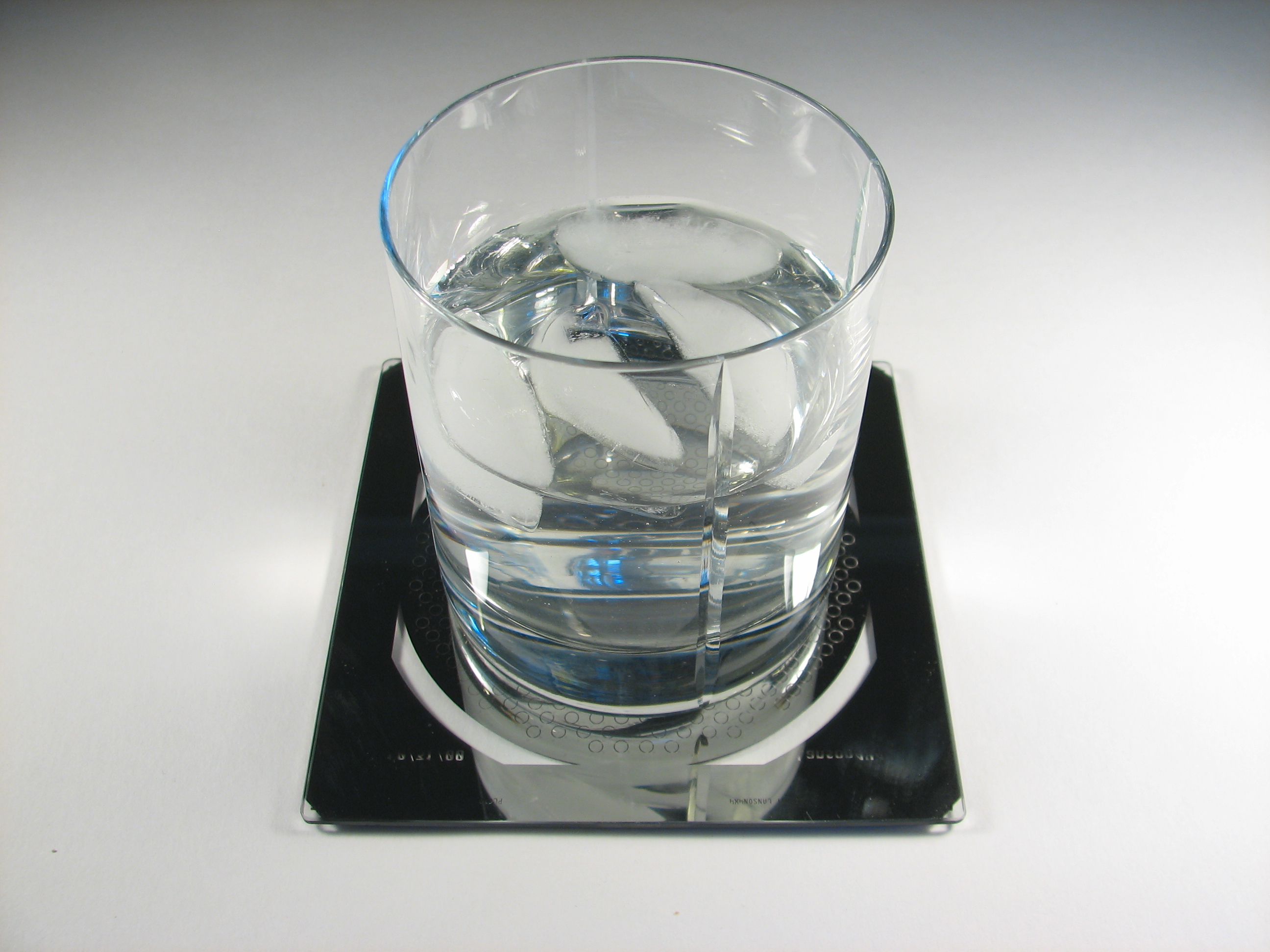
Photolithographic masks, or photomasks are clear templates used in semiconductor manufacturing. Typically, they are made of UV-grade fused silica and have a highly intricate chrome metal film pattern on one side. These remarkable objects are exactly the sort of wonderful thing that occasionally pops up at good electronics surplus stores. We recently found a few, took some pictures (see below) and, in the spirit of re-use, made them into some classy coasters.
Continue reading Photomask coasters
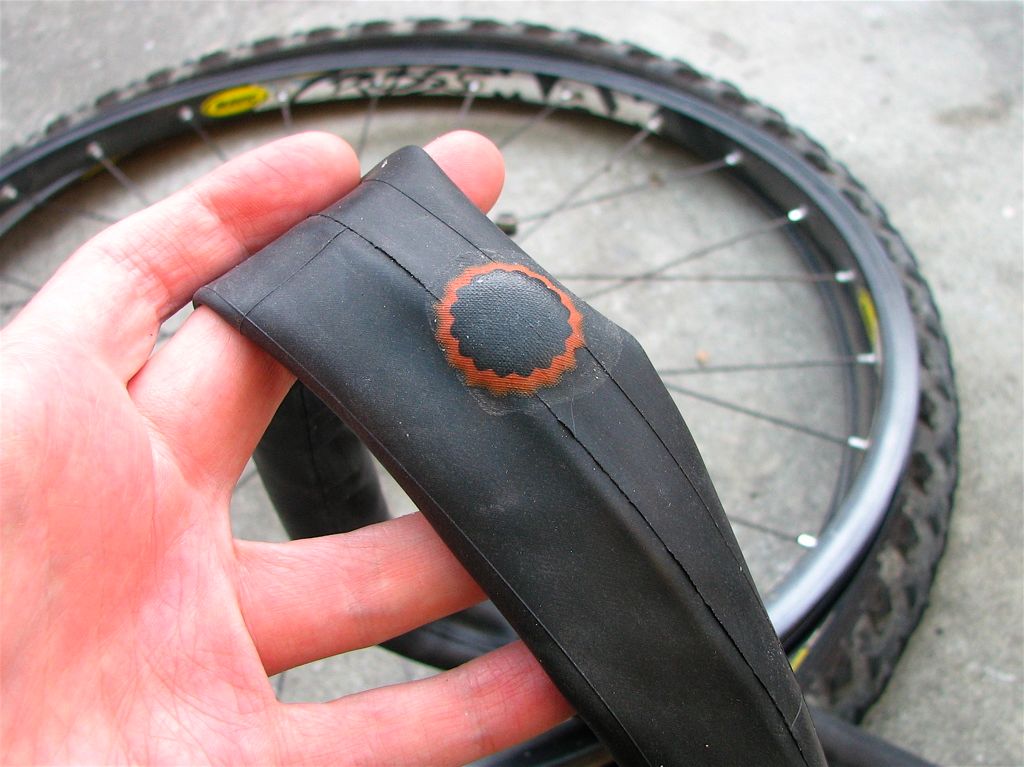
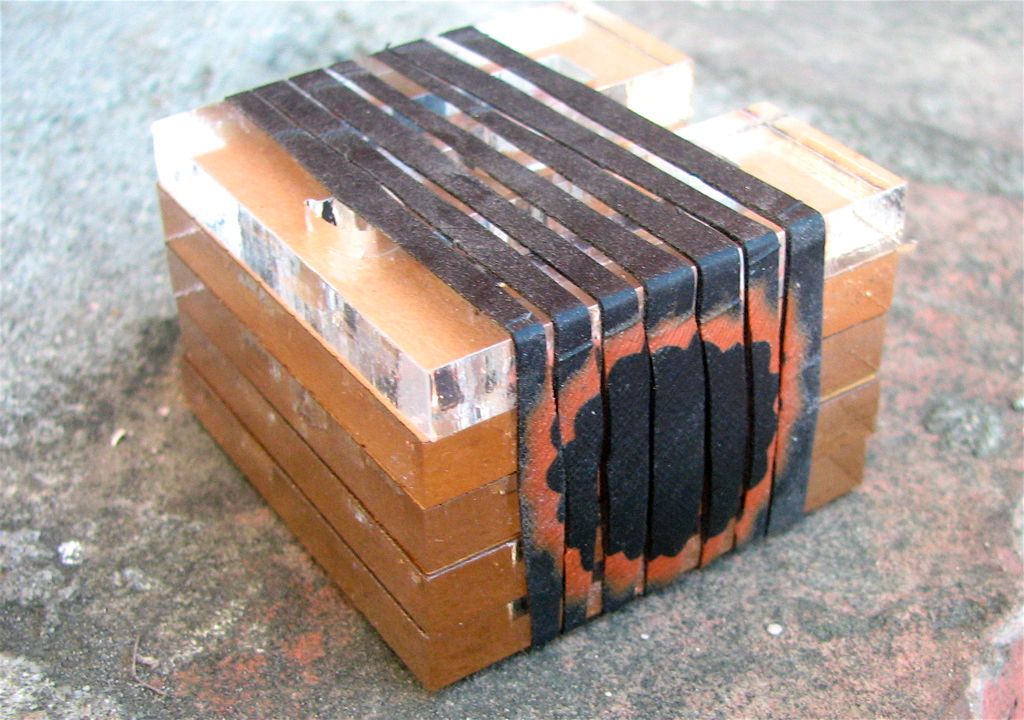
Once a bike tube needs its (n+1)th repair, where nis the number of times you’re willing to fix it, you can slice up what remains, and end up with a semi-infinite stash of cool looking rubber bands.
Useful? Yup. Cheap? You bet. Quick? Yes, to the point of being trivial.
On the other hand, not only is this a fun way to recycle, but using these is the office supplies equivalent of the secret biker’s handshake– only other bikers will even notice what you’re using.
Continue reading One minute project: Bike tube rubber bands

